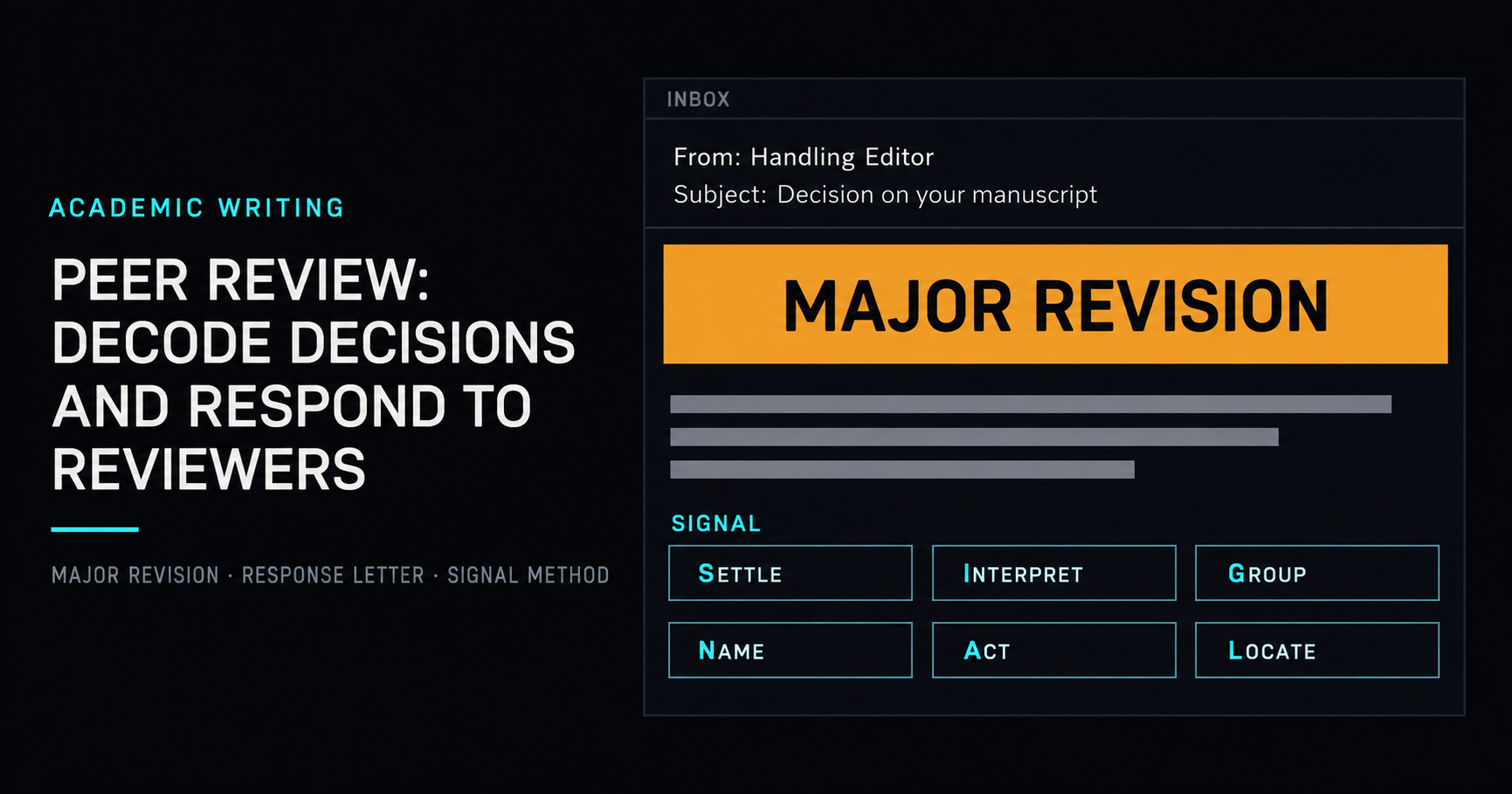
Short answer: Reviewers advise; the handling editor decides. A major revision means your manuscript is still viable but must resolve substantive concerns, a minor revision means bounded corrections, and a reject can reflect fit as much as quality. Respond with the SIGNAL method: Settle, Interpret, Group, Name, Act, Locate.
The decision email arrives late enough to ruin the evening and early enough to prevent sleep. You scan past the manuscript title, the editor’s formal thanks and the first reviewer’s measured paragraphs. Then two words take over the screen: Major Revision.
For a few minutes, the peer review process feels brutally personal. Months of design choices, failed analyses, rewritten introductions and co-author negotiations seem compressed into a stranger’s verdict. The verdict is not what it seems. A journal decision is neither a referendum on your competence nor an average of reviewer recommendations. It is an editorial judgment made under uncertainty, from reports written by people with different expertise, workloads, standards and tolerance for risk.
This guide opens the editorial-office door first, then turns to the harder problem: what criticism does to you. By the end you will know what each main decision signals, how editors handle reviewer disagreement, and how to write a response that is calm, exact and hard to dismiss.
Key Takeaways
Reviewers advise; the handling editor interprets their reports and makes the editorial decision.
Major revision means the manuscript remains viable, but substantive concerns must be resolved before acceptance.
No universal acceptance probability can be defended for major revision, minor revision or revise and resubmit.
Before responding, classify what each comment does and identify the uncertainty beneath it. The peer review process rewards precision over speed.
A strong response to reviewers letter shows what changed, why it changed and where the editor can verify it.
What Happens Inside the Peer Review Process?
What Is Screening and Desk Rejection?
The peer review process starts before any external reviewer sees your file. Editorial staff may check file completeness, anonymization, authorship, competing interests, ethics approvals, reporting checklists, data statements and plagiarism indicators. Automated similarity or integrity checks may also occur, but their use varies by publisher and journal (Springer Nature Support, n.d.).
A scholarly editor then asks a different set of questions. Does the paper fit the journal’s remit? Is the contribution distinct enough? Will the readership care? Does the design appear capable of supporting the main claim? Is the paper strong enough to justify scarce reviewer time? Journal editorials describe an initial selection based on significance, fit and technical promise rather than a single universal quality test (Nature Methods, 2024a).
This stage produces the desk rejection. Read a desk-rejection letter as a statement about a paper–journal match first. A technically credible manuscript can be declined because its contribution is too specialized, its framing does not reach the journal’s audience, or similar work has recently occupied the journal’s editorial space.
The distinction has strategic consequences. If the editor identifies a fatal validity problem, the paper needs repair. If the letter says the work is sound but too narrow, rebuilding the analysis may waste months. The better response is usually a sharper abstract, a better-matched journal and a cover letter that states the contribution in that journal’s terms. Our guide to journal selection and cover letters that avoid desk rejection covers that path, and the SciCampus Journal Finder can help shortlist better-matched journals.
Why Do Reviewer Fatigue and Delays Affect Your Reports?
If the paper passes screening, the handling editor builds a reviewer list, sends invitations, waits, replaces those who decline, and often repeats the cycle. Selection weighs expertise, conflicts of interest, publication history, availability, and sometimes diversity of method, geography or career stage.
Reviewing sits on top of research, teaching, supervision and administration. For you, reviewer fatigue shows up as uneven attention: a report that dwells on the reviewer’s own specialty, a terse comment whose reasoning stayed in the reviewer’s head, or weeks of silence.
Fatigue also shapes what happens after revision. A reviewer returning months later may barely recall the original. Publisher guidance for reviewers of revised manuscripts points them to the decision letter and author response to check whether the requested work was completed (Wiley Author Services, n.d.), and PLOS reviewers also receive the editor’s decision letter (PLOS, n.d.-a). Your response letter is therefore not ceremonial correspondence. It is the map an overextended reader uses to reconstruct the revision.
Are Reviewer Reports Evidence or Votes?
Reviewers generally assess originality, methodological rigor, reporting, interpretation, ethics and relevance, and they may recommend acceptance, revision or rejection. The editor receives those recommendations, but the decision is not ordinarily produced by majority vote.
Research helps explain why. A meta-analysis by Bornmann, Mutz and Daniel (2010) synthesized 70 reliability coefficients from 48 studies covering 19,443 manuscripts. Mean inter-reviewer reliability was low: .34 for the intraclass correlation and .17 for Cohen’s kappa. This does not mean reviewers choose at random. It means independent experts often assign different overall judgments to the same work.
Barnett et al. (2024) surveyed reviewers at BMJ Open, Epidemiology and F1000Research about uncertainty in their recommendations. The study reported that only 23% of reviewers had no uncertainty about any of their recommendations. Three biomedical journals are a narrow base, and the uncertainty measure was new. Even so, the result suggests that “reject” and “major revision” are often boundary calls rather than settled convictions.
Editors synthesize, but they do not weigh every report equally. Smith, Kennard, Du and McFarland (2025) analyzed about 80,000 reviews of 28,000 manuscripts in engineering and the life sciences and found that editors tended to side with the most critical reviewers. One plausible reading is that an unresolved threat to validity outweighs several expressions of enthusiasm. Treat this as a pattern, not a rule, and do not generalize an engineering and life-science result to the humanities.
Why Can Opposite Reviews Both Be Right?
Two reviewers can disagree because they probe different inferential links. A methodologist sees an untested assumption, a domain specialist sees an important finding, and a theorist sees an underspecified mechanism. Each may be right about one part of the same paper. PLOS tells its academic editors that discrepancies between reviewers are common because peer review is meant to support scientific debate (PLOS, n.d.-a).
Then there is “Reviewer 2.” Rebecca Colesworthy, an academic-book editor, offers a mundane origin for the label in The Chronicle of Higher Education: editors tend to put the more positive report first and the relatively negative one next (Colesworthy, 2025). We found no study showing that second reviewers are systematically harsher. The phrase survives because the discordant negative report is memorable. It turns harmful when it tempts you to guess identities or dismiss a report before reading it. A better question is: which claim in my paper became less credible after this person read it?
Which Peer Review Models Change What You Do?
Peer review terminology is not standardized, so read the journal’s definition rather than inferring the model from its label.
Single-anonymous review: Reviewers know the authors’ identities; authors do not know the reviewers’.
Double-anonymous review (often searched as double-blind review): Identities are concealed both ways, although topic, self-citation, repositories and preprints can reveal authors.
Open review: Depending on the journal, this can mean signed reports, reciprocal disclosure, public discussion, published reports, or a mix.
Transparent peer review: Reports, decision letters and author responses are published with the article, while reviewers may remain anonymous.
Registered Reports: Editors and reviewers evaluate the rationale and protocol before outcomes are known. A successful Stage 1 submission can receive in-principle acceptance, with final publication depending on adherence to the approved plan and responsible interpretation.
In 2025 Nature made transparent peer review the default for new research-article submissions: the reviewer reports and author responses are published with accepted papers, reviewers stay anonymous unless they choose to sign, and the policy applies to submissions from 16 June 2025 (Springer Nature, 2025). Other journals handle transparent review differently, so a single “Nature policy” cannot be assumed. If your response letter may become public, write it as a public document.
Registered Reports change something deeper than visibility. PLOS ONE reviews the question, design and analysis plan before data collection or analysis, and accepted protocols receive in-principle acceptance for the eventual results article (PLOS ONE, n.d.). This moves part of the peer review process from retrospective criticism to prospective design improvement. See our guide to writing Methods and Results without overclaiming for how preregistration and Registered Reports fit into reporting.
What Does Each Peer Review Decision Mean?
Labels differ across journals. “Reject and resubmit,” “revise and resubmit” and “resubmission invited” can describe similar editorial intentions, and some systems record an invited resubmission as a technical rejection. Read the editor’s letter, not just the status line. Springer Nature’s author-support page lists the editor’s options as accept as is, minor or major revision, or rejection for unresolvable concerns, with article transfer considered (Springer Nature Support, n.d.).
Accept
What it really means: The scholarly decision is positive, although production queries or formal corrections may remain.
What the editor expects: Accurate completion of proofs, declarations, metadata and publication requirements.
Your strategic response: Check every production change carefully; do not treat proof correction as clerical trivia.
Minor revision
What it really means: The manuscript is publishable in principle, but acceptance is not final.
What the editor expects: Bounded corrections to presentation, analysis, references, reporting or interpretation.
Your strategic response: Answer every comment and verify that small edits have not introduced inconsistencies.
Major revision
What it really means: The paper remains viable, but substantive concerns prevent acceptance in its present form.
What the editor expects: Convincing repair of the analysis, method, argument, evidence or scope of claims.
Your strategic response: Plan the revision before editing; separate essential conditions from optional suggestions.
Reject and resubmit
What it really means: The current version is closed, but the editor will consider a substantially rebuilt paper.
What the editor expects: A manuscript closer to a new submission than a corrected draft, often with fresh evaluation.
Your strategic response: Confirm mechanics (new manuscript ID, cover letter, whether prior reviewers return) and address the earlier reports.
Reject after review
What it really means: The journal has ended consideration because of validity, fit, priority or feasibility concerns.
What the editor expects: Usually no further action at that journal unless the editor invites resubmission or an appeal has a valid basis.
Your strategic response: Preserve the useful criticism, revise for transfer, and remove journal-specific framing.
Desk reject
What it really means: The paper will not go to external reviewers at this journal.
What the editor expects: No response unless the letter contains a clear factual or procedural error.
Your strategic response: Diagnose fit, contribution, framing and compliance before choosing the next journal.
Major revision is good news in a precise sense: the journal has left the peer review process open for your paper. It is not a coded acceptance, and minor revision is not either. A reject decision can describe a defective manuscript, an unsuitable journal, or a paper whose required repair exceeds what that editor will supervise.
Reject and resubmit deserves special attention. Under major revision the manuscript normally stays in the active editorial record. Under reject and resubmit the editor has closed the present version while signaling interest in a rebuilt one. That difference can change deadlines, manuscript identifiers and reviewer continuity.
Do not trust any percentage for “chances after major revision.” Rates depend on journal, field, editor, article type, review round and the size of the requested work. None has been shown to transfer across settings, and a figure from one journal is not a forecast for your manuscript. If rejection means a new target, see how to choose between Q1 and Q2 journals.
Can You Use Generative AI With Reviewer Reports and Responses?
Policies differ by publisher and keep changing. As of October 2026, the common threads are human accountability, disclosure where required, protection of unpublished material, and a bar on listing an AI system as an author. Always check the target journal’s current rules.
Elsevier
Position documented in the sources reviewed: Authors may use generative AI in preparation with human oversight and a declaration (basic grammar checks are exempt). Reviewers must never upload a manuscript, or any part of it, to an AI tool; they may use private tools only in a supporting role, such as improving the language of a report, with human control and disclosure (Elsevier, n.d.).
Springer Nature
Position documented in the sources reviewed: Updated AI policies announced 10 September 2026 assess how AI is used, its potential impact and the level of risk, and keep confidentiality in editorial evaluation as a principle; handing peer review over to AI remains prohibited (Springer Nature, 2026). Its guidance says reviewers should not upload manuscript content to unsecured or public AI systems (Springer Nature, n.d.).
Wiley and Taylor & Francis
Position documented in the sources reviewed: Reviewer-policy comparisons report that both prohibit uploading unpublished manuscripts to AI tools and allow only limited language support for an already-written review (Wiley, n.d.; Taylor & Francis, n.d.). Disclosure details vary, so read the current policy.
For a response to reviewers letter, the safe rule is simple. Decision letters and reports are confidential. Do not paste them into a public AI tool, check the target journal’s policy first, and remember that you remain accountable for every sentence. For the wider picture, read our guides on journal AI policy and the traceability standard and AI academic writing ethics. If you polish the letter’s wording with a tool such as the SciCampus AI Humanizer, re-check that every concession and every location reference still matches your revised manuscript.
Why Does Reviewer Criticism Feel So Personal?
A manuscript is rarely a detachable file. It holds months of effort, a claim to belong in a field, and often a thesis milestone, a grant or a job. A systematic review and qualitative meta-synthesis in PLOS ONE found that insecurity, high demands and difficult working conditions can weigh heavily on researcher well-being (Nicholls et al., 2022). Colesworthy (2025) notes that peer review can be stressful even for seasoned writers.
The first reaction to harsh reviewer comments may therefore be anger, shame or an urge to compose a devastating reply. None of that marks you as unfit for scholarship. The danger lies in sending the defensive draft. Anger also compresses attention around tone and injustice, while an effective revision requires you to separate validity, clarity, scope and preference.
What Is the SIGNAL Method for Responding to Reviewers?
The SIGNAL method gives that reaction a structure: Settle, Interpret, Group, Name, Act, Locate. The first four stages handle the human side. The last two build the editorial record.
S: How Do You Settle Your Response?
Read the decision once, save the reports, and do not start the rebuttal letter while your attention is fixed on the cruelest sentence. Editors writing in Nature Geoscience have advised at least one good night’s sleep between reading the reviews and beginning a rebuttal (Nature Geoscience, 2019), and a Nature Index feature similarly recommends a day or two of distance (Parletta, 2021). No trial has identified an ideal interval, so treat this as practical editorial convention, not a proven optimum.
Two techniques from general psychology can help:
Reappraisal: deliberately reinterpreting a situation such as a harsh review. A meta-analysis of emotion-regulation strategies found that reappraisal affects emotional outcomes (Webb et al., 2012). A modest reappraisal sounds like: “This report is evidence about how the paper performed for one expert reader.” It does not require you to believe every comment is correct.
Self-distancing: viewing the situation as an observer would. Kross and Ayduk (2017) review it as a way to reduce emotional reactivity while still reflecting. Replace “They think I’m incompetent” with “The report disputes whether Measure X captures Construct Y.”
Neither technique was tested on manuscript review, so treat this as informed application rather than demonstrated effect. In the meantime:
Write a private factual summary: decision, deadline, the editor’s key requests, unresolved questions.
Tell co-authors the decision has arrived, but postpone strategy until everyone has read it.
Do not circulate screenshots for collective ridicule, which can harden an interpretation before the report is analyzed.
Draft angry text in a document that cannot be submitted by accident.
Illustrative composite: A doctoral researcher receives, “The authors appear unfamiliar with the foundational literature.” Her first draft begins, “The reviewer has ignored twelve citations.” The next morning she notices that those citations sit in a compressed paragraph near the end of the introduction. The accusation was unfair; the visibility problem was real.
I: How Do You Interpret the Editorial Signal?
Read the editor’s letter before rereading the reports. An editor may name two concerns that must be resolved and call the rest suggestions, and those two define your minimum viable revision. Underline the verbs: must demonstrate, should clarify, would encourage, would require, cannot support. Editors often reveal priorities through modal language even when they do not number the issues.
Then separate comment from commenter. Psychological distance is not suppression. It is a change in perspective that makes the problem more tractable.
G: How Do You Group Reviewer Comments by Function?
Classify every comment before deciding how to answer it.
Valid and actionable: The paper has the identified defect, and the remedy is feasible.
Valid but badly expressed: The wording is abrasive, but the scholarly concern is real.
Misunderstanding caused by unclear writing: The answer is in the paper, but a careful reader could not find it.
Out-of-scope demand: The request needs unavailable data, a new research question or a different article.
Unfair, hostile or illogical: The comment relies on personal language, unsupported accusation, discrimination or faulty reasoning.
Take the line, “The sample is hopelessly unrepresentative, so none of the claims are credible.” The tone is excessive, but the function depends on your paper. If you generalize to a national population from a convenience sample, the comment is valid but badly expressed. If you study one bounded organization and make no population claim, it may be an illogical objection that needs clarification, not compliance.
A useful check, also voiced in the Nature Index feature: when a reviewer is wrong, the writing may have invited the misunderstanding, so correct the paper as well as the reviewer. A clearer title and abstract help here; see our guide to title engineering and keyword strategy.
N: How Do You Name the Reviewer’s Underlying Need?
Separate what the reviewer says from what the reviewer needs.
“Collect another dataset” may mean the generalization exceeds the evidence.
“Add twenty references” may mean the contribution is hard to locate within a tradition.
“Run a different model” may mean the association’s robustness is in doubt.
Once you see the need, you have more options than obeying or refusing. You can collect evidence, narrow a claim, add a robustness check, reposition the theory, explain a design boundary or state a limitation. The reviewer does not always own the best remedy.
Illustrative composite: A reviewer asks a social-science team for a nationally representative follow-up survey, which cannot be completed during revision. The authors read the request as a demand for external-validity discipline. They remove population-wide language, distinguish analytic from statistical generalization, add a sensitivity analysis, explain the sampling boundary and specify replication as future work. They decline the study and still answer the concern.
How Do You Write a Response to Reviewers Letter?
Within the peer review process, a response to reviewers letter works as an audit trail. Editors of Nature Computational Science describe it as a working document and recommend opening with a short account of the main concerns and revisions, reproducing the reviewers’ comments in full, answering each individually, and making changes easy to identify (Nature Computational Science, 2025). PLOS offers similar practical guidance (PLOS, n.d.-b). The Nature Index feature adds two tricks: reference page and line numbers, and highlight each reviewer’s changes in a different color.
A: How Do You Act, Concede or Rebut?
For each comment, choose a disposition.
Act: Make the change because it improves validity or communication.
Concede partly: Accept the concern but use a more proportionate remedy.
Rebut: Decline because the request is technically unsound, unsupported, contradictory or outside the study’s defensible scope.
A strong rebuttal has four elements: recognize the concern, state the disagreement precisely, support your position with evidence or methodological reasoning, and offer a manuscript change that reduces the underlying uncertainty. Colesworthy (2025) advises explaining both why a proposed fix is unsuitable and what you will do instead.
Respect is not surrender, and gratitude is not a style. “We thank the reviewer for this insightful observation” sounds hollow when it appears forty times. “We agree,” “We partly agree” and “We respectfully do not adopt this analysis because…” are enough.
L: How Do You Locate Every Change?
Open the letter with a brief overview of the major changes, then use the same block for every point:
Reviewer 1, Comment 4: [verbatim comment]
Response: [agree, partly agree, or respectfully disagree]
Action and rationale: [what changed, or why another solution is stronger]
Location: [section, page and line numbers]
Quote the whole comment unless it is unusually long, and split multi-part comments into labeled subparts without changing their meaning. Give section headings as well as line numbers, since pagination shifts between files. Include enough reasoning to justify the decision, but do not bury the answer under a miniature literature review.
What Does a Professional Rewrite of a Reactive Draft Look Like?
The method is misstated
Reactive draft: “The reviewer has clearly failed to understand our model.”
Professional response: “We agree that the original description did not make the model sequence sufficiently visible. The analysis does include the stated adjustment. We have rewritten the Methods section and added the complete specification on lines 218–236.”
An invalid test is requested
Reactive draft: “The proposed test is inappropriate and would produce meaningless results.”
Professional response: “We respectfully do not apply the proposed test because its independence assumption is not met by the repeated observations. We instead report a mixed-effects analysis addressing the same comparison and explain this choice on lines 301–320.”
A different study is demanded
Reactive draft: “This experiment is completely beyond the scope of the paper.”
Professional response: “The proposed experiment would address an important causal question, but it requires prospective data unavailable in this retrospective design. We have narrowed the causal wording, expanded the limitation, and identified the experiment as a necessary next step.”
The comment is vague and harsh
Reactive draft: “We cannot answer the unsupported claim that the paper is ‘fundamentally confused.’”
Professional response: “We interpreted this concern as referring to the relationship between Hypotheses 2 and 3. We have separated their rationales and revised Figure 1. If the editor understands the concern differently, we would welcome clarification.”
Notice what vanishes from the right-hand column: speculation about motives, competence or identity. The professional version answers the scholarly record and neither flatters the reviewer nor concedes false points.
What If Reviewers Contradict Each Other?
Do not obey one reviewer silently and ignore the other. A private contradiction table keeps the logic visible.
Theoretical background
Reviewer 1: Shorten substantially
Reviewer 2: Expand the mechanism
Proposed resolution: Shorten general history; expand only the mechanism that supports the hypotheses.
Supplementary analysis
Reviewer 1: Remove as distracting
Reviewer 2: Move into the main text
Proposed resolution: Keep the full analysis in the supplement; summarize the decisive result in the main text.
Terminology
Reviewer 1: Use established term A
Reviewer 2: Use newer term B
Proposed resolution: Define both, explain the distinction, and use the field-standard term consistently.
In the letter, write: “Reviewers 1 and 2 offered different recommendations on this point. We adopted the following resolution because…” If the demands are mutually exclusive or touch the study’s central logic, ask the handling editor to arbitrate, since the editor owns the decision.
Illustrative composite: One reviewer asks a qualitative team to strip interpretation from the findings section; another calls the same section too descriptive. The authors add targeted interpretation tied to their coding framework but keep findings and discussion separate. Their response names both recommendations and explains why the compromise preserves the methodological approach.
How Do You Handle Harsh Reviewer Comments Without Retaliation?
COPE’s guidelines expect reviewers to be objective, constructive and confidential, and to avoid hostile or derogatory personal comments (COPE, 2019). You need not pretend abusive wording is acceptable, but you should separate content from conduct.
Answer every legitimate scholarly point in the point-by-point response.
Report personal insults, discriminatory remarks, threats or coercive citation requests privately to the editor, quoting only what is necessary.
Never identify reviewers publicly or share confidential reports on social media.
If a reviewer alleges fabrication, plagiarism, duplicate publication or another integrity breach, reply with documentation, not outrage. Useful material includes ethics approval, preregistration records, data provenance, version history, code, consent language, or an explanation of textual overlap. Offensive wording does not make an integrity question disappear. A manuscript integrity SOP for multi-author labs helps you keep that documentation ready, and if the allegation concerns textual overlap or AI-generated text, the SciCampus Similarity checker and AI Detector can help you review the passage before you reply. Our guide to defending a manuscript against false AI flags explains how to assemble an evidence file.
When Is an Appeal Justified?
An appeal is warranted for a material factual error, a procedural irregularity, an undisclosed conflict, discriminatory reasoning, or a decision that contradicts the journal’s stated policy. Disagreement with academic judgment rarely qualifies.
Follow the journal’s published route. State the contested decision, identify the precise error, supply evidence and request a defined remedy. Do not send a second full rebuttal disguised as an appeal, and do not lean on prestige, funding deadlines or career consequences. While an appeal is active, do not submit the same manuscript elsewhere unless the journal confirms that consideration has ended. COPE addresses whether a member journal followed its own procedures and ethical standards; it is not a second review of your science (COPE, n.d.).
What Is the SIGNAL Decision Tree?
Use this sequence from the moment the decision arrives. It applies at any stage of the peer review process.
Settle. Save the decision and reports, record the deadline, and wait at least overnight before drafting (an evidence-informed convention, not a proven optimum). If the deadline is tight, ask for an extension early rather than late.
Interpret the decision path.
Minor revision: list the bounded corrections and flag any item that could turn substantive.
Major revision: separate validity conditions from desirable improvements.
Reject and resubmit: confirm whether the journal wants a new manuscript record and whether earlier reviewers will be consulted.
Reject after review: look for a genuine appeal ground; otherwise revise for another journal.
Desk reject: determine whether the problem was fit, threshold, framing, compliance or validity.
Group the comments. Mark each as actionable, valid but badly expressed, clarity-driven misunderstanding, out of scope, contradictory or unfair.
Name the need. Ask what uncertainty the reviewer wants removed, and whether the answer is stronger evidence, narrower language, clearer positioning, a robustness check or a stated limitation.
Act, concede or rebut. Make changes that strengthen the paper. When declining, give a technical reason and a proportionate alternative.
Locate and verify. Attach a manuscript location to every promised change. Have one co-author read only the letter for tone and logic, and another compare every promise against the revised paper.
Finish with a consistency audit. Every comment should have an answer, every promised change should exist, and every new analysis or caveat should agree across the abstract, methods, results, tables, figures, discussion, supplement and cover letter. Revision often fixes one problem while creating another, and the audit is where you catch it. Our 10-minute pre-submission audit is a quick final gate, and tools such as the SciCampus AI Detector are free to start with no card required.
Frequently Asked Questions
Is major revision a good sign?
Yes, but only because the editor has left a viable route forward. Major revision means the manuscript is not acceptable in its present form and that substantive concerns must be resolved. It is neither rejection nor provisional acceptance. No universal probability of eventual acceptance can be defended, because the peer review process differs across journals, fields and editors.
Does minor revision mean my paper will be accepted?
No. Minor revision means the editor expects a relatively bounded set of changes, but the manuscript remains under consideration. Acceptance can still be withheld if you omit comments, introduce inconsistencies or reveal a deeper problem. Treat every point as requiring either a visible change or a concise, reasoned explanation.
How long should I wait before responding to reviewers?
Wait at least overnight before drafting substantive responses, as Nature Geoscience editors and a Nature Index feature suggest. This is a practical editorial convention, not a scientifically established optimum. The aim is to separate emotional activation from classification. Use the pause to record facts and identify the editor’s priorities, without sacrificing the revision deadline.
Do I have to make every change a reviewer asks for?
No. You must answer every comment, but you need not implement every proposed solution. Decline a request that would weaken the analysis, violate methodological assumptions, require unavailable evidence or create a different study. Explain why, and address the underlying concern another way where possible.
What if reviewers contradict each other?
Name the contradiction, propose a reasoned resolution, and explain how it protects validity, clarity or disciplinary convention. Do not silently choose the easier request. When the recommendations are mutually exclusive or affect the central design, ask the handling editor which direction is essential for the decision.
Can I use AI to write my response to reviewers?
Only within the target journal’s current policy and confidentiality rules. Reviewer reports, decision letters and unpublished manuscript passages may be confidential, so never upload them to a public AI tool by default. Policies differ by publisher. You remain responsible for accuracy, tone, citations and any required disclosure.
What Should You Do When the Decision Email Returns?
The peer review process is imperfect because it asks people with different expertise and standards to judge work whose significance is not yet settled. That imperfection produces disagreement, uncertainty and occasionally poor behavior. It also leaves room for real improvement, which is the part you control.
Your task is not to become indifferent. Indifference would be an odd response to research that has consumed years of attention. The more useful skill is controlled separation: the paper is yours, but each comment can be examined as a claim about evidence, method, inference or communication.
When the next decision arrives, read the editorial signal before reacting to the loudest sentence. Settle the response, group the comments and name the need. Then act, concede or rebut, and give the editor a clear route through every change. None of this guarantees acceptance, and nothing ethical can. It does replace defensive improvisation with editorial control.
Related reading
References
Barnett, A., Allen, L., Aldcroft, A., Lash, T. L., & McCreanor, V. (2024). Examining uncertainty in journal peer reviewers’ recommendations: A cross-sectional study. Royal Society Open Science, 11, 240612. https://doi.org/10.1098/rsos.240612
Bornmann, L., Mutz, R., & Daniel, H.-D. (2010). A reliability-generalization study of journal peer reviews: A multilevel meta-analysis of inter-rater reliability and its determinants. PLOS ONE, 5(12), e14331. https://doi.org/10.1371/journal.pone.0014331
Colesworthy, R. (2025, January 15). How to respond (politely) to a negative peer review. The Chronicle of Higher Education. https://www.chronicle.com/article/how-to-respond-politely-to-a-negative-peer-review
Committee on Publication Ethics. (2019). COPE ethical guidelines for peer reviewers (Version 2). https://doi.org/10.24318/cope.2019.1.9
Committee on Publication Ethics. (n.d.). Submitting a complaint against a COPE member: Frequently asked questions. https://publicationethics.org/facilitation-and-integrity/submitting-complaint-against-cope-member-faq
Elsevier. (n.d.). Generative AI policies for journals. https://www.elsevier.com/about/policies-and-standards/generative-ai-policies-for-journals
Kross, E., & Ayduk, O. (2017). Self-distancing: Theory, research, and current directions. Advances in Experimental Social Psychology, 55, 81–136. https://doi.org/10.1016/bs.aesp.2016.10.002
Nature Computational Science. (2025, November 21). How to respond to reviewers [Editorial]. https://www.nature.com/articles/s43588-025-00931-5
Nature Geoscience. (2019, May 29). The art of responding to reviews [Editorial]. https://doi.org/10.1038/s41561-019-0386-7
Nature Methods. (2024a). Peer review demystified: Part 1 [Editorial]. Nature Methods, 21, 361. https://www.nature.com/articles/s41592-024-02225-6
Nicholls, H., Nicholls, M., Tekin, S., Lamb, D., & Billings, J. (2022). The impact of working in academia on researchers’ mental health and well-being: A systematic review and qualitative meta-synthesis. PLOS ONE, 17(5), e0268890. https://doi.org/10.1371/journal.pone.0268890
Parletta, N. (2021, May 18). How to respond to difficult or negative peer-reviewer feedback. Nature Index. https://www.nature.com/nature-index/news/how-to-respond-difficult-negative-peer-reviewer-feedback
PLOS. (n.d.-a). Editor resources: Editorial decisions. https://explore.plos.org/editor-resources-editorial-decisions
PLOS. (n.d.-b). Responding to peer review. https://explore.plos.org/author-resources/responding-to-peer-review
PLOS ONE. (n.d.). What we publish: Registered Reports. https://journals.plos.org/plosone/s/what-we-publish
Smith, D. S., Kennard, N. N., Du, T., & McFarland, D. A. (2025). How values and uncertainty shape scientific advance in peer review. American Sociological Review, 90(5), 879–915. https://doi.org/10.1177/00031224251362254
Springer Nature. (2025, June 19). Transparent peer review now standard for Nature [Press release]. https://group.springernature.com/de/group/media/press-releases/transparent-peer-review-now-standard-for-nature/27788498
Springer Nature. (2026, September 10). Springer Nature launches updated AI policies and guidance to support responsible AI use [Press release]. https://group.springernature.com/gp/group/media/press-releases/sn-policy-responsible-ai-use/53209516
Springer Nature. (n.d.). AI guidance for our researchers and communities. https://group.springernature.com/gp/group/ai/ai-guidance-for-our-researchers-and-communities
Springer Nature Support. (n.d.). Editorial process after submission. https://support.nature.com/en/support/solutions/articles/6000251301-editorial-process-after-submission
Taylor & Francis. (n.d.). AI policy. https://taylorandfrancis.com/our-policies/ai-policy/
Webb, T. L., Miles, E., & Sheeran, P. (2012). Dealing with feeling: A meta-analysis of the effectiveness of strategies derived from the process model of emotion regulation. Psychological Bulletin, 138(4), 775–808. https://doi.org/10.1037/a0027600
Wiley. (n.d.). Guidelines on the use of AI in publishing. https://www.wiley.com/publishing/article/ai-guidelines
Wiley Author Services. (n.d.). Reviewing revised manuscripts. https://authors.wiley.com/Reviewers/journal-reviewers/how-to-perform-a-peer-review/reviewing-revised-manuscripts.html