A multi-author manuscript can lose integrity long before it reaches a journal. A single unlogged AI rewrite can remove a limitation, change an association into a causal claim, insert a citation no author has checked, or paraphrase a source closely enough to create an attribution problem. In collaborative laboratories, these risks are compounded because responsibility is distributed while final accountability remains shared.
This standard operating procedure gives corresponding authors, principal investigators, postdoctoral researchers, and doctoral candidates a practical system for controlling those risks. It combines author roles, revision rules, evidence checks, sentence-level stylometry, DOI-linked similarity review, and highlighted PDF audit reports from SciCampus. The aim is not to prohibit every writing tool. It is to ensure that every substantive edit can be understood, verified, attributed, and defended before submission.
Why Do Labs Need a Manuscript Integrity SOP?
How Does Collaboration Create Invisible Revision Risk?
Most research groups already have informal writing practices. A student drafts the methods; a postdoc refines the discussion; a PI revises the framing; a collaborator adds literature; a professional editor improves fluency; and an AI assistant may be used at several points. The final document may be stronger, but its provenance can become difficult to reconstruct.
The greatest risk is not that every use of AI is inherently improper. The risk is that substantive changes occur without ownership or verification. If nobody can say who altered a conclusion, why a limitation disappeared, whether a source supports a reworded claim, or how a paragraph was generated, the team is poorly positioned to respond to an editor's question.
An effective SOP makes responsibility visible. It distinguishes ordinary mechanical editing from changes that affect scientific meaning. It creates a fast route for reviewing high-risk edits. And it preserves enough documentation for the corresponding author to submit with confidence rather than relying on memory.
Why Is Semantic Drift a Scientific Problem, Not Just a Style Issue?
Semantic drift occurs when a revision alters the meaning of a sentence or the scope of a conclusion. It often appears subtle:
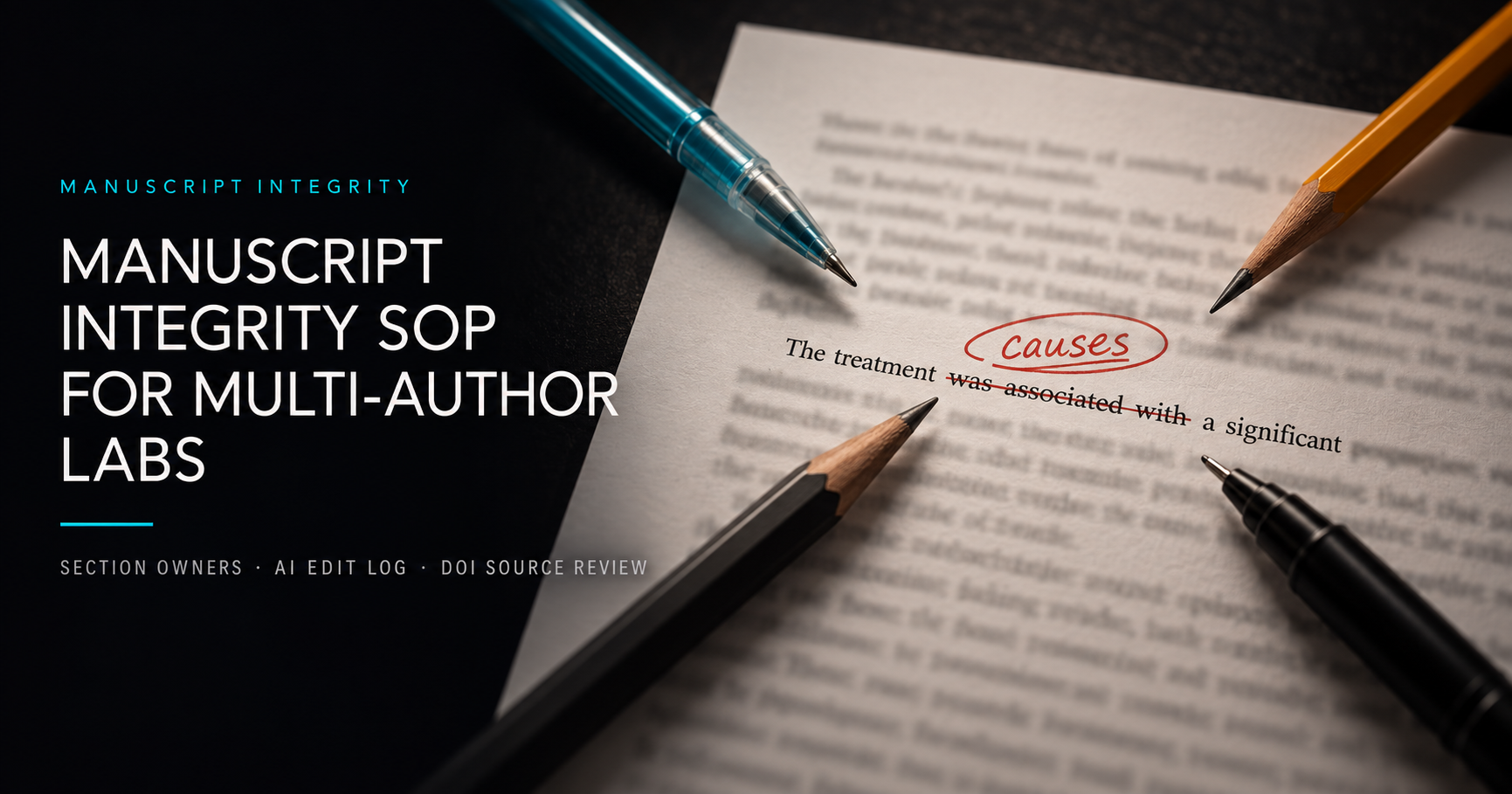
“Was associated with” becomes “reduced” or “caused”
“In this sample” becomes “among patients” or “generally”
“May support further investigation” becomes “demonstrates effectiveness”
A limitation is deleted to make an abstract shorter
A source's finding is paraphrased without retaining its caveat or citation
These are not harmless improvements in style. They change what readers, reviewers, and editors are entitled to infer from the study. For a deeper look at how this happens sentence by sentence, see our piece on semantic drift in academic paraphrasing.
Before (a conclusion altered without evidence review): “Higher baseline adherence was associated with lower rates of missed follow-up appointments.”
After (semantic drift through causal rewriting): “Improving baseline adherence reduces missed follow-up appointments.”
The second sentence may sound more direct, but it changes an observed association into a causal intervention claim. Unless the research design and analysis support causal inference, it is scientifically inaccurate.
Before (a limitation preserved in the draft): “The result was observed in two urban outpatient clinics and may not generalize to other settings.”
After (a limitation removed for fluency): “The intervention provides a scalable solution for outpatient care.”
The edited language is shorter, but it removes the settings, generalizability constraint, and evidentiary boundary that readers need to interpret the result.
How Do Unattributed AI Edits Amplify the Risk?
AI-assisted editing can be appropriate when authors control and verify the output. The problem arises when a tool adds scientific content, restructures evidence, paraphrases a source, drafts a conclusion, or proposes references without a knowledgeable human reviewing the result.
The publication-ethics standard is clear: named human authors remain responsible for the submission. AI systems cannot hold authorship because they cannot accept responsibility, manage conflicts of interest, approve the final manuscript, or respond to an integrity concern. Elsevier similarly requires authors to retain human oversight, verify generated output and sources, protect confidentiality, and disclose substantive AI use. Our overview of COPE, ICMJE, IEEE, and Elsevier disclosure requirements covers this in more detail.
A lab SOP should therefore treat substantive AI assistance as an accountable manuscript event — not as an invisible convenience feature.
What Are the Five Operating Principles Behind This SOP?
Principle 1: Every Substantive Claim Has a Human Owner
Assign a responsible author to each high-stakes section: abstract, introduction, methods, results, discussion, conclusion, figures, tables, and references. The assigned author does not have to write every word, but they must be able to verify that the final text accurately represents the data, literature, and intended interpretation.
Substantive claims include:
Research questions, hypotheses, and novelty statements
Methods and analytical descriptions
Results, effect estimates, and uncertainty statements
Causal, clinical, policy, or practical implications
Limitations and generalizability statements
Literature claims and theoretical framing
References generated, revised, or inserted during editing
Mechanical changes — spelling, punctuation, capitalization, layout, and non-substantive grammar corrections — usually need not be escalated. The moment a revision changes content, meaning, source use, or inference, the content owner must review it.
Principle 2: Preserve Meaning Before Improving Style
Before a substantial rewrite, the editor or author should identify the sentence's invariant content:
Population, sample, setting, and timeframe
Study design and analytical model
Exposure, intervention, comparator, and outcome
Effect direction, magnitude, and uncertainty
Causal or non-causal status
Limitations and stated boundary conditions
Source DOI or data output supporting the sentence
Workflow: capture the invariant claim before rewriting. Write a short note before editing: “Prospective cohort; 214 outpatient participants; baseline adherence; six-month attendance; adjusted association; observational design; residual confounding possible.” The revised sentence may become clearer, but it must not contradict this record.
This practice separates the scientific proposition from surface wording. It is one of the simplest ways to prevent semantic drift in an AI-assisted or multi-author workflow.
Principle 3: Treat Attribution as a Source-Level Decision
Citation is not decoration. If a sentence uses another author's idea, finding, method, definition, or interpretation, the source must be cited at the point where it is used. If the language remains materially close, citation alone may not be sufficient; the team may need quotation marks, a more independent paraphrase, or removal.
Use SciCampus DOI-linked similarity evidence to move from a matched phrase to the underlying scholarly record. Read the source context before deciding whether the overlap is standard terminology, legitimate quotation, attributed paraphrase, self-overlap, or a material integrity concern.
Before (AI-paraphrased but source-dependent writing): “Electronic alerts strongly improve adherence and prove that digital interventions are highly successful.”
After (attributed, scope-preserving paraphrase): “In a randomized study of outpatient reminder messages, participants assigned to the intervention reported higher medication-adherence scores than controls; the findings support further evaluation of reminder systems in comparable settings (Author, Year).”
The improved version identifies the underlying design, avoids a universal claim about digital interventions, preserves the evidence boundary, and makes source attribution explicit.
Principle 4: Use AI Signals as Review Prompts
The SciCampus AI Detector provides sentence-level stylometry rather than only a document-wide score. Its color bands — red at ≥99%, orange at ≥96%, and yellow at ≥93% (confirm these current thresholds on the live product page before quoting exact percentages) — prioritize passages for human review. They do not prove misconduct or determine authorship. Our piece on why aggregate AI scores fail explains why this sentence-level signal matters more than one whole-document number.
The platform's sub-classification can help distinguish likely raw AI-generated text from likely AI-paraphrased writing. The distinction guides review:
A probable raw-AI sentence may need verification for generic language, unsupported claims, invented details, fabricated citations, or inaccurate inference
A probable AI-paraphrased sentence may need DOI-linked source investigation, accurate citation, quotation, or more independent restructuring
A likely false positive may be retained when the author can confirm its scientific accuracy and provenance through drafts, data, notes, or tracked changes
Feature highlight: audit the passage, not the percentage. The SciCampus AI Detector helps a lab identify specific sentences for review. Use the signal to ask, “What evidence supports this claim, who approved it, and does it require source verification?” Do not rewrite valid prose merely to change a color band.
Principle 5: Archive Decisions Before Submission
The final manuscript is only one part of the submission record. A robust lab archive includes the candidate version, source and DOI checks, an AI-use log where substantive assistance occurred, author approvals, and the SciCampus highlighted PDF audit report.
The PDF should be treated as a review artifact, not as a guarantee of ethical compliance or proof of human authorship. Its value is contextual: it preserves highlighted sentence-level findings and source-review evidence so the team can show what it examined and how it resolved material issues.
The Lab SOP: Eight Required Steps
Step 1: Open a Manuscript Record at Project Launch
Create the shared record before drafting expands. Record the working title, planned target journal, corresponding author, integrity lead, section owners, approved storage location, and known policy constraints. This avoids reconstructing responsibility after several rounds of revision.
The integrity lead is typically the corresponding author, senior postdoc, or designated project manager. Their role is to coordinate the process, not to unilaterally decide scientific content. Technical and subject-matter authors must approve changes within their areas of responsibility.
Workflow: define responsibility before prose proliferates. Assign an owner to each manuscript section and name one integrity lead. Record who is responsible for checking citations, methods, results, AI disclosures, and final submission compliance.
Step 2: Set Permitted-Use Boundaries for AI Tools
Define the boundary before anyone uploads or generates content. At project launch, agree on what AI may and may not do. Record the decision in the manuscript file and revisit it once the target journal is selected.
Commonly lower-risk uses, subject to target-journal policy, include:
Spell checking, punctuation, formatting, and non-substantive grammar suggestions
Translation or language-clarity support that the author fully reviews
Brainstorming keywords or non-substantive outline prompts
Higher-risk uses requiring explicit author verification and often disclosure include:
Generating or substantially reorganizing manuscript text
Paraphrasing source content
Producing references or literature summaries
Drafting methods, results, discussion, limitations, or conclusions
Writing or revising code used in research analysis
Creating or altering figures, images, datasets, or analytical outputs
Never upload confidential manuscript material, reviewer comments, personally identifiable information, restricted data, or collaborator-owned material to an AI tool without authority and a privacy review.
Step 3: Log Substantive Edits as They Occur
Log first; do not reconstruct later. Whenever an AI tool makes a substantive suggestion that is accepted, record the tool, version, date, purpose, manuscript section, responsible reviewer, and final action.
Workflow: use a minimal AI-edit log. Record: “Tool/version; purpose; section; content owner; output accepted, modified, or rejected; date; reviewer.” A brief, contemporaneous record is more credible and useful than a detailed but uncertain retrospective account.
This log supports journal disclosures, co-author communication, and a later response to an inquiry. It also makes clear that an AI tool was used as assistance, not as an unacknowledged ghostwriter.
Step 4: Run a Section-Owner Semantic Review
Verify meaning before polishing style. Each section owner should compare edited passages with the data, code, source, or technical draft that supports them. The purpose is to detect causal inflation, missing limits, inaccurate methods language, and references that do not support the claim.
The reviewer should confirm:
No observational association has become a causal statement
No population or setting has been broadened beyond the study sample
No confidence interval, caveat, or limitation has been removed
No result or effect direction has changed
No method is described more precisely than it was actually executed
No external claim has been inserted without an authentic source
Before (a narrower finding): “The adjusted model found a negative association between baseline non-adherence and six-month follow-up attendance.”
After (an unjustified stronger claim): “Baseline non-adherence causes patients to miss follow-up appointments.”
The second statement is inappropriate unless the study design, assumptions, and analysis support causal interpretation.
Before (a source-based statement with a boundary): “Prior trials reported improved adherence scores after reminder-message interventions, although effects varied across study settings (Author, Year).”
After (an overgeneralized rewrite): “Reminder messages improve adherence in all clinical settings.”
The correct edit is not to make the claim shorter or more persuasive. It is to preserve the study-design and setting-dependent limits of the underlying evidence.
Step 5: Perform DOI-Grounded Source Review
Verify high-stakes external claims at source level. At least one author with relevant domain knowledge should check every external claim that is central to the paper's argument. Use SciCampus to inspect DOI-linked similarity sources where available, then read the relevant source context. Do not rely on citation titles, snippets, or automated reference suggestions.
Classify every material match:
Retain: standard terminology, a legitimate quotation, or independently written and accurately cited text
Cite: a source-dependent idea, result, method, or definition that lacks attribution
Reframe: a cited passage whose wording or argument sequence is still too close to the source
Disclose: text overlap with a thesis, preprint, protocol, conference output, or prior publication that requires transparency
Remove: unsupported content, fabricated citations, unverifiable claims, or unattributed borrowing
Workflow: resolve the source relationship. Open the DOI-linked record, read the surrounding article, record the relationship, and make the appropriate editorial change. A similarity percentage does not establish whether overlap is legitimate; source context does.
Step 6: Conduct the Final Sentence-Level Integrity Pass
Review the text an editor will encounter first. Once the manuscript is stable, screen it using the SciCampus AI Detector. Start with the title, abstract, graphical-abstract text, highlights, opening and closing paragraphs, results claims, discussion, and conclusion. Then inspect material red, orange, and yellow signals in context.
The final pass should not become a score-chasing exercise. An accurate, appropriately hedged, author-owned sentence may still display regular stylometric patterns. Retain it if the evidence supports it. Conversely, a sentence with no detector signal may still require revision if it is inaccurate, unsourced, or misleading.
Workflow: assign one of six outcomes. For every material sentence-level signal, choose retain, substantiate, rewrite for precision, cite and reframe, disclose, or remove. Add a short reason and obtain the relevant section owner's approval.
Step 7: Generate the Final Evidence Package
Export the record before the final upload. Once all material findings are resolved, export the SciCampus highlighted PDF audit report. Store it with the candidate manuscript, decision log, substantive AI-use log, DOI records, tracked changes, data evidence, author approvals, and journal-specific disclosure statement.
Feature highlight: keep the report with the record it audited. The exported PDF preserves highlighted sentence-level findings and source-review results for the exact version it screened. Naming convention matters here: file it as “Manuscript version + audit date” alongside the decision log, so any co-author or editor can match the report to the exact text it covers.
Workflow: turn individual reviews into a shared audit trail. Have each author or the integrity lead download their SciCampus PDF audit report and file it, together with the manuscript version, reviewer name, and source-disposition notes, in the lab's own shared folder — that folder, not any single run, is the team's record of what was reviewed.
These collaboration controls support PI oversight, but they do not change authorship duties. The corresponding author and co-authors must still ensure that every submitted claim, citation, disclosure, and conclusion is accurate.
Step 8: Obtain Final Approvals and Submit the Audited Version
Confirm the exact file, not just general approval. The corresponding author should circulate a final approval request that identifies the file name and version. Each author should confirm that they approve the content, authorship order, contribution statement, disclosures, conflicts of interest, data-availability statement, and target journal.
Workflow: confirm the exact version. Require every author to approve the same frozen manuscript that completed the audit. If a post-audit change affects the abstract, methods, results, interpretation, citations, or disclosure, rerun the relevant review step and regenerate the evidence record if needed. For a compressed version of this final pass built for a solo author rather than a full lab, see our 10-minute pre-submission audit checklist.
Handling Common Failure Scenarios
Scenario 1: A Polished Paragraph Appears After a Collaborator's Revision
Risk: the team cannot identify whether the paragraph was drafted by the collaborator, generated by AI, or paraphrased from a source.
Action: ask the contributor for the source and purpose of the revision. Verify every scientific claim and reference. Use sentence-level review and DOI-linked source checks. If provenance cannot be established, rewrite from the data and documented sources rather than retaining the paragraph because it sounds polished.
Scenario 2: A Non-Native English Author's Writing Receives AI-Style Signals
Risk: the team assumes the author must rewrite accurate prose to avoid a false positive.
Action: do not degrade language or introduce unnatural variation. Verify claims, preserve drafts and tracked changes, and retain a brief note explaining the review. A high signal is not proof of misconduct. The appropriate defense is evidence of human authorship and scientific accuracy.
Scenario 3: An AI Tool Inserts References During Copy-Editing
Risk: the reference appears plausible but is fabricated, inaccurate, or does not support the claim.
Action: verify every inserted reference through a DOI or publisher record before it enters the manuscript. If the source cannot be found or does not support the stated proposition, remove the citation and revise the sentence. Never rely on reference-manager formatting or AI-generated bibliographies as proof of source validity.
Scenario 4: A Senior Author Removes Limitations to Strengthen the Abstract
Risk: a leadership edit turns a calibrated finding into an overstated conclusion.
Action: the relevant methods, analysis, or results owner should explain the evidentiary concern in tracked changes and propose a concise alternative that preserves the limitation. Escalate unresolved disagreements to the corresponding author and PI before submission. Seniority does not remove the need for accurate reporting.
Scenario 5: The Lab Has a Required Legacy Similarity Tool
Risk: the team treats a mandated overall score as final clearance and skips contextual review.
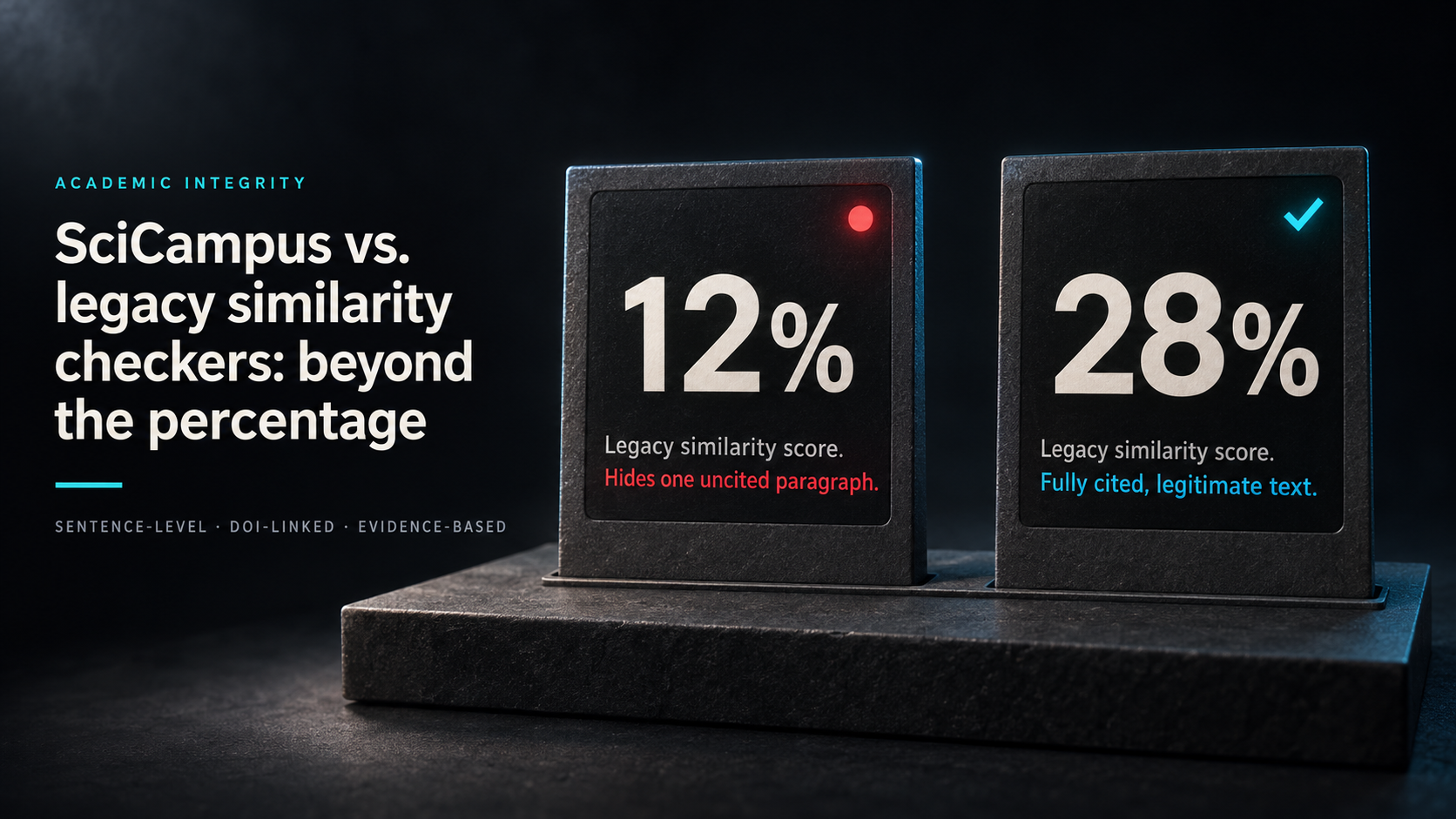
Action: complete the institutional requirement, then use SciCampus to interpret material findings at sentence and source level. Required screening and evidence-based review are complementary — see our comparison of SciCampus and legacy similarity checkers for where each one fits. The final question remains: can the authors explain the passage and its relationship to the source?
Make every co-author's edits visible and defensible. Start using SciCampus — free to start, no card required — to review sentence-level signals, verify DOI-linked sources, and assemble a pre-submission evidence package your team can stand behind.
A Practical Final Checklist
Before substantive editing
A manuscript integrity lead and section owners are named
The team has agreed permitted and prohibited AI uses
Confidentiality, data-classification, and access rules are clear
The target journal's current policies are identified
During drafting and revision
Each substantive AI-assisted edit is logged with tool, purpose, section, reviewer, and action
Every material rewrite is checked against invariant scientific content
Causal language, scope, uncertainty, effect estimates, and limitations remain accurate
External ideas, methods, findings, and definitions are cited at the point of use
New references are verified through authentic DOI or publisher records
During final review
Sentence-level signals are reviewed as prompts, not automatic verdicts
Possible raw AI output is checked for accuracy, specificity, and disclosure needs
Possible AI-paraphrased writing is checked against DOI-linked source evidence
Legitimate self-overlap is disclosed or revised according to journal requirements
Every material finding has a recorded outcome and relevant section-owner approval
Before submission
The SciCampus highlighted PDF audit report is stored with the audited manuscript version
Source checks, decision notes, author approvals, and disclosures are complete
No AI tool is listed as an author
The PI or delegated integrity lead has visibility into the completed audit package
The corresponding author has verified the exact file to be uploaded
The submitted file matches the audited and approved version
Build a Lab Culture of Defensible Writing
An SOP is not a barrier to efficient research writing. It is a way to make collaboration safer and faster. When authors know who owns a claim, when AI edits are logged at the point of use, when sources are checked through DOI-linked records, and when high-risk passages are reviewed at sentence level, the final submission process becomes less stressful and more reliable.
SciCampus gives labs an evidence-based workflow for that final stage: sentence-level stylometry to focus attention, raw-versus-paraphrased classification to guide review, DOI-linked similarity checks to establish attribution context, and downloadable PDF reports to preserve what the team examined. A shared decision log and a consistently named archive folder make that workflow practical across multiple authors and concurrent projects. It does not replace authorship or scientific judgment. It makes that judgment easier to apply and explain.
Protect your next multi-author submission before the final deadline. Start using SciCampus — free to start, no card required — to run sentence-level and source-level review, then submit a version your entire team can defend.
Policy note: Journal requirements differ and change. Before submission, consult the current instructions for the exact target journal. Where those instructions are more restrictive than this SOP, the journal's policy governs.
Selected policy resources
Related reading (topic ideas for future posts)
How to write an AI-use disclosure statement journals will actually accept
Building a manuscript version-control system for multi-author labs
What to do when a co-author's edit introduces a fabricated citation
Semantic drift vs. legitimate simplification: where to draw the line