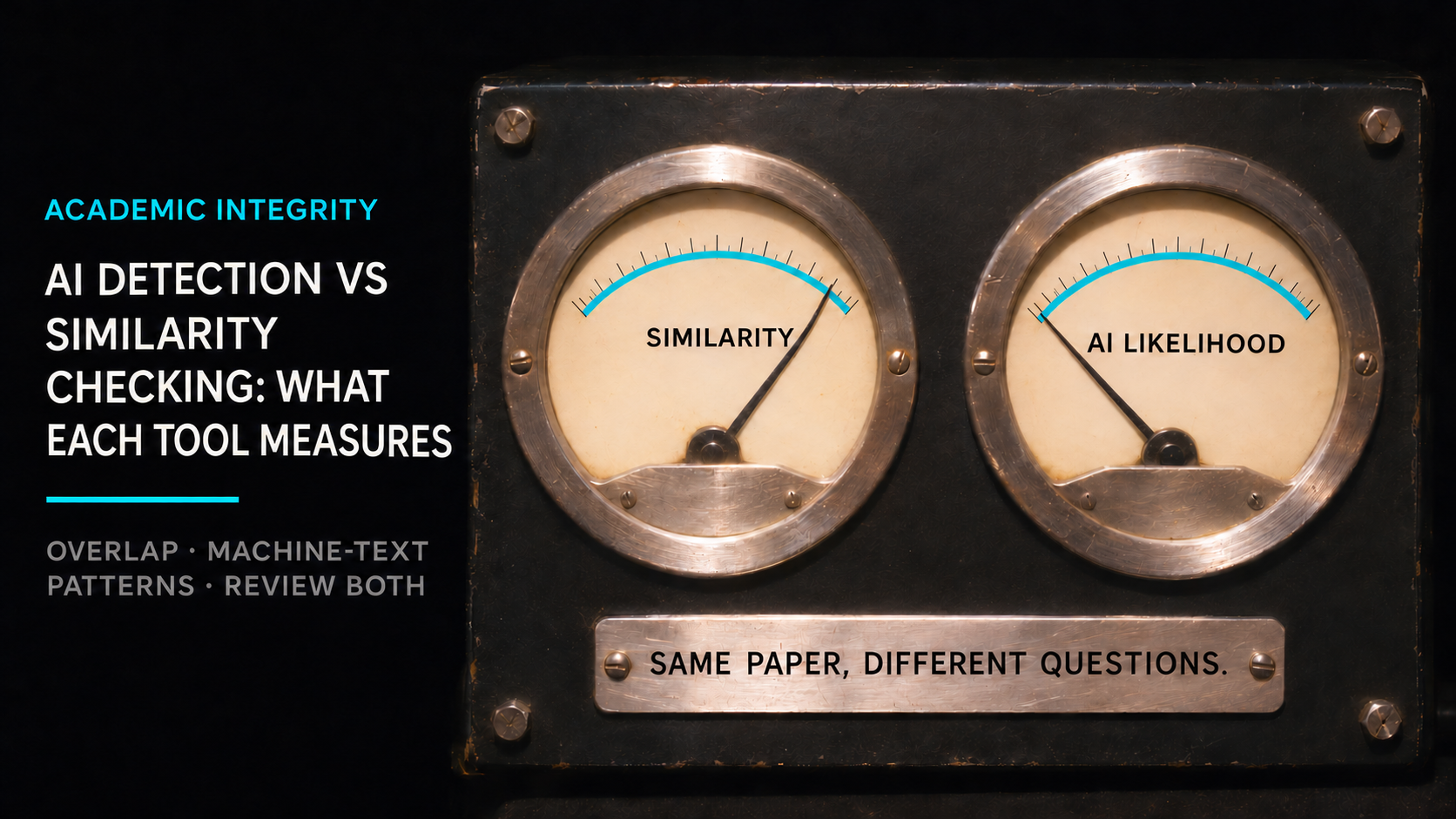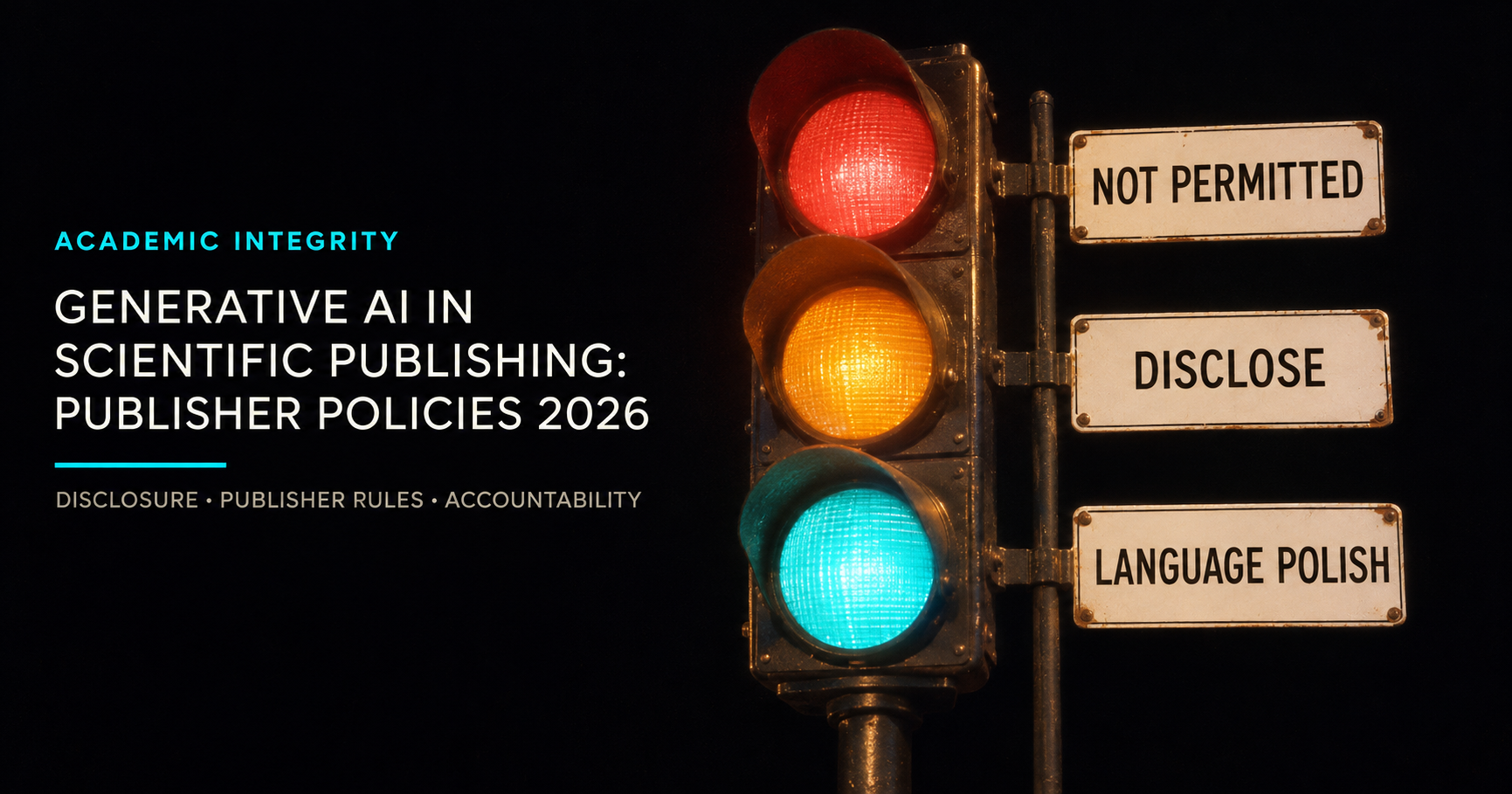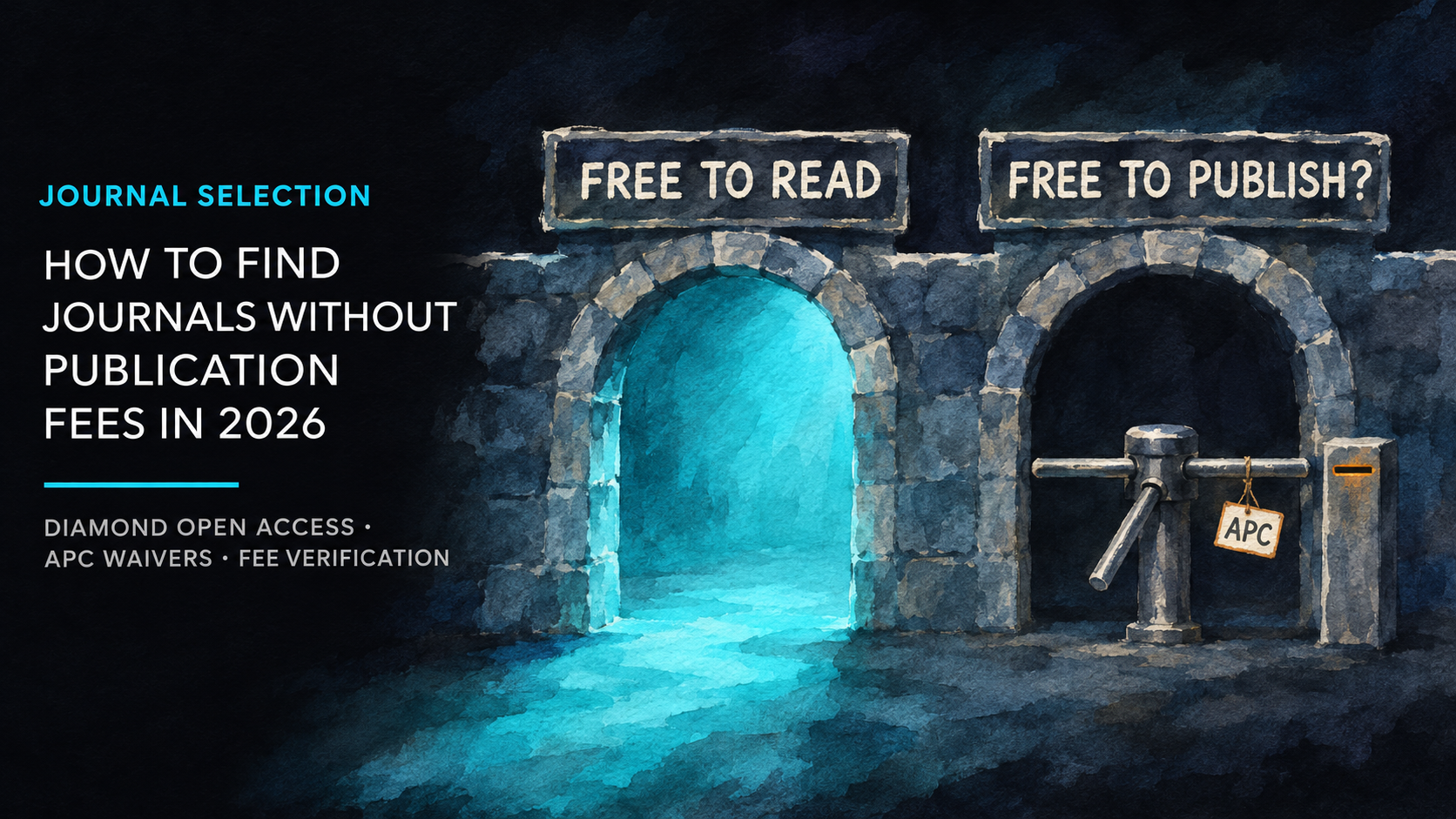
Short answer: to find journals without publication fees, shortlist journals that fit your research, then check each one's own author-charge statement, access policy and any waiver conditions. You can also start from cost with DOAJ's filter for journals without article processing charges (APCs) and judge subject fit afterwards. "No fees" can mean a journal charges nobody, a subscription route avoids the APC, or another organisation pays it. An open-access label or a "no APC" tag does not prove your submission will generate no author bill, so verification is the decisive step.
What does "no publication fees" actually mean?
Free to read concerns the reader. Free to publish concerns the author. Neither statement establishes the other.
Open access is not the same as no author fee. Many open access journals charge an APC. DOAJ accepts only open access journals, with immediate free access, no embargo and a clearly stated reuse licence (DOAJ guide to applying).
Diamond (platinum) open access is described as a model that charges no fees to authors or readers, with scholarly communities keeping control of the publishing (EDCH).
Subscription and hybrid journals are funded through subscriptions or other access payments. Hybrid journals add an optional open access route for individual articles.
A waiver removes a charge; a discount reduces it. Institutional or funder cover means another organisation pays an eligible cost. In both cases an APC still exists even if you do not personally pay it.
A search such as "free publication journals" therefore needs a sharper question: which charges, for which article, under which publishing route?
What are the four routes to a zero author bill?
A. Diamond / platinum journals
How it avoids an author bill: No fees for authors or readers
Main thing to check: Explicit no-author-fee statement covering your article type
B. Other open access journals reporting no APC
How it avoids an author bill: Journal reports no APC (DOAJ filter)
Main thing to check: Other charges: submission, page, colour
C. Subscription route in hybrid journals
How it avoids an author bill: Publishing under the subscription model carries no APC
Main thing to check: Funder access, licence and deposit rules; embargoes
D. APC journals with a waiver or external cover
How it avoids an author bill: Publisher, funder or institution removes or pays the charge
Main thing to check: Eligibility and confirmed approval, not an estimate
A. Are diamond or platinum journals the clearest option?
At model level, yes: they offer publication without author charges and open access for readers. Publishing still costs money, so institutions, consortia or public-interest organisations usually carry it. Do not rely solely on a "diamond" label in a directory. Read the journal's current instructions and confirm the statement covers your article type.
B. Can DOAJ help me find open access journals with no APC?
DOAJ's journal search offers a filter for journals without article processing charges. Filter labels and positions can change, so look for the control in the current search page rather than an older tutorial. DOAJ requires journals to list every fee an author may pay from submission to publication, including submission fees, APCs, page charges and colour charges, and to say explicitly when there are none (DOAJ guide).
Treat results as candidates, not cost confirmations. "No APC" answers one charging question. Confirm the same information on the journal's own author-instructions page. A no-APC journal may also be diamond, but the diamond model covers all reader and author fees, while the no-APC field covers one charge.
C. Can a subscription or hybrid route avoid an APC?
Often, yes. DOAJ lists fully open access journals only, so subscription and hybrid journals will not appear there; check the publisher's own pages. Elsevier's waiver policy (last updated 4 October 2026) says authors can publish free through the subscription route in hybrid journals, and that APC waivers are not offered for hybrid journals. That is Elsevier's policy, not a rule for all publishers.
The catch is compatibility. Avoiding an APC does not show that the route satisfies a funder's requirements for immediate access, a particular licence or repository deposit. Check whether you may deposit the accepted manuscript, where, and whether an embargo applies.
D. Can I get an APC waiver?
Possibly, but eligibility is publisher- and journal-specific, and an application or initial estimate is not confirmed support.
Elsevier: waiver requests are considered case by case; waivers may be available in fully open access journals, with priority for applicants from Research4Life-eligible countries. Some funding bodies reimburse the fee through agreements with Elsevier (Elsevier).
Wiley: geographical waivers apply to fully open access journals, not hybrid. Eligibility is based on the responsible corresponding author's affiliation, and at least half of all authors must be affiliated with institutions in the same eligible country group. Initial estimates are checked against the full author list. Discounts cannot be combined; only the highest applies (Wiley).
Conditions can include journal type, corresponding-author affiliation, author-group composition, funding eligibility and individual approval. Waivers are never assured, and a partial discount leaves a balance unless another source covers it.
Reassuringly, the Principles of Transparency and Best Practice (version 5.0, from COPE, DOAJ, OASPA and WAME) state that author fees or waiver status must not influence editorial decision making.
For institutional agreements, ask your library or research office to confirm the exact journal, article type, author eligibility and dates, and whether support pays the publisher directly or requires reimbursement. That matters if you have no money upfront.
How do I find journals without publication fees: fit first, then fee?
Separate two decisions: does the journal suit the research, and does the publishing route meet your budget and access requirements?
Step one: how do I build a subject-fit shortlist?
Read each journal's aims and scope, then inspect recent articles for comparable questions, methods, article types and readers. The SciCampus Journal Finder is designed for this stage. Enter a title, abstract or keywords and it suggests journals to review, drawing candidates from sources including Crossref, OpenAlex, DOAJ, Europe PMC, OpenAIRE, Semantic Scholar, PubMed, CORE and Springer. Its ranking weights how closely a journal's own published articles match your paper, shows those closest articles so you can judge fit yourself, and displays open-access status and an early predatory-journal signal. The examples on the page are examples, not recommendations for your manuscript.
Enter your abstract, or your title and keywords, and run the search.
Open the closest published articles for the top candidates and compare their questions, methods and article types with yours.
Note each candidate's open-access status and any early signal, and shortlist three to five journals.
Take every shortlisted journal through step two.
Step two: how do I verify fees independently?
An open-access label is not a fee answer. The Journal Finder helps with fit and does not replace a fee check, so treat each result as a lead. Check the fee statement on DOAJ and on the journal's own pages. If cost must come first, reverse the order: use DOAJ's journal search to find journals reporting no APCs, then read their recent publications. Either way, both questions must end resolved: does the paper fit, and is the route affordable?
Metrics such as SJR quartiles describe citation standing, not fees; see our guide to choosing Q1 and Q2 journals. Once you have chosen, the guide to journal selection and cover letters covers fit and how to introduce the work.
What costs and conditions exist outside the APC?
A "no APC" statement does not settle total cost, because the APC is only one author charge. DOAJ's criteria name submission fees, article processing charges, page charges and colour charges. The Principles of Transparency also require fee information to be easy to find before submission begins, require journals with no author fees to say so, and say a waiver policy should be available where fees apply, with clear criteria on who qualifies, which authors in a group must qualify, and how to apply (WAME).
Article processing charge
What to ask: Does it apply to my article type and route?
Submission or page charges
What to ask: Are they mandatory, and from what length?
Colour charges
What to ask: Print only, online, or both?
Language editing
What to ask: Optional service, or a condition of publication?
Membership fees
What to ask: Required for a discount or for submission?
Embargo or deposit limits
What to ask: Does the route meet my funder's immediate-access rules?
Some conditions concern access rather than an invoice. An embargo can make a no-APC subscription route unsuitable for an immediate-access obligation, and an institutional agreement can remove your payment while moving the cost to the university.
How do I verify a "no fees" claim?
Locate the journal's own fee statement. Open the author instructions, publication-charge page and publisher policy. Look for an explicit no-author-fees statement, not merely the absence of a price. Save the page and date.
Establish what applies to your submission. Confirm article type, publishing route and any length, figure, supplementary-material or membership conditions. If statements conflict, ask the journal's official contact in writing before submitting.
Read waiver conditions separately. Check eligibility, timing, evidence and which charges are covered. Get confirmation, not just an estimate.
Cross-check the DOAJ record. Match title, publisher, ISSN and linked website. DOAJ inclusion is evidence of assessment against its criteria, not a guarantee of suitability or a fee quotation for your paper.
Confirm identity and access compatibility. Use the official publisher site and consistent identifiers; for broader checks see our guide to verifying the journal behind a website. Ask your library or research office about funder requirements, accepted-manuscript deposit, licensing, embargoes and agreement coverage.
A concise enquiry can help: "For this article type and publishing route, please confirm all mandatory author charges, including submission, page, colour, editing and membership charges, and whether the stated waiver or agreement covers them." Keep the reply with the policy pages. If a zero author bill is essential, unresolved conditions are a reason to pause, not to assume no invoice will follow.
What should I check before I commit? A submission checklist
Proceed when each applicable answer is yes. A "no" or "not sure" means stop and check.
Does the journal's scope, article types and recent publications fit my manuscript?
Have I matched the journal's title, publisher, ISSN and official submission website?
Have I found the journal's own author-fee statement, available before submission?
Have I confirmed the APC position for my exact article type and publishing route?
Have I confirmed that no mandatory page, colour, submission, editorial-processing, language-editing, membership or supplementary charges remain payable by my author group?
Does the route meet my funder's and institution's open access requirements, including licensing, deposit timing and embargo?
If I rely on a waiver, have I checked the author-group criteria and obtained confirmation of approval and coverage?
If I rely on institutional or funder cover, have I confirmed eligibility, dates, payment arrangements and coverage of every mandatory charge?
Have I resolved conflicting statements and kept dated policy pages or written confirmation of the expected zero author bill?
Start your shortlist by entering your abstract in the SciCampus Journal Finder, then use this checklist to confirm fees, waivers and open access conditions on each journal's own pages.
Related reading
Target Journal Selection and the Art of the Cover Letter: Why Most Manuscripts Face Desk Rejection
Journal Indexing Risks in 2026: Verify Q1, SJR, and the Journal Behind the Website
References
DOAJ. Guide to applying: inclusion criteria. https://doaj.org/apply/guide
COPE, DOAJ, OASPA & WAME (2026). Principles of Transparency and Best Practice in Scholarly Publishing, Version 5.0. https://doaj.org/bestpractice and WAME
Elsevier. What is Elsevier's waiver policy for open access fees? (updated 4 October 2026). elsevier.support
Wiley Author Services. Waivers and Discounts. authors.wiley.com
EDCH. Diamond open access. resources.edch.eu