The final ten minutes before manuscript submission should not be spent staring at an unexplained percentage. They should be spent answering the questions an editor may ask: which claims need support, which matched sources have been verified, which AI-style signals are genuine concerns versus false positives, and what the authors did about them.
SciCampus gives corresponding authors a focused integrity workflow for that decision point. Use the AI Detector to inspect sentence-level stylometry, distinguish likely raw AI-generated passages from AI-paraphrased writing, check meaningful overlap against DOI-linked sources, and export a highlighted PDF audit report. The goal is not automated clearance. It is a submission record that is accurate, attributable, transparent, and ready for human editorial scrutiny.
Why the last ten minutes matter
Submission readiness is more than formatting
A polished cover letter, a correctly formatted reference list, and completed upload fields do not prove that a manuscript is ready for peer review. Editors assess the intellectual record behind the formatting: whether the abstract faithfully states the result, whether citations support the claims they accompany, whether source overlap is legitimate, whether authors have retained accountability for AI-assisted work, and whether the paper follows the target journal's policies.
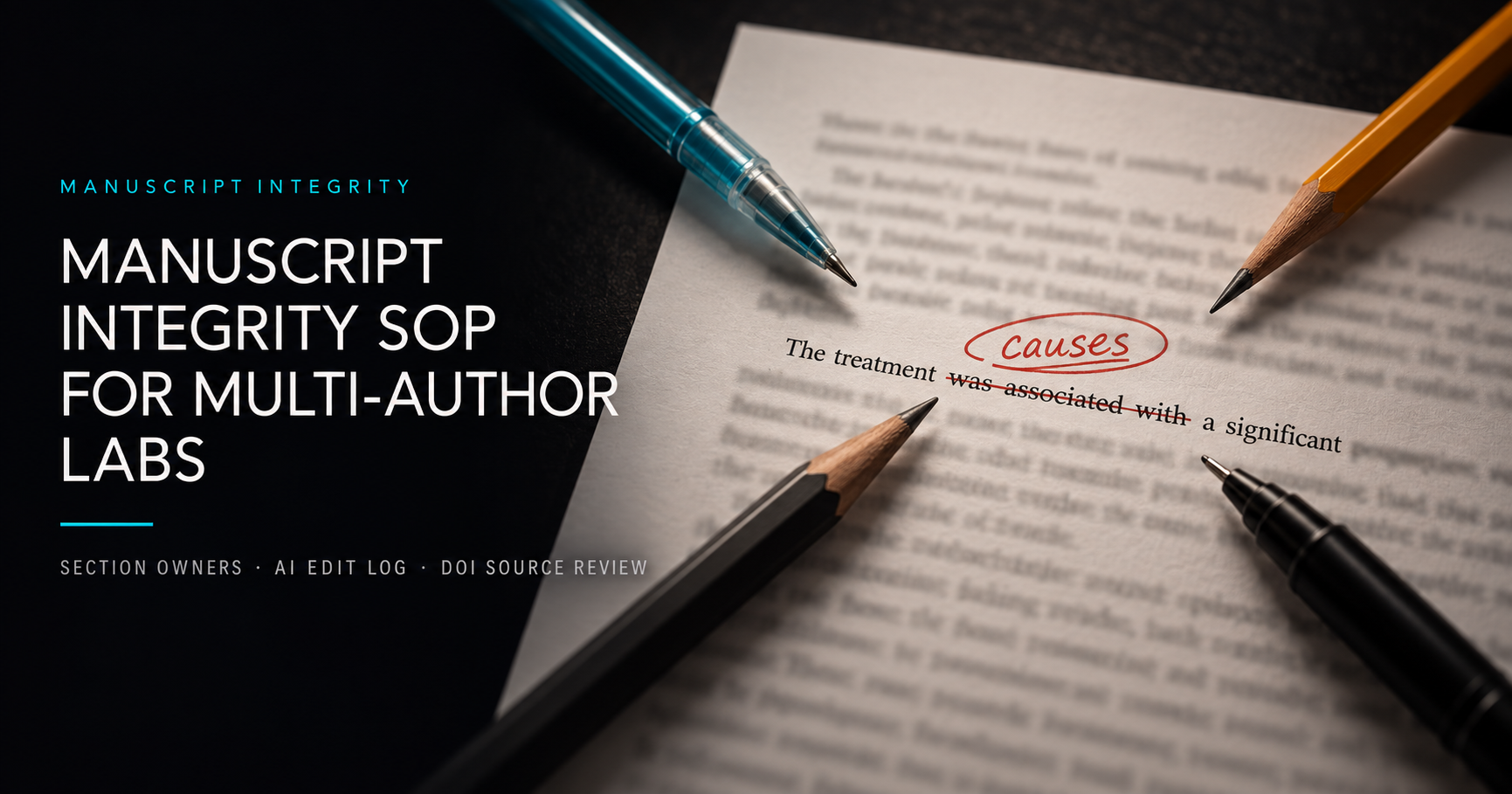
Many manuscripts encounter avoidable delay because the final check is too broad or too shallow. A team runs a legacy checker, sees an overall similarity percentage, and treats it as a pass/fail result. Or a researcher receives an AI detector signal, rewrites sentences to make a number disappear, and accidentally removes a limitation or changes an association into a causal claim. Neither response creates a defensible submission.
The useful final audit is targeted. It does not attempt to replicate peer review, rerun every analysis, or promise to eliminate every uncertainty in ten minutes. It focuses on high-impact risks that can be inspected immediately: the claims an editor will see first, the sentences most likely to require explanation, the sources behind meaningful overlap, and the evidence record the corresponding author can retain.
The objective: evidence, not a lower score
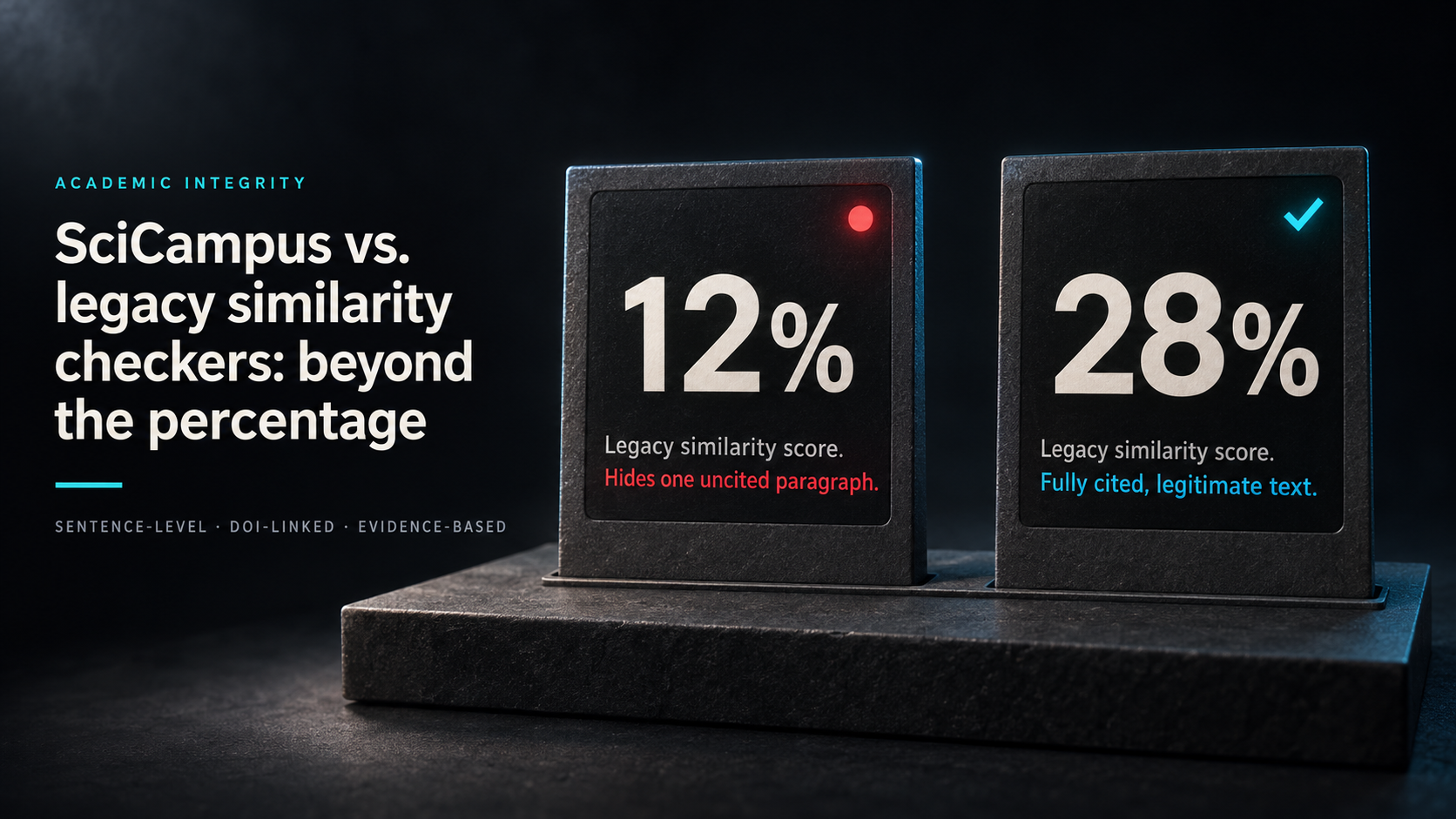
A generic document-wide percentage cannot identify a specific problem or tell an author how to solve it. A 10% similarity score may hide an uncited close paraphrase in the literature review. A 25% score may be defensible because it includes references, standard language, quotations, or disclosed overlap with a preprint. Similarly, an AI-likelihood score cannot establish authorship intent, source provenance, or misconduct.
The correct final question is not, "Can we make the score lower?" It is, "Can we explain this sentence, this source relationship, and this claim with evidence?" SciCampus shifts the workflow to that question.
An audit that follows editorial logic. SciCampus combines sentence-level stylometry, DOI-linked similarity verification, and a downloadable highlighted PDF report. Instead of treating one percentage as a verdict, review the precise passage, inspect its source, record the decision, and retain the evidence.
What this audit does and does not do
A ten-minute review is a high-value triage routine for a candidate submission version. It can identify clear issues, improve documentation, and help a corresponding author decide whether the manuscript needs deeper review before upload.
It does not replace:
Independent validation of statistics, code, or raw data
A full literature review or exhaustive plagiarism investigation
The target journal's author instructions and disclosure requirements
Co-author approval of scientific claims
Institutional research-integrity procedures where a serious concern exists
The value lies in focus: when time is scarce, review what is most likely to affect editorial trust.
Your 10-minute audit plan
Minute 0–1: Freeze the candidate submission version
Do not audit a moving target. Save a clearly named manuscript version before screening. Confirm that the title, abstract, main text, references, figures, and supplementary files correspond to the draft the corresponding author intends to upload.
Save the file as "Submission Candidate – Date – Version." Preserve the immediately previous draft and pause simultaneous co-author editing. An audit report is only useful if it can be connected to a specific manuscript version.
At this stage, gather the supporting materials that may be needed if a passage is questioned: tracked changes, key data outputs, reference-library records, a list of substantive AI tools used, and any previous manuscript version. You do not need to review everything in ten minutes; you need to know where the evidence is.
Minute 1–3: Scan the abstract, results claims, and conclusion
Start where editors start. Read the title, abstract, highlights or key messages, final results statements, discussion claims, and conclusion against the study's actual design and key outputs.
Ask five fast questions:
Does the abstract describe the correct population, setting, sample, and study design?
Is an association being presented as causation?
Has a relative comparison been converted into an absolute claim of effectiveness?
Have limitations, uncertainty, adjustment variables, or timeframes been omitted?
Does every claim of novelty, broad impact, or recommendation follow from evidence in the manuscript?
Before: overstated conclusion
"The intervention reduced missed appointments and demonstrates an effective strategy for all outpatient settings."
After: design-faithful conclusion
"Receipt of the intervention was associated with fewer missed appointments after adjustment for baseline attendance patterns; evaluation in additional outpatient settings is needed before wider implementation."
The revised statement may be less promotional, but it preserves the likely observational nature of the evidence, identifies adjustment, and retains a necessary boundary on generalization.
Minute 3–5: Review sentence-level AI signals, not a single percentage
Review the passages, not just the score. Run the candidate manuscript, or its highest-risk sections, through the AI Detector. Start with red signals (≥99%), then review orange signals (≥96%), followed by substantive yellow signals (≥93%). The color bands are not findings of misconduct. They create a practical order for human attention.
For each material signal, read the surrounding paragraph. Then classify the issue before changing anything:
Probable raw AI-generated text: Is the passage generic, unsupported, overly certain, or disconnected from the study's methods and results?
Probable AI-paraphrased writing: Does the passage seem to retain a source's conceptual order, conclusion, or distinctive expression despite changed words?
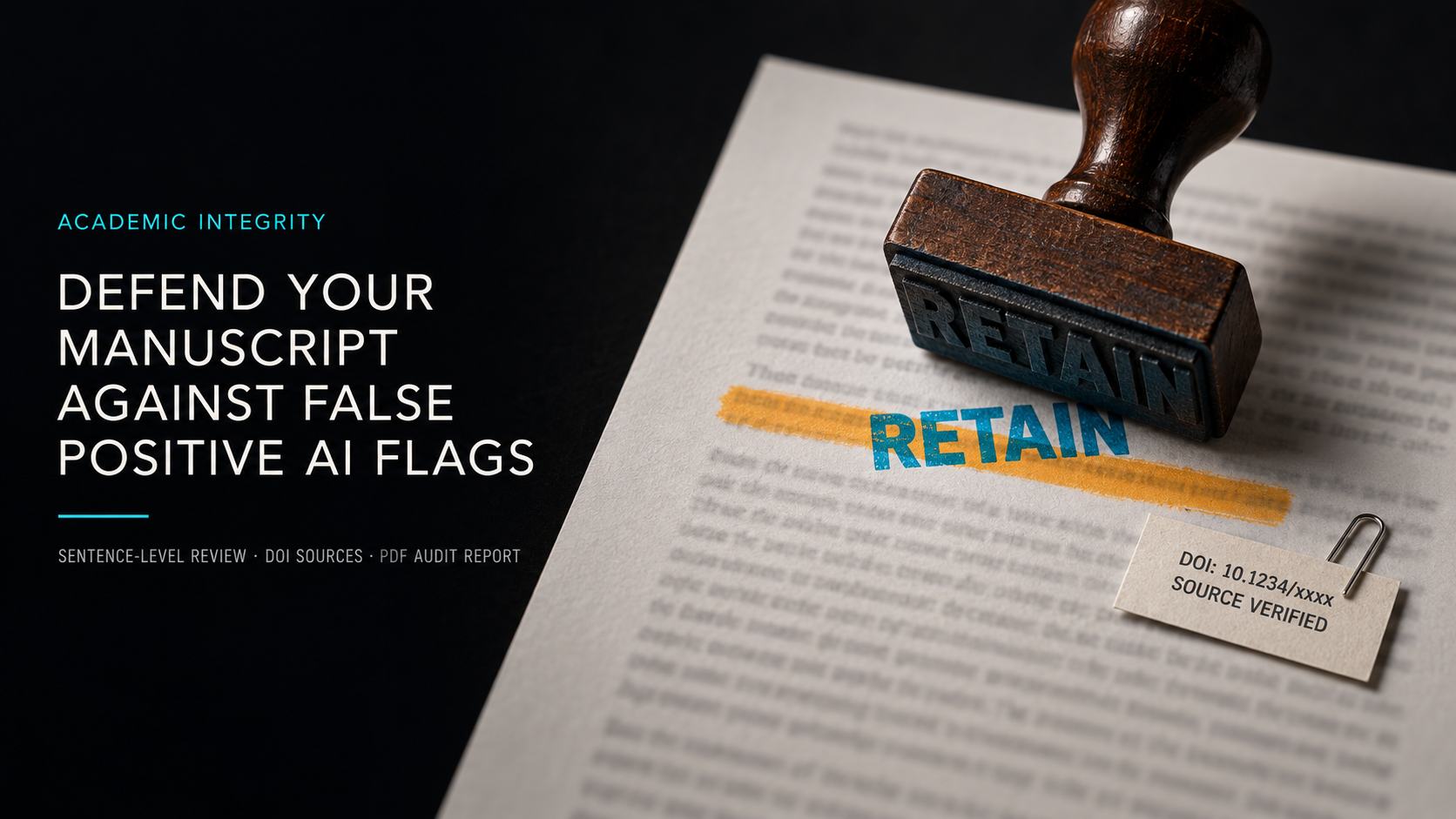
Likely false positive: Is it standard technical language, a professionally edited human sentence, a conventional methods phrase, or a passage the author can trace through drafts and notes?
For each material red, orange, or yellow signal, choose one documented action: retain, substantiate, rewrite for precision, cite and reframe, disclose, or remove. Do not revise merely to change a color band.
This distinction matters. Raw AI-style text often needs claim verification and a rewrite grounded in the actual study. AI-paraphrased writing needs source investigation and attribution review. A likely false positive may need no textual change at all — only documented provenance and author confirmation.
Before: generic, unsupported language
"These significant findings reveal the urgent need for a comprehensive solution to this major challenge."
After: specific, evidence-led language
"After adjustment for age and baseline severity, lower baseline adherence was associated with reduced six-month follow-up attendance; future implementation studies should test whether reminder systems improve attendance in comparable outpatient settings."
The improved version contains a result, a boundary on inference, and a proportionate next-step recommendation. It is not better because it "sounds human"; it is better because it is scientifically specific.
Minute 5–7: Verify meaningful overlap through DOI-linked sources
Move from match to source. Use SciCampus to inspect search-grounded similarity matches. Focus on material overlap in the abstract, introduction, methods, discussion, conclusion, and key figure or table language — not on every common phrase.
Open the available DOI-linked source and read beyond the matching fragment. Determine what relationship the manuscript has to the source:
Standard language: Retain it if the phrase is conventional and does not copy a distinctive argument.
Quotation: Confirm quotation formatting, citation accuracy, and permission requirements where relevant.
Attributed paraphrase: Confirm that the wording and argument sequence are independent enough and that the citation is placed at the point of use.
Self-overlap: Check whether the match is to a thesis, preprint, protocol, conference paper, or prior article; disclose or revise according to the target journal's policy.
Close or unattributed reuse: Cite, substantially reframe, quote, or remove it before submission.
Open the DOI-linked record, read the source context, and document one outcome: retain, cite, reframe, disclose, or remove. A percentage tells you that text may match; DOI-grounded review tells you what the match means.
Before: source-dependent paraphrase
"High-status citations make journals more influential, so SJR reveals which outlets produce the greatest impact."
After: bounded and attributable formulation
"SJR weights citations according to the prestige of citing journals and reports journal standing within defined subject categories; it should be considered with scope, readership, and article-type fit when selecting a journal (Author, Year)."
The second version accurately explains the metric's function, avoids deterministic language, and signals the need for an authentic supporting citation.
Minute 7–8: Confirm the journal's policy requirements
Check the exact target journal, not just a publisher-wide rule. Open the journal's current author instructions. Confirm requirements for AI use, authorship, acknowledgements, data availability, ethics approval, figures, images, preprints, text recycling, reporting guidelines, and supplementary files.
Major publisher policies converge on human accountability. COPE states that AI tools cannot be authors because they cannot take responsibility for submitted work. Elsevier requires authors to verify AI-generated output, document substantive use, and remain responsible for published content; basic grammar, spelling, and punctuation checks are generally treated differently from substantive changes to text structure or organization. IEEE requires disclosure of AI-generated content, naming the system, affected sections, and degree of use.
If generative AI made substantive changes to text, organization, analysis, figures, code, or data processing, check the journal's current required disclosure location and wording. State the tool, its purpose, affected content, and the authors' human review — never list the tool as an author.
Disclosure model
"During manuscript preparation, the authors used [tool name and version] to assist with [specific purpose]. The authors reviewed, edited, and verified all output and take full responsibility for the accuracy, originality, and integrity of the submitted manuscript."
Adapt this language to the journal's exact instructions. Do not use a disclosure statement to excuse unverified text or invented citations.
Minute 8–10: Export the evidence report and obtain approval
Create the audit trail. After resolving material signals and sources, export the highlighted PDF audit report. Keep it with the frozen manuscript, DOI-source notes, final disclosure, and author approvals.
Convert a screen into an audit trail. The downloadable PDF report preserves highlighted findings in a shareable format. Use it with version history and DOI checks to show what the team reviewed, what it retained, and what it changed before submission.
The corresponding author should then confirm one final point: the file being uploaded is the same version that completed the audit. If a co-author makes a substantive post-audit change to the abstract, methods, results, discussion, or references, rerun the relevant step rather than assuming the prior report still applies.
Turn ten minutes into submission confidence. Start your SciCampus audit — free to start, no card required. Verify the sentences, sources, and policy requirements that matter before your manuscript reaches an editor. Create a free account.
How to handle common objections
"What if the AI detector flags a false positive?"
A flag is a review prompt, not a judgment. False positives can occur with short text, standard methods language, professional copy-editing, non-native English writing, formulaic scientific phrasing, and highly regular human prose. A responsible author should not assume a flag proves AI use, and should not rewrite accurate prose simply to reduce a probability band.
Use the signal to focus human review. Check whether the sentence is supported, author-owned, and traceable through notes, drafts, tracked changes, or data output. If it is, retain it. Preserve the evidence in case an editor asks. If it is generic or weakly connected to the study, improve its specificity regardless of the detection label.
"Our journal has a strict AI policy."
Strict policy makes evidence more valuable, not less. First, identify whether the manuscript used AI only for basic proofreading or for substantive generation, reorganization, analysis, code, figures, or translation. Then follow the exact journal instruction for disclosure and permitted uses.
Do not confuse detection with policy compliance. A detector cannot decide whether a particular use was permitted under a journal's rules. The authors must compare their actual workflow with the policy, make a truthful disclosure, and retain responsibility for all content.
"We already use a legacy similarity checker."
Use required institutional tools but do not stop at the percentage. Legacy reports can identify overlapping strings. The missing layer is interpretation: which sentence matters, which source it comes from, whether the overlap is legitimate, and what an editor will need to see.
Add a final-decision workflow. SciCampus complements required screening with sentence-level stylometry, likely raw-versus-paraphrased sub-classification, DOI-linked source investigation, and a downloadable PDF audit report.
"Can we audit an unpublished manuscript safely?"
Privacy is a responsibility shared by the authors and the institution. Before uploading any manuscript to any platform, confirm the applicable institutional, funder, sponsor, collaborator, patient-data, and journal restrictions. Do not upload personally identifiable information, restricted data, third-party confidential material, or documents under peer review unless you have authority to do so and the platform's terms permit the use.
Use a deliberate workflow for author-owned drafts. Limit access to the relevant team, maintain version control, and follow your laboratory's data-classification policy. An integrity audit should never create a confidentiality breach.
"Can a tool replace co-author approval?"
No. SciCampus can focus attention and preserve evidence; it cannot assume authorship, scientific judgment, or responsibility. The corresponding author remains accountable for claims, citations, disclosure, and final submission. Subject-matter authors should approve material changes to their methods, results, analyses, limitations, and conclusions.
Do not let an aggregate score make the final decision. Try SciCampus — free to start, no card required — to inspect material sentences, verify DOI-linked sources, and export evidence your team can review together. Get started.
A lab-ready 10-minute SOP
Assign a manuscript integrity lead
Assign responsibility before the final week. The integrity lead is usually the corresponding author, senior postdoc, or project manager. This person coordinates the review, freezes the candidate version, assigns source checks, and confirms that content owners approve substantive edits. The role is coordination, not unilateral authority over science.
Use a compact decision log
Record only what the team needs. For each material finding, capture:
The sentence or passage reviewed
The source, DOI, data output, or draft record consulted
The decision: retain, substantiate, cite, reframe, disclose, or remove
The responsible author and date
The final manuscript version
This record takes minutes, not hours, and makes later questions easier to answer.
Preserve the final evidence package
For every submission, retain:
The candidate version that was audited
The highlighted SciCampus PDF audit report
DOI-linked source dispositions
The final AI-use disclosure, if applicable
Author approvals for substantive revisions
The final submitted file and journal confirmation
For teams managing several papers, a shared review environment can centralize reviews and reports across a lab. Administrative features should support predictable access, but they should never replace the human responsibilities defined in the authorship statement.
Final five-point checklist
Claims and scientific meaning
The title, abstract, key messages, and conclusion match the actual design and findings.
Associations have not been rewritten as causal effects without appropriate evidence.
Population, comparator, outcome, timeframe, adjustment, and limitations remain accurate after editing.
Generic novelty or impact claims have been replaced with evidence-specific statements.
AI signals and provenance
Material sentence-level red, orange, and yellow signals have received contextual human review.
Probable raw AI-generated text has been checked for factual support and required disclosure.
Probable AI-paraphrased writing has been investigated for source dependence and attribution.
Likely false positives have been retained only with defensible provenance and author confirmation.
DOI and similarity verification
Meaningful matches have been opened against DOI-linked source records where available.
Quotations are marked and cited accurately.
Paraphrases are independent in both expression and argument structure.
Self-overlap with preprints, theses, protocols, or prior papers is disclosed or revised as required.
Journal compliance
The target journal's current AI, authorship, ethics, data, image, text-reuse, and reporting requirements have been checked.
Required disclosure language matches the team's actual use of AI tools.
Each author has approved material changes in the sections connected to their contribution.
Evidence retention
The highlighted PDF audit report is saved with the audited manuscript version.
DOI checks, decision notes, source records, and author approvals are retained.
The uploaded manuscript is the same version that completed the final audit.
Submit with evidence, not assumptions
The final ten minutes before submission cannot prove that a manuscript will be accepted. They can ensure that the corresponding author has done something more valuable than chase a score: inspect the highest-risk sentences, verify meaningful source relationships, align disclosures with journal policy, and retain an evidence record.
SciCampus turns that final check into a practical, defensible workflow. Use sentence-level stylometry to see where review is needed. Use DOI-linked similarity evidence to understand source relationships. Use the highlighted PDF report to preserve the decisions your team made. Then submit the audited version with confidence in the process behind it.
Audit before you upload. Create your SciCampus account — free to start, no card required — and complete a focused pre-submission review today. Try it free.
Policy note: Journal and publisher requirements evolve. Always check the current author instructions for the exact target journal; where those requirements are stricter than general guidance, the journal's policy governs.