A false positive AI flag is not proof of misconduct, and it should not force an author to weaken accurate scientific prose. It is, however, a signal that deserves a disciplined response: inspect the flagged sentence in context, verify the claim and source relationship, preserve drafting provenance, and document the human judgment that led to the final wording.
SciCampus helps authors prepare that response before submission. Its sentence-level AI Detector provides stylometric probability bands, differentiates likely raw AI-generated text from AI-paraphrased writing, connects meaningful overlap to DOI-linked sources, and produces downloadable highlighted PDF audit reports. Together, these features help a corresponding author build an evidence file — not a blanket denial — if a journal, reviewer, or institution asks questions.
Why a Detector Score Isn't Proof of Anything
AI-detection systems infer probability from linguistic patterns — lexical distribution, sentence regularity, structural predictability, punctuation, function words, readability, and other stylometric features. These methods can help identify passages for review, but they cannot directly observe who wrote a sentence, what editing occurred, whether an author drafted from notes, or whether text is properly attributed.
This limitation matters in scholarly writing. Academic manuscripts often contain highly regular prose: standard methods language, technical definitions, formal reporting structures, repeated abstract conventions, and careful hedging. A non-native English author may also use professional editing or grammar assistance that makes text more uniform. A short, polished, or formulaic passage — including entirely original writing — can receive a high AI-style signal without establishing that AI generated it. That is exactly why sentence-level review is more useful than a whole-document verdict: a signal is an invitation to examine the passage, its support, and its provenance, not a conclusion to argue with.
The appropriate response is neither panic nor dismissal. It is contextual evidence review. A corresponding author should identify the sentence, verify its scientific basis, examine possible source overlap, establish what drafts or notes exist, and decide whether the text should be retained, clarified, cited, reframed, disclosed, or removed.
Feature highlight: replace a black-box score with an audit target. The SciCampus AI Detector identifies signals at the sentence level, letting authors inspect the exact passage, its supporting evidence, its citations, and its drafting history instead of arguing about one whole-document percentage.
Why “Humanizing” the Text Is the Wrong Move
Authors sometimes respond to a flag by adding stylistic irregularity, replacing precise terminology, changing sentence length, or running the text through another paraphrasing tool. These actions can create a worse record.
Detector evasion is not evidence. It may reduce a probability score while leaving the real concern unresolved. It can also introduce the kind of semantic drift discussed in our piece on paraphrasing and meaning loss — an association becomes causation, a limitation disappears, a source is paraphrased too closely, or a result becomes more certain than the data justify.
Evidence is the stronger defense. A defensible response shows that the sentence is scientifically supported, traceable to a human author's work, accurately attributed where needed, and retained or revised after reasoned review.
Before (rewriting to evade a signal): “The results unequivocally show that the intervention solves the appointment-attendance problem.”
After (rewriting to preserve evidence): “In this cohort, receipt of the intervention was associated with fewer missed appointments after adjustment for baseline attendance patterns; evaluation in additional settings is required before broader implementation.”
The second version is not preferable because it is less likely to be flagged. It is preferable because it reports the evidence, preserves the design boundary, and distinguishes an observed association from a generalized causal conclusion. For more on how paraphrasing can quietly change what a sentence actually claims, see our breakdown of semantic drift in academic paraphrasing.
What Journals Actually Expect From Authors
Journals do not need authors to prove that no software ever touched their manuscript. They need authors to be accountable for submitted content, transparent about substantive AI use, and able to explain the provenance and accuracy of questionable material.
COPE states that AI tools cannot be authors because they cannot take responsibility for the work; named human authors retain that responsibility. Elsevier requires human oversight, verification of AI-supported output and sources, attention to confidentiality and intellectual property, and disclosure of substantive AI use. IEEE requires disclosure of AI-generated content, including the system used and affected sections.
Where a target journal prohibits substantive AI use outright, that policy controls. The first step is identifying what assistance actually occurred — grammar checking, translation, restructuring, generation of prose, code support, analysis, or image generation — and then following that journal's exact rules and disclosure requirements. A detector can help authors inspect and document what happened; it cannot convert a prohibited workflow into a permissible one, and it should not be used to conceal use.
A well-prepared evidence file speaks directly to these expectations. It does not claim that a detection output is meaningless. It demonstrates that the authors investigated it responsibly.
What Belongs in a Defensible Evidence File
Freeze the Candidate Manuscript Version
A PDF audit report cannot be interpreted meaningfully if co-authors continue editing the document without version control. Name the candidate file clearly and preserve the prior version.
Workflow: freeze the record. Save the manuscript as “Submission Candidate — Date — Version.” Preserve the preceding version, pause simultaneous edits during the audit, and ensure the final PDF report can be tied to the exact document later submitted.
For greater internal traceability, teams may record their own version identifier or file checksum in the project log before initiating the review. That identifier is a lab-maintained provenance control, not a claim that the SciCampus PDF report itself provides a cryptographic manuscript hash. Keep the distinction clear when communicating with editors.
Keep Sentence-Level Review Notes
The core of the evidence file is an explanation of how the team handled material signals. Use the AI Detector to prioritize sentences by probability band (confirm the current thresholds on the live product page before quoting exact percentages). These bands are prompts for inspection, not classifications of misconduct. Our piece on why aggregate AI scores fail goes deeper into why sentence-level signal beats a single whole-document number.
For each material signal, record:
The flagged sentence and manuscript location
The surrounding paragraph or argument
The sentence's function: result, method, literature summary, interpretation, limitation, or conclusion
The evidence supporting it: data output, table, figure, source, laboratory note, or draft history
The author responsible for verification
The final action: retain, substantiate, reframe, cite, disclose, or remove
This record is usually concise. The purpose is not to create a legal brief for every sentence; it is to preserve the reasoning behind the passages most likely to draw editorial questions.
Separate Raw AI Text From AI-Paraphrased Writing
SciCampus distinguishes probable raw AI-generated text from probable AI-paraphrased writing, because the risks differ.
Probable raw AI-generated text can be generic, overly fluent, unsupported, or detached from the study. It may introduce fabricated references, invented numerical details, categorical claims, or broad conclusions. The response is to verify the claim against data and sources, rewrite it in study-specific language, disclose relevant substantive use where policy requires it, or remove it.
Probable AI-paraphrased writing may retain the conceptual architecture, distinctive expression, or inferential sequence of a source even though words have changed. The response is to locate the source, verify its DOI-linked record, assess attribution and textual closeness, then cite, quote, independently reframe, or remove the passage.
Feature highlight: different signal, different remedy. Use the AI Detector to distinguish a likely generated claim that needs evidence verification from likely paraphrased source material that needs citation and provenance review — one cosmetic edit does not fix both problems.
Pull DOI-Linked Source Records
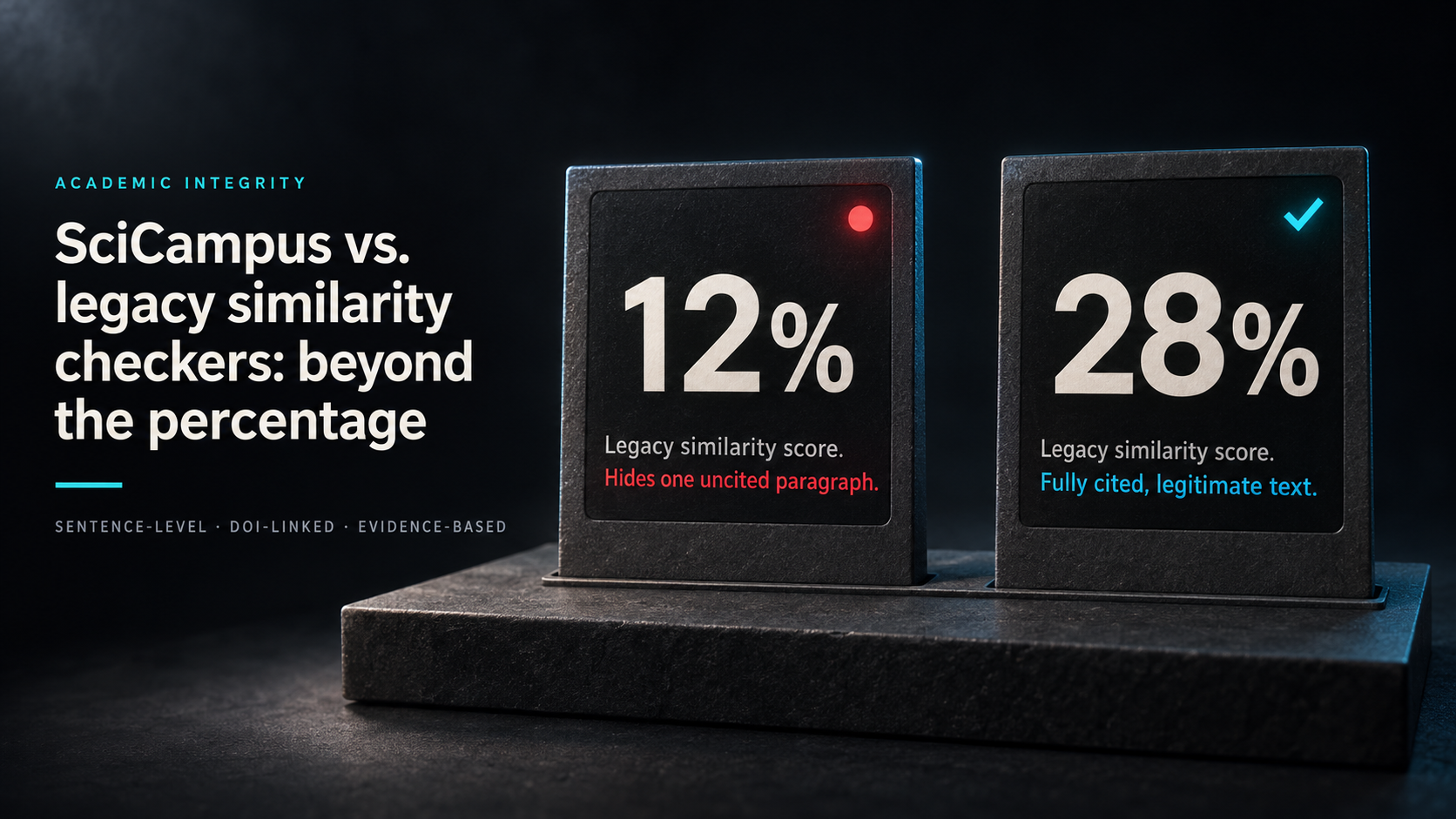
A highlighted phrase is not sufficient evidence of plagiarism or legitimate reuse. SciCampus provides search-grounded similarity investigation with DOI-linked sources where available, allowing the team to move from a match to the publication record — the same DOI-linked layer we compare against conventional similarity tools in SciCampus vs. legacy similarity checkers.
For every meaningful match, identify which relationship applies:
Standard language: technical or conventional wording that does not reproduce a distinctive source argument
Correct quotation: exact or near-exact language that is formatted and cited appropriately
Attributable paraphrase: a source-based claim rewritten independently and cited at the point of use
Self-overlap: reused material from a thesis, preprint, protocol, conference paper, grant, or earlier article that may require citation, disclosure, permission, or revision
Material concern: unattributed or excessively close borrowing, a citation that does not support the claim, or content that cannot be defended
Workflow: verify the source before defending the sentence. Open the DOI-linked record, read beyond the matched fragment, and document one disposition: retain, cite, reframe, disclose, or remove. A generic overlap score does not reveal whether a match is legitimate; source context does.
If your institution already runs a mandated similarity check, this layer is complementary rather than redundant: institutional tools are good at identifying strings of overlapping text, while the DOI-linked review here adds sentence-level stylometry, the raw-versus-paraphrased distinction, and an exportable evidence record — run the mandated check first, then use SciCampus to interpret material findings in the context an editor or research-integrity officer needs.
Preserve Draft History and Get Author Confirmation
The most persuasive provenance evidence is often ordinary research workflow: outlines, source notes, tracked changes, version history, analysis outputs, data tables, co-author comments, and dated drafts. Retain relevant records without manufacturing a retrospective narrative.
If an author used AI for language support, keep a brief, accurate record of the tool, purpose, scope of use, and human review applied. Where use was substantive, prepare the disclosure required by the journal. Where a sentence was written independently but flagged, retain supporting drafts and ask the responsible subject-matter author to confirm its accuracy.
Confidentiality comes first at this stage: before uploading any file to any service, check institutional, funder, sponsor, collaborator, patient-data, and journal restrictions. Do not upload personally identifiable information, restricted data, third-party confidential material, or peer-review documents unless authorized and permitted under the relevant terms — limit project access, preserve version control, and apply your lab's data-classification policy. An integrity workflow must never create a privacy breach.
How to Review Signals Before You Submit
Which parts of the manuscript deserve the closest look?
Editors usually form an early impression from the title, abstract, introduction, methods, central results, discussion, conclusion, figures, and references. Begin the audit there. A false-positive defense is stronger when it focuses on content that actually matters to editorial evaluation.
Workflow: start with editor-facing text. Review the title, abstract, highlights, key results, discussion claims, conclusion, and any flagged literature or methods passages. Verify that population, design, comparator, outcome, timeframe, adjustment, uncertainty, and limitations are still represented accurately.
How should a flagged sentence actually be read?
A red band should not trigger automatic deletion. An orange or yellow sentence should not be ignored merely because its percentage is lower. Read every substantive signal with the surrounding argument, citations, and evidence, and ask:
Is the sentence supported by the manuscript's data, analysis, or a verifiable source?
Is it specific to the current study, or could it appear unchanged in an unrelated paper?
Does it preserve the actual study design and the appropriate strength of inference?
Does it seem to be raw generic language, source-dependent paraphrase, conventional technical prose, or a possible false positive?
Can a named author explain how it was drafted, edited, and verified?
Before (formulaic result claim): “These important findings demonstrate a breakthrough solution to a pressing challenge.”
After (claim tied to evidence): “After adjustment for age and baseline severity, lower baseline adherence was associated with reduced six-month follow-up attendance; additional implementation research is needed to determine whether reminder systems improve attendance in comparable settings.”
The revised statement is a stronger defense because it has an identifiable analytical basis, calibrated inference, and a clear limitation — it does not depend on a detector accepting it. For a compressed, minute-by-minute version of this pass, see our 10-minute pre-submission audit checklist.
What if the sentence traces back to a source?
For a sentence classified as likely AI-paraphrased or otherwise source-dependent, open the DOI-linked source. Compare ideas, sequence, wording, methods, results, and conclusions. A proper citation must accurately support the claim; a citation attached to a closely copied sentence may still require a quotation or more independent reframing.
Before (source-dependent, unbounded paraphrase): “High-value citations make a journal influential, proving that SJR identifies the best scholarly outlets.”
After (attributable, bounded explanation): “SJR weights citations according to the prestige of citing journals and reports standing within defined subject categories; it is one bibliometric indicator to consider alongside scope, readership, article type, and indexing status (Author, Year).”
The second formulation does not merely sound more formal. It defines the measure accurately, avoids claiming that one metric identifies the universally “best” journal, and makes the citation requirement clear.
Retain, substantiate, or remove — how do you decide?
When a sentence presents a genuine concern, do not conceal it through synonym swapping or detector evasion. Choose a resolution that addresses the underlying issue:
Retain accurate, supported, author-owned text and preserve evidence of its provenance
Substantiate a claim by adding a missing result, table reference, or accurate source
Cite and reframe source-based material in independent language and argument order
Disclose legitimate self-overlap or substantive AI use as the target journal directs
Remove unsupported, fabricated, misleading, or indefensible text
Workflow: record the decision, not just the score. For every material flagged passage, record the author's decision and the evidence consulted. A one-line note — “Retained: human draft; supported by Table 2; grammar-only edit” — can be more useful than a lower aggregate probability with no explanation.
Exporting the SciCampus PDF Audit Report
Once material findings have been resolved, export the highlighted PDF audit report. Pair it with the candidate manuscript version, source-disposition notes, DOI records, author approvals, and any required AI disclosure.
Feature highlight: turn screening into an evidence file. The downloadable PDF audit report includes sentence-level color-mapped overlays, sentence probability scores, raw-AI versus AI-paraphrased classifications, and search-grounded source findings with direct DOI cross-reference links where available. Each analysis is retained in run history for later replay, so the team can revisit the underlying interactive result alongside the exported PDF.
For clear provenance, add your own audit date, manuscript version identifier, reviewer names, and decision-log reference to the project record when the report is exported. The report is a defensible audit exhibit, not an “official” or indisputable legal determination — SciCampus does not represent it as an immutable, timestamped, or cryptographically hashed certificate, and it cannot assume authorship, validate scientific conclusions, or make the final ethical decision on the team's behalf. The corresponding author and co-authors remain responsible for claims, citations, disclosures, and the submitted version. Its strength is its traceable, reviewable evidence: highlighted sentences, probability information, linked sources, saved run history, and documented author decisions.
Build your evidence file before an editor asks for it. Try SciCampus free to start, no card required — inspect sentence-level signals, verify DOI-linked sources, and export a highlighted PDF audit report today.
If an Editor Actually Raises a Question
Do not write only, “The detector was wrong.” Detectors are imperfect, but a blanket denial does not help an editor evaluate the paper. A concise evidence file gives the editor the information needed for an informed, proportionate review. A focused response package includes:
The exact manuscript version and questioned passages
A short statement explaining the role of the passage in the paper
The data output, source record, or draft evidence supporting it
DOI-linked source checks for relevant similarity findings
A brief account of AI use and the human verification performed
The final disclosure statement, where applicable
The highlighted PDF audit report and the team's resolution notes
Response model for editors: “Thank you for raising this question. We reviewed the identified passages against the underlying data, draft history, and relevant sources. The attached SciCampus PDF Audit Report identifies the manuscript version reviewed, sentence-level findings, DOI-linked source checks where available, and the corrective actions taken where required. Any AI-assisted language work was subject to author review and is disclosed in accordance with the journal's instructions. We remain fully responsible for the manuscript's accuracy, originality, and integrity.”
This is not a template for avoiding scrutiny. It is a way to make appropriate scrutiny efficient, evidence-based, and fair.
When a False Positive Turns Into a Real Concern
A flag can reveal a substantive problem even when AI did not generate the passage. It may expose a generic claim, an under-cited source, a close paraphrase written manually, or wording that does not match the data. Do not frame every flag as something to defeat — use it as a quality-control opportunity. If the audit reveals fabrication, data manipulation, extensive unattributed reuse, compromised authorship, or a significant policy breach, pause the submission process and follow institutional and journal procedures. A PDF report supports review; it is not a substitute for formal investigation.
Building This Into a Lab Workflow
Designate a corresponding author, senior postdoc, or project manager as the integrity lead. This person coordinates the audit, freezes the candidate version, requests source checks, and maintains the evidence file. Subject-matter authors should approve material changes to methods, data interpretation, results, limitations, and conclusions.
Keep a compact audit log — for each material passage, record only what's necessary: manuscript location and sentence, supporting data or DOI record, the concern identified, the action taken, the responsible author and approval date, and the audited manuscript version. The objective is traceability, not bureaucracy: a compact log makes future questions faster to answer and protects the team from reconstructing decisions under pressure.
Archive the final package: the candidate manuscript, the highlighted PDF report, DOI-source dispositions, relevant drafts, author approvals, disclosure statement, final submitted file, and submission confirmation. For labs running several manuscripts at once, keeping each manuscript's package in its own clearly dated folder is usually enough to keep decisions traceable without extra process.
Final pre-submission checklist
Candidate manuscript version frozen and clearly named; material signals reviewed in context
Each retained flagged passage has a data, source, or draft-provenance rationale on record
DOI-linked matches opened and dispositioned: retain, cite, reframe, disclose, or remove
Target journal's current AI, authorship, and text-reuse policies checked; no AI system named as author
Highlighted PDF audit report saved with the final candidate version, alongside the decision log
Submit With a Defensible Record
False positive AI flags do not have to become publication delays, and a generic percentage does not have to be the final word on manuscript integrity. The strongest response is a transparent evidence file: sentence-level review, data- and source-based verification, DOI-linked attribution checks, documented author decisions, and a PDF report that preserves the audit trail.
SciCampus gives corresponding authors a practical way to build that record before submission — identify the passages worth reviewing, understand source relationships through DOI-linked evidence, export the highlighted PDF report, and submit with an explanation you can stand behind.
Prepare your defense before you need it. Start your SciCampus evidence-file audit free to start, no card required, and submit your next manuscript with source-grounded confidence.
Policy note: AI and publication-ethics requirements vary by journal and evolve over time. Always follow the current author instructions of the exact target journal; where they are stricter than this general framework, the journal policy governs.
Selected policy resources
Related reading (topic ideas for future posts)
How editors actually read an AI-detection report during peer review
Building an institutional AI-disclosure policy template for a research group
DOI-linked similarity checks vs. traditional plagiarism reports: what each one misses
What counts as “substantive” AI use under major journal policies