Somewhere this morning, a researcher will publish a careful paper that almost nobody will find. The methods may be exacting and the conclusions restrained; nevertheless, it will enter an archive crowded with competing records, described in language that its intended readers do not search. It will not be refuted or consciously ignored. It will simply fail to become a candidate for attention.
That prospect is not melodrama. Citation is distributed unevenly, although no single ratio should be mistaken for a universal law. Chatterjee, Ghosh and Chakrabarti analysed Web of Science citations to articles and reviews from 42 institutions and 30 journals in physics, chemistry, biology and medicine, using publication cohorts from 1980, 1990, 2000 and 2010. Within that specific dataset, the top 25% of institutional papers accumulated about 75% of citations, while the top 29% of journal papers accumulated about 71%. The result does not tell us that every field obeys a “75/25 rule.” It tells us something more intellectually serious: scholarly attention has a steep gradient, and good work does not circulate on merit alone.
The word guarantee in this article's title is therefore a provocation. No title can guarantee a citation, and no keyword can compel another scholar to use a finding. What rigorous description can guarantee is the removal of avoidable defects in discoverability. Title engineering is the disciplined construction of a paper's public interface so that databases can retrieve it, recommendation systems can place it and qualified readers can recognize its relevance.
In the way SciCampus frames this series, the Research Showcase Phase begins once the argument and manuscript have stabilized, usually after internal review, and continues through submission, acceptance and metadata deposit. Distinct from writing, it addresses how the argument is represented across the title, abstract, keywords, controlled vocabularies and repository metadata. The question changes from “Is the claim defensible?” to “Will the right communities and systems identify what has been defended?”
What Makes a Title High-Impact?
A scientific title is a compressed model of the paper. It must identify the research object, delimit the context and signal the contribution. A descriptive title states topic and scope; a declarative title states the principal result; an interrogative title stages the research question. None is intrinsically superior. The appropriate form depends on the study's purpose, whether its design licenses causal language and whether the result can be stated without amputating its conditions.
The evidence resists the folklore that one title formula always wins. Jamali and Nikzad classified 2,172 papers across six PLOS journals and found that question titles attracted more downloads but fewer citations. Jacques and Sebire examined highly and minimally cited articles in medical journals and reported associations between title features, such as length, colons and acronyms, and citation counts. Their disagreement is the finding: optimal title form is context-dependent, and observational associations are not causal instructions.
Researchers encounter titles in ranked lists, usually while rationing attention. Processing-fluency theory suggests that ease of processing can shape judgment, but its application here is analogical, not direct evidence that readable syntax increases citations. The defensible implication is modest: make the title parseable on first reading. Nominalizations, undefined acronyms and throat-clearing phrases impose cognitive cost without adding information.
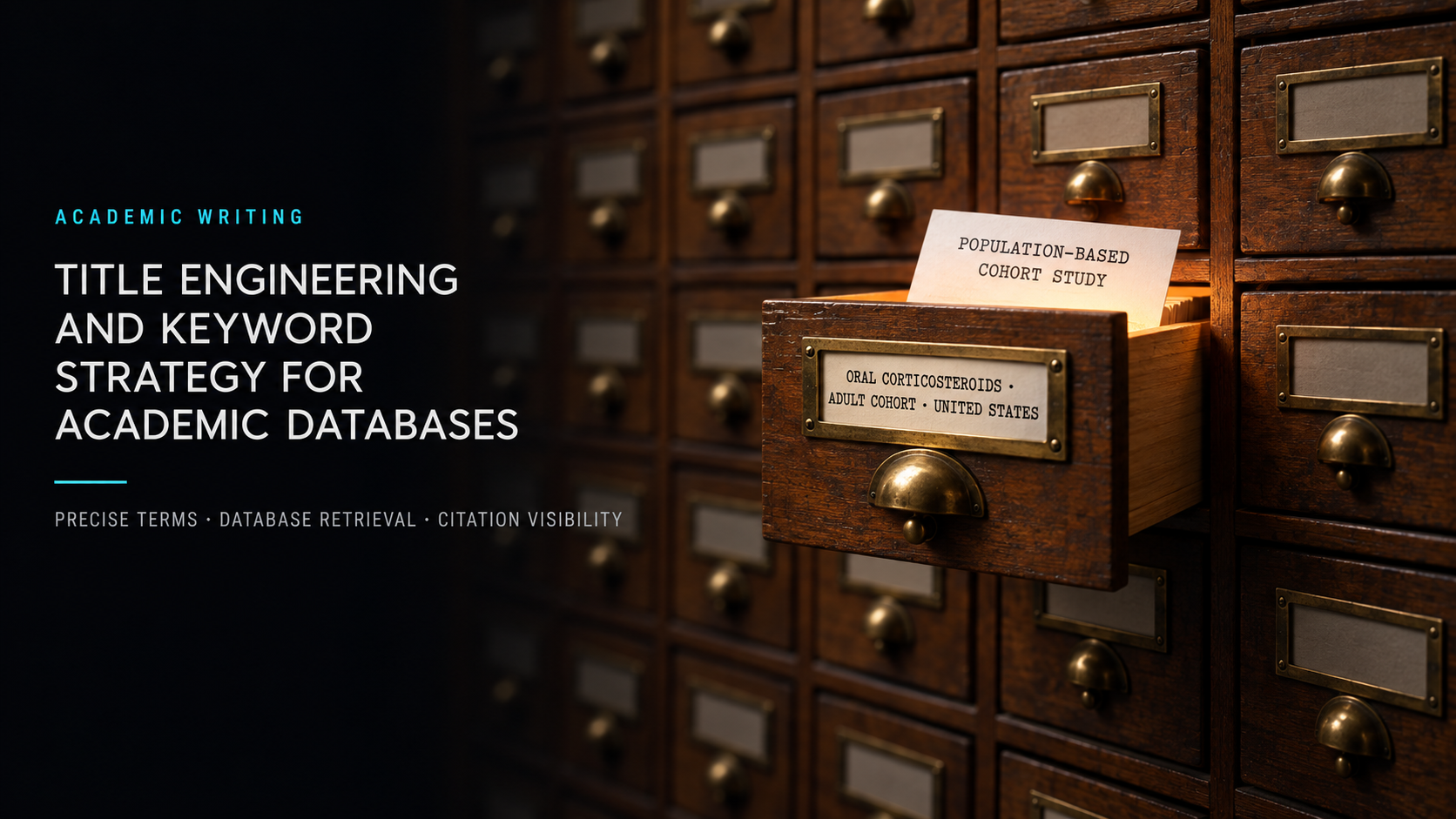
Two published titles reveal the stakes. Waljee and colleagues' “Short term use of oral corticosteroids and related harms among adults in the United States: population based cohort study” names the exposure, outcome frame, population, geography and design. Nearly every term changes retrieval or interpretation. By contrast, Yuri Lazebnik's “Can a biologist fix a radio? Or, what I learned while studying apoptosis” is memorable but weak for literal retrieval of its subject: the limits of informal explanatory models in systems biology. A celebrated paper can survive a cryptic title through reputation and circulation. Most papers cannot.
Authors should stop treating opacity as evidence of sophistication. A title is not the place to demonstrate how many abstractions a field can tolerate. Semantic precision is intellectual hospitality. Name the phenomenon in the language the field recognizes, add the population, material, method or setting when it changes meaning, and state a result only at the level of certainty the design can sustain.
How Should an Abstract Work as a Discovery Interface?
The abstract is neither a miniature introduction nor a suspense narrative. It is a structured discovery interface through which readers, reviewers and indexing systems decide what kind of object the paper is. A reader should be able to identify the problem, question, design, evidence, principal result and warranted implication without retrieving the full text.
Where journal conventions permit, the Background–Objective–Method–Results–Conclusion sequence provides a strong architecture. Background establishes the problem; Objective states the question; Method identifies design, sample, setting, measures and analysis; Results supplies the answer; Conclusion interprets it without exceeding it. Hartley rewrote 24 abstracts from the Journal of Educational Psychology in structured form and asked 48 academic authors to rate their clarity. The structured versions were longer but more informative, readable and clear. The study cannot settle every convention, yet it shows how structure prevents authors from describing importance while scarcely reporting evidence.
Semantic density is not terminological congestion. A dense abstract carries decision-relevant information: research object, design, scale, variables, result and boundary conditions. “Machine learning was used to investigate risk” is lexically modern but scientifically thin; naming the model class, dataset, outcome horizon and validation design creates epistemic value and searchable language.
At this stage, coherence concerns semantic fields rather than algorithms. The abstract should develop the conceptual territory opened by the title: established term, accepted synonym, narrower mechanism, broader domain and methodological descriptor. This calls for propositions rich enough that specialists and adjacent communities can recognize the work from their own vocabularies, not for stuffing variants into every sentence. A 2024 survey by Pottier and colleagues examined 5,323 studies from 230 ecology and evolutionary-biology journals and found that 92% used keywords that were redundant with terms already in the title or abstract. The statistic belongs to that disciplinary sample, not to science universally; its strategic meaning is that scarce keyword slots are often spent repeating access points the abstract already supplies.
Senior research leaders should regard this as portfolio infrastructure. Research offices can audit institutional outputs for missing designs, undefined acronyms, absent controlled terms, vague results and metadata discrepancies, while offering discipline-specific templates rather than one institutional dialect. Structured-abstract policies, librarian consultation and repository checks can scale discoverability across a research portfolio. The meaningful metric is not “SEO compliance,” but the proportion of outputs whose metadata accurately represents their content.
How Do You Engineer Keywords for Database Discoverability?
Keyword optimization for academic papers begins only after the abstract is stable, because keywords should extend an articulated semantic map rather than compensate for an empty one. Authors need canonical terms naming indispensable concepts, legitimate variants used by neighboring communities and controlled descriptors from a disciplinary thesaurus. Primary terms belong in the title or early abstract; secondary terms earn keyword space when they provide a genuinely different route into the paper.
In biomedicine, Medical Subject Headings provide MEDLINE's controlled vocabulary. All MEDLINE journals have been indexed through automated indexing since April 2022, and since 2024 that has been done with the neural MTIX system, which learns from titles, abstracts and previous MeSH assignments. Human indexers still conduct quality assurance and focused curation; the National Library of Medicine has said that roughly one-third of automatically indexed articles will also receive human curation. Authors cannot assign the final MeSH record, but they can give human and machine indexers unambiguous evidence in the title and abstract.
Scopus exposes title, abstract and keyword fields to fielded search, while Web of Science Topic searches include title, abstract, author keywords and Keywords Plus. Clarivate generates Keywords Plus terms from recurring words and phrases in the titles of cited references; a candidate must occur more than once in the bibliography. References therefore help form the paper's discoverability signature as well as its intellectual genealogy; thematic recurrence across cited titles can affect generated terms. Reference-list order is not documented as a ranking factor, so authors should not rearrange citations to game it. The responsible strategy is to cite the genuinely central literature comprehensively enough that the bibliography represents the field the paper actually enters. The same logic extends to where you publish: our piece on verifying a journal's indexing and Q1 claims explains why a record only helps if the venue behind it is genuinely indexed.
Classical latent semantic indexing reduced a term-document matrix into a lower-dimensional space, relating documents beyond exact word identity. Describing every modern database as “using LSI,” however, is technically lazy. Contemporary retrieval is better understood through four layers: BM25-style lexical matching; dense neural embeddings that connect semantically related expressions; citation-graph evidence about intellectual proximity and influence; and metadata-weighted ranking across fields such as title, abstract, author, venue, date and document type.
No outsider can specify every production weight, and the major platforms differ. Semantic Scholar's documented relevance endpoint uses an Elasticsearch index over titles, abstracts and author names, with metadata filters and optional sorting by citation count or publication date. Authors cannot control proprietary weights, personalization, citation accumulation or faulty metadata ingestion. They can control terminological precision, accepted variants, metadata accuracy and the truthful relationship between paper and references. Conceptual consistency works because lexical systems need recognizable terms, dense systems need coherent context, graph systems need defensible citation relationships and metadata systems need clean fields.
Why Do Title–Abstract Coherence and Ranking Go Together?
The title and abstract are not merely prose at different lengths, but coupled signals. Lexical systems observe term occurrence and proximity; embedding systems observe patterns distributed across the full title-abstract representation; graph systems situate that representation among cited and citing papers. When a title promises “causal effects,” an abstract reports only cross-sectional association, and the references belong mainly to another problem, the record is not merely stylistically untidy. It sends incompatible coordinates.
SPECTER makes this concrete. It builds scientific-document embeddings from title-abstract pairs and learns relatedness from the citation graph; on the SciDocs benchmark, it improved classification, recommendation and citation prediction. Such models place papers partly according to title-abstract geometry calibrated through citation relationships. Authors should therefore use central constructs consistently, cite the literature that defines them and avoid fashionable terminology unsupported by the methods and results. This is not writing for an algorithm; it is removing contradictions that mislead humans and machines.
Semantic coherence should not be confused with mechanical repetition. A paper on federated learning in multicentre radiology might use the canonical phrase in the title, define the privacy mechanism in the objective, name the imaging task and federation design in the method, and report diagnostic performance in the results. The meaning grows while the conceptual centre holds. By contrast, repeating “federated learning” eight times without specifying task, data distribution or privacy claim creates frequency without information.
Citation-prediction and recommendation systems do not infer future impact from wording alone. Content, authorship, venue, citation networks, publication time and later attention all matter. That is why the promise of guaranteed citation impact must finally be refused. Title engineering can improve entry into the candidate set; it cannot determine what readers do after entry. That is the boundary between communication strategy and bibliometric superstition.
A Practical Title Engineering Checklist
Begin with an evidence-to-title audit. Write down the paper's research object, population or system, design, principal relationship and strongest warranted conclusion, then compare each element with the proposed title. Remove any causal verb, scope claim or fashionable concept that the methods and results cannot carry.
Benchmark length rather than obeying a mythical universal number. Optimal title length is empirically contested and discipline-specific. Follow the target journal's submission rules first, then examine recent high-impact papers of the same article type in that journal to identify the prevailing informational density and syntax. If you have not settled on a journal yet, SciCampus Journal Finder and our guide to journal selection and desk rejection are a sensible place to start.
Design the abstract before finalizing the keywords. Confirm that Background, Objective, Method, Results and Conclusion each perform a distinct informational function, even when headings are not displayed. Place the central concept and research object early, report the actual result, and preserve uncertainty rather than converting statistical association into declarative certainty.
Use keyword slots to expand legitimate access routes. Retain canonical terms, add accepted synonyms or neighboring disciplinary language, and consult the relevant controlled vocabulary. In biomedical work, test candidate concepts in the MeSH Browser while remembering that final MEDLINE indexing is algorithmically assigned and selectively curated, not dictated by author keywords.
Conduct a title-abstract-reference coherence audit. Highlight the few concepts without which the paper would become a different study. Verify that the title names them, the abstract develops and evidences them, and the bibliography connects them to the correct intellectual lineage. A concept appearing only in the title is usually marketing; one buried only in the results is concealed knowledge.
Test the published object, not merely the manuscript. Run realistic searches in the databases used by the intended community, inspect neighboring results, and examine how publisher and repository records display the title, abstract, keywords, DOI and author identifiers. Correct metadata failures before they propagate across aggregators, because elegant prose cannot rescue a malformed or incomplete record.
Why Is Visibility a Scholarly Responsibility?
Research visibility is often reduced to professional advantage: more readers, stronger metrics, better rankings. That view is philosophically insufficient. Knowledge that cannot be discovered is not equivalent to knowledge that has entered the common intellectual world. It may exist as a document, yet remain absent from the chain of criticism, replication, synthesis and application through which science becomes more than privately held evidence.
What is lost when valid work remains undiscoverable? Not only citations. Meta-analyses become less complete; duplication consumes resources; policy rests on narrower evidence; researchers outside prestigious networks lose opportunities to alter a field's questions. Because ranking systems learn from prior attention and citation relationships, algorithmic mediation can turn yesterday's inequalities into tomorrow's recommendations. The archive remembers what the system has learned to notice.
Responsibility therefore extends beyond the author. Universities choose repositories, metadata standards, library staffing, incentives and evaluation systems. Leaders who demand impact while treating discoverability infrastructure as clerical overhead misunderstand influence. Institutions should maintain reliable metadata, accessible abstracts, persistent identifiers, controlled-vocabulary support and audits of their outputs across databases, while resisting superficial optimization that inflates claims or homogenizes language.
The ethical purpose of bibliometric discoverability is not to force every paper into prominence. Science needs filtering and unequal judgments of relevance. The purpose is to ensure that exclusion follows informed assessment rather than preventable opacity. A precise title is a promise about what evidence exists. A truthful abstract is an invitation to inspect it. A disciplined keyword strategy situates it among the conversations to which it belongs.
The guarantee worth making is narrower and more demanding than the title suggests. Researchers cannot guarantee citation, but they can avoid hiding their work through careless representation. Institutions cannot guarantee influence, but they can build conditions under which intellectual merit has a fairer opportunity to become visible. That conviction — that discoverability is a structural condition of scientific progress, not a marketing afterthought — runs through this series. In an epistemic economy increasingly governed by machines, making knowledge findable is part of making knowledge public.
References
Chatterjee A, Ghosh A, Chakrabarti BK. Universality of citation distributions for academic institutions and journals. PLOS ONE. 2016;11(1):e0146762. https://doi.org/10.1371/journal.pone.0146762
Jamali HR, Nikzad M. Article title type and its relation with the number of downloads and citations. Scientometrics. 2011;88(2):653–661. https://doi.org/10.1007/s11192-011-0412-z
Jacques TS, Sebire NJ. The impact of article titles on citation hits: an analysis of general and specialist medical journals. JRSM Short Reports. 2010;1(1):1–5. https://doi.org/10.1258/shorts.2009.100020
Alter AL, Oppenheimer DM. Uniting the tribes of fluency to form a metacognitive nation. Personality and Social Psychology Review. 2009;13(3):219–235. https://doi.org/10.1177/1088868309341564
Waljee AK, Rogers MAM, Lin P, Singal AG, Stein JD, Marks RM, Ayanian JZ, Nallamothu BK. Short term use of oral corticosteroids and related harms among adults in the United States: population based cohort study. BMJ. 2017;357:j1415. https://doi.org/10.1136/bmj.j1415
Lazebnik Y. Can a biologist fix a radio? Or, what I learned while studying apoptosis. Cancer Cell. 2002;2(3):179–182. https://doi.org/10.1016/S1535-6108(02)00133-2
Hartley J. Improving the clarity of journal abstracts in psychology: the case for structure. Science Communication. 2003;24(3):366–379. https://doi.org/10.1177/1075547002250301
Pottier P, Lagisz M, Burke S, Drobniak SM, Downing PA, Macartney EL, Martinig AR, Mizuno A, Morrison K, Pollo P, Ricolfi L, Tam J, Williams C, Yang Y, Nakagawa S. Title, abstract and keywords: a practical guide to maximize the visibility and impact of academic papers. Proceedings of the Royal Society B. 2024;291(2027):20241222. https://doi.org/10.1098/rspb.2024.1222
National Library of Medicine. MTIX: the next-generation algorithm for automated indexing of MEDLINE. NLM Technical Bulletin. 2024;(457):e4. https://www.nlm.nih.gov/pubs/techbull/ma24/ma24_mtix.html
Clarivate. Web of Science Core Collection full record details: Keywords Plus. https://webofscience.help.clarivate.com/en-us/Content/wos-core-collection/wos-full-record.htm
Cohan A, Feldman S, Beltagy I, Downey D, Weld DS. SPECTER: document-level representation learning using citation-informed transformers. In: Proceedings of the 58th Annual Meeting of the Association for Computational Linguistics. 2020:2270–2282. https://doi.org/10.18653/v1/2020.acl-main.207
Kinney R, Anastasiades C, Authur R, et al. The Semantic Scholar open data platform. arXiv preprint. 2023. https://doi.org/10.48550/arXiv.2301.10140
Related reading (topic ideas for future posts)
How to check whether your author keywords duplicate your title and abstract
A researcher's guide to MeSH terms and the MeSH Browser
What Keywords Plus is, and why your reference list shapes it
Auditing your institution's repository metadata for discoverability gaps