Short answer: to write a paper people can read, trust and use, start from the reason the research exists, build the literature review around your question, paraphrase only what you understand, write for a reader who was not in your lab, keep results and interpretation separate, and review sources before you submit. Clear writing cannot rescue weak research, but unclear writing can hide strong research.
Why isn't great research enough on its own?
Scientific work does not communicate itself. Other researchers can build on a study only if they can understand what was investigated, why, how the evidence was obtained and what it allows the authors to conclude. A paper must pass editorial and peer review, and after publication it still has to be read.
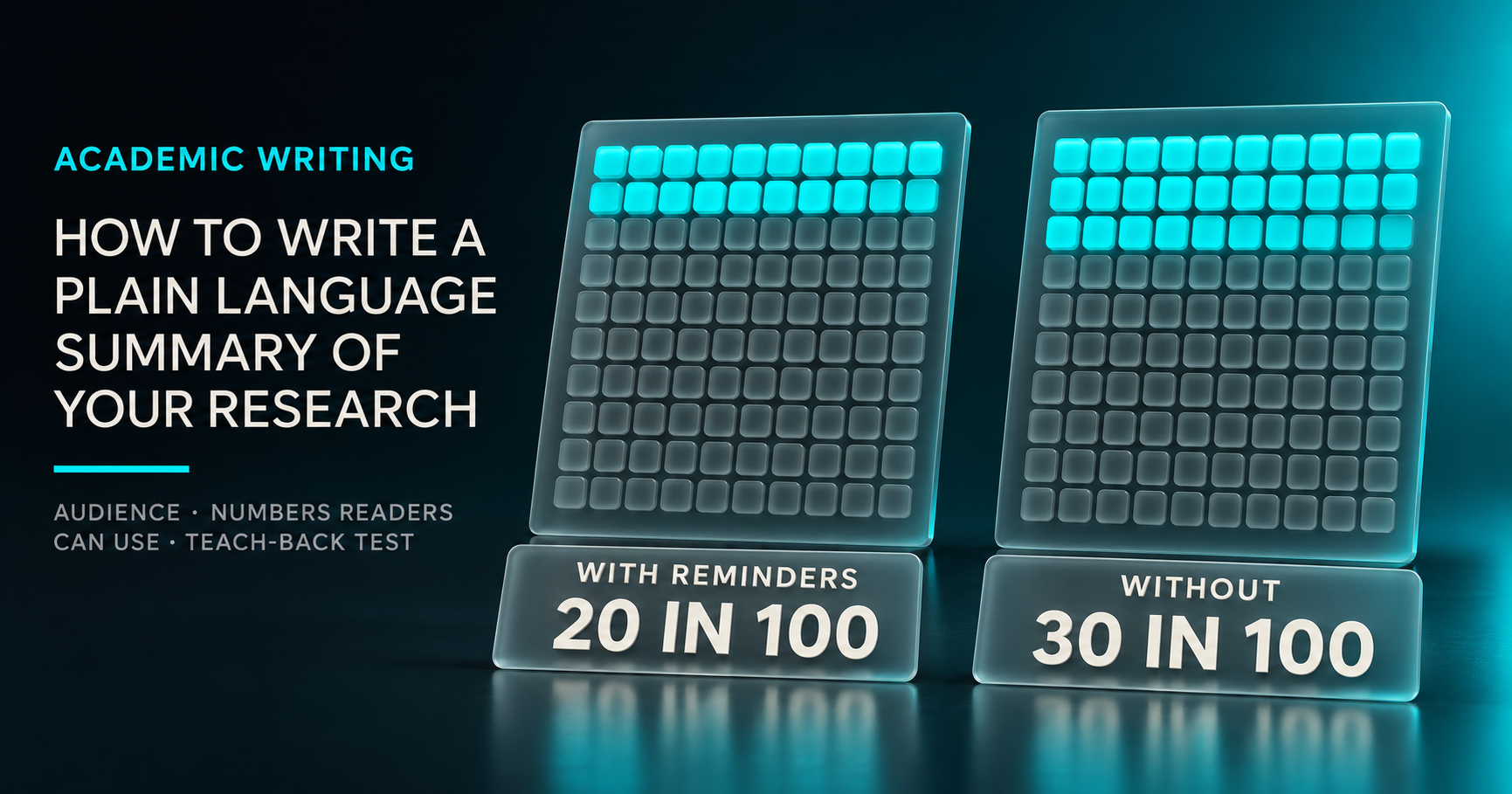
Experimental work supports the idea that presentation matters. In a randomised experiment, Ryba and colleagues (2021) rewrote real published abstracts into traditional and accessible versions. Among 170 undergraduate science students, the accessible versions were rated more readable (mean 66.3% versus 44.4%), produced somewhat more correct answers (57.9% versus 47.9%) and higher confidence in understanding. The effect on understanding was small, and the study tested abstracts, three topics and one student population, so it does not show the same result for every reader or for full papers.
The aim is not promotional writing. Doubleday and Connell (2017) argue that scientific writing can be objective and engaging while sensationalism and inaccuracy remain unacceptable. The practical question is: how can I make the real value of this research visible without changing, exaggerating or oversimplifying what it says?
How do you start with why the research exists?
A strong manuscript begins as a relationship between a problem and a reason for investigating it. Writing a research plan forces you to specify what will be investigated and why, and to connect a particular problem to a larger scientific question (Gordon, 2007). Knowing a topic is not the same as knowing where your project sits within it, so the literature has to be understood well enough to see how major studies relate to each other and to yours.
That structure later becomes your Introduction: context, then an unresolved problem, then why it matters, then what this study does about it (Turabian, 2018).
Originality should be stated realistically. A new population, a different method or a careful replication can all add something useful. Instead of making every study sound revolutionary, show precisely what this study contributes. For the full paper structure, see our scientific writing roadmap.
How should the literature review lead somewhere?
A literature review is more than a list of publications. It gives a critical account of existing knowledge and locates your work within it (Blaxter, Hughes & Tight, 2010). The sources support the argument; they do not become the argument.
Instead of asking "how many papers should I include?", ask: what does the reader need to understand from these papers before my research question becomes clear? Sources can then play different roles:
Role of the sourceWhat it does for the readerSeveral studies agreeEstablish an accepted findingStudies disagreeReveal inconsistent evidenceA methodological paperShows why earlier results need cautionA recent close studyBrings the reader to your exact question
Return to the relevant literature in the Discussion, so it keeps a role after the Introduction. At sentence level, attach each reference to the claim it supports. Scientific-writing guidance warns that several statements may stand before one citation although the source supports only the last (Laake, Benestad & Olsen, 2007).
What makes good paraphrasing?
Paraphrasing is not replacing individual words. Chicago-style guidance distinguishes genuine paraphrase from wording so close that readers can follow parallel words and phrases in the original (Turabian, 2018). One recommended method is to read the passage, look away, think about the meaning, write the idea in your own words, and only then compare it with the source. Qualifications must survive: a shorter sentence should not make the source sound stronger. Our guide to semantic drift in paraphrasing shows how meaning slips during rewriting.
How do you write for someone who did not do the research with you?
You know why a variable was chosen and why an experiment was repeated. Your reader does not. Scientific-writing guidance stresses knowing your audience: what they know, need and can reasonably be expected to understand (Laake et al., 2007; Gordon, 2007). Ask "what does the reader need at this point?" rather than "what information do I have?"
After what is known, show what is unresolved.
After the unresolved problem, show why it matters.
After the method, show what it produced.
After the findings, show what they mean.
This flow comes from the relationship between ideas, not from decorative transition words.
Can a scientific paper have a narrative without exaggeration?
Yes. In this context "narrative" means connecting ideas so the reader can follow them, not manufacturing suspense. Doubleday and Connell (2017) describe the preferable model as one combining accuracy and objectivity with writing that is concise, clear and accessible. The evidence carries the contribution; the writing helps the reader see it.
Distinguish necessary scientific complexity from unnecessary linguistic complexity. A statistical model may need technical explanation, and removing necessary detail makes a paper less accurate. But very long sentences can bury the central meaning, and paragraphs should develop one related subject and move toward the next (Blaxter et al., 2010). Use specialist terms when precision needs them, and simpler words when they say exactly the same thing.
Why should you write early and revise often?
Writing tests an argument. A relationship between two ideas may need an assumption you never stated, a conclusion may look stronger beside its evidence, and two sections may turn out to make one point. Phillips and Johnson (2022) advise researchers not to leave all writing until the end, since drafts, notes and critiques can be written during the research itself.
Two practical checks:
Let the draft cool. Reread the Introduction, the opening of each section and the Conclusion, then try to explain the paper's argument to someone who has not read it (Turabian, 2018). If it does not hold together, the organisation needs work.
Get outside readers. Colleagues from neighbouring specialities may notice unclear logic you cannot see (Laake et al., 2007).
How do you write an Introduction, Abstract and Title that work?
The Introduction needs enough information for the study to make sense, without becoming a history of the field. Use four connected elements: context → unresolved question → significance → claim or purpose (Turabian, 2018). When the gap is already familiar to your audience, less background is needed.
Many readers see only the title and abstract before deciding whether to continue. The abstract should be understandable without the full paper and move from the problem to the approach, the most reliable results and a conclusion; titles should be specific and informative rather than vague (Laake et al., 2007). See our guides to the four-function abstract and title and keyword strategy.
What is the difference between Results and Discussion?
Results
Question it answers: What did you find?
What belongs there: Findings in logical order, with measures of uncertainty; patterns highlighted without repeating every number in tables
Discussion
Question it answers: What do the findings mean?
What belongs there: Interpretation, alternative explanations, reliability, comparison with earlier studies, generalisability, uncertainties, future research
Keeping them separate lets readers see where evidence ends and interpretation begins (Laake et al., 2007). For more, read our guides to writing Methods and Results without overclaiming and interpreting findings in the Discussion.
How are research integrity and writing connected?
A manuscript represents how research was conducted, what was found, which ideas came from others and how confidently the evidence can be interpreted. Research-ethics literature discusses fabrication, misleading treatment of results, false descriptions of methods, plagiarism, authorship problems and duplicate publication as practices that damage the scientific record (Laake et al., 2007). Plagiarism can involve a whole work or smaller passages copied directly or only slightly altered.
At sentence level, problems arise when a source is cited but exact wording is not marked as quotation, when a paraphrase stays so close that the source can be followed almost word for word, or when an idea or method is used without acknowledgement (Turabian, 2018).
Where does a similarity check fit in revision?
After a literature review or Discussion built on many sources, it is hard to remember which phrases developed naturally and which stayed close to the papers you read. The SciCampus Similarity Check compares your text with published academic sources and shows where passages overlap. It runs as part of an AI Detector analysis, so you do not submit a second document. It reports an overall similarity percentage and a matched percentage, lists the primary sources with match percentages, and lets you open the matched passages and source links. It searches published sources and does not search a private repository of student papers.
Use it late, once sources, quotations and interpretations are visible in context:
Start with an important match.
Open the associated source and read the passage in context.
Return to the manuscript and decide what the relationship means.
What you findLikely actionAppropriately paraphrased and cited passageNo changeStandard methodological phraseMay legitimately stay similarQuotationConfirm it is marked and referencedSource-dependent sentence with no citationAdd the citationVery close paraphraseRewrite more independently
Limits matter. Coverage depends on what each source makes accessible, a similarity score alone does not establish plagiarism, and a lack of matches does not establish that a passage is original. The report supports your judgement; it does not replace it. The goal is not a lower number but a clear, defensible relationship between your paper and its sources.
What should you check before you submit?
Revise from large questions to small ones.
Does the Introduction establish the problem the paper actually addresses, and does the literature lead toward it?
Can the main claim be identified, and do all major sections serve the same argument?
Does the Conclusion represent the paper that was actually written?
Does each reference support the statement attached to it?
Are quotations identified and paraphrases independent, with the source's meaning preserved?
Do the conclusions stay within what the evidence supports?
Have you reviewed important similarity matches against their sources?
Have you checked references, terminology, figures, tables and journal formatting?
Good scientific writing cannot create evidence that was never collected or justify a conclusion the data do not support. Its role is more precise: it makes the question visible, shows why it matters, organises earlier research around it, presents evidence that can be inspected, separates findings from interpretation and credits the work you depend on.
Related reading
The Scientific Writing Roadmap: From a Research Idea to a Clear, Credible IMRAD Manuscript
The Funnel Formula: How to Structure an Introduction and Actually Find Your Research Gap
References
Blaxter, L., Hughes, C. & Tight, M. (2010). How to research. McGraw-Hill Education (UK).
Doubleday, Z. A. & Connell, S. D. (2017). Publishing with objective charisma: breaking science's paradox. Trends in Ecology & Evolution, 32(11), 803–805. doi:10.1016/j.tree.2017.06.011
Gordon, J. C. (2007). Planning research: a concise guide for the environmental and natural resource sciences. Yale University Press.
Laake, P., Benestad, H. B. & Olsen, B. R. (Eds.) (2007). Research methodology in the medical and biological sciences. Academic Press.
Phillips, E. & Johnson, C. (2022). How to get a PhD: a handbook for students and their supervisors (7th ed.). McGraw-Hill Education (UK).
Ryba, R., Doubleday, Z. A., Dry, M. J., Semmler, C. & Connell, S. D. (2021). Better writing in scientific publications builds reader confidence and understanding. Frontiers in Psychology, 12, 714321. frontiersin.org
Turabian, K. L. (2018). A manual for writers of research papers, theses, and dissertations (9th ed.). University of Chicago Press.
SciCampus. Similarity Check.