A SciCampus editorial for researchers, research leaders, and journal editors.
The decisive question facing a manuscript in 2026 is no longer simply whether an author used generative AI. It is whether the research team can show, clearly and credibly, what the tool did, what the humans checked, and how the scholarly record remained under human control. For editors balancing speed, fairness, confidentiality, and scientific accountability, that shift is redefining what responsible submission looks like.
Across major publishers, the direction of travel is remarkably consistent: routine language assistance may be tolerated, but substantive AI involvement must be transparent, reproducible where relevant, and owned by accountable authors. The result is a new traceability standard — one that turns documentation, source verification, and human review into practical conditions of publication rather than optional ethics rhetoric.
The 2026 traceability standard
Publisher policies increasingly regulate AI by function rather than by a fixed percentage of machine-generated text. The relevant questions are whether AI materially changed content, analysis, structure, code, imagery, or judgment; whether confidential content left a controlled environment; and whether the named authors can defend every element of the final work.
Nature Portfolio: declare meaningful use, retain accountability
Nature Portfolio permits generative AI to assist with writing and editing, but expects authors to disclose its use in the Methods section when it has been used to generate or improve manuscript content. The policy preserves a non-negotiable principle: AI tools cannot be authors, because they cannot take responsibility for a paper. It also prohibits the uploading of confidential manuscripts to generative-AI tools during peer review.1
Elsevier: the declaration is now part of submission discipline
Elsevier's August 2026 update makes the disclosure process more explicit. Authors are expected to submit a separate AI declaration that identifies the tool, explains the purpose of use, and confirms human review, editing, and full author responsibility. The policy distinguishes basic spelling and grammar checks from more substantive intervention. If AI changes structure or content, or supports research design, methods, collection, analysis, or interpretation, authors should disclose the use and describe it reproducibly in the Methods section. AI-generated or AI-edited images require additional transparency, and primary research images may not be fabricated or altered by AI.2
IEEE: name the system and identify the affected content
IEEE requires disclosure of AI-generated content — including text, figures, images, and code — in the acknowledgments. Authors should identify the system used, the sections affected, and the extent of the assistance. IEEE also cautions authors to verify AI-generated results and not allow editing tools to change reference lists. Its peer-review guidance treats the use of public AI platforms to process manuscript information as a confidentiality breach.3
Cell Press: visible declaration, protected review
Cell Press similarly requires an in-manuscript declaration before the references when generative AI has been used in scientific writing. Authors must name the tool, state its purpose, confirm review and editing, and accept responsibility for the published content. Its guidance also restricts reviewers and editors from using generative-AI services to evaluate manuscripts, reinforcing that peer review is both an intellectual and a confidentiality obligation.4
What these policies do not create is a defensible universal "20% AI" rule. The leading policies examined here do not make compliance turn on a numerical share of AI-written prose. They turn on the nature, materiality, transparency, and verification of the use. A single undisclosed AI-generated Methods paragraph, fabricated citation, or altered research image can be more consequential than extensive, declared language support.
Integrity risks, false positives, and the impact on ESL scholars
The central integrity risk is not a detector score by itself. It is the loss of an accountable evidence trail: an AI-generated citation that no one checked, a data interpretation that no researcher can reconstruct, a manipulated image, or a peer review produced after confidential material was exposed to a public model.
For authors, non-compliance can trigger editorial queries, delayed screening, requests for correction, rejection, or a research-integrity investigation — especially where the issue involves inaccurate references, hidden substantive assistance, image manipulation, plagiarism, or confidentiality. The named authors remain responsible for the article even when an AI system drafted the language.
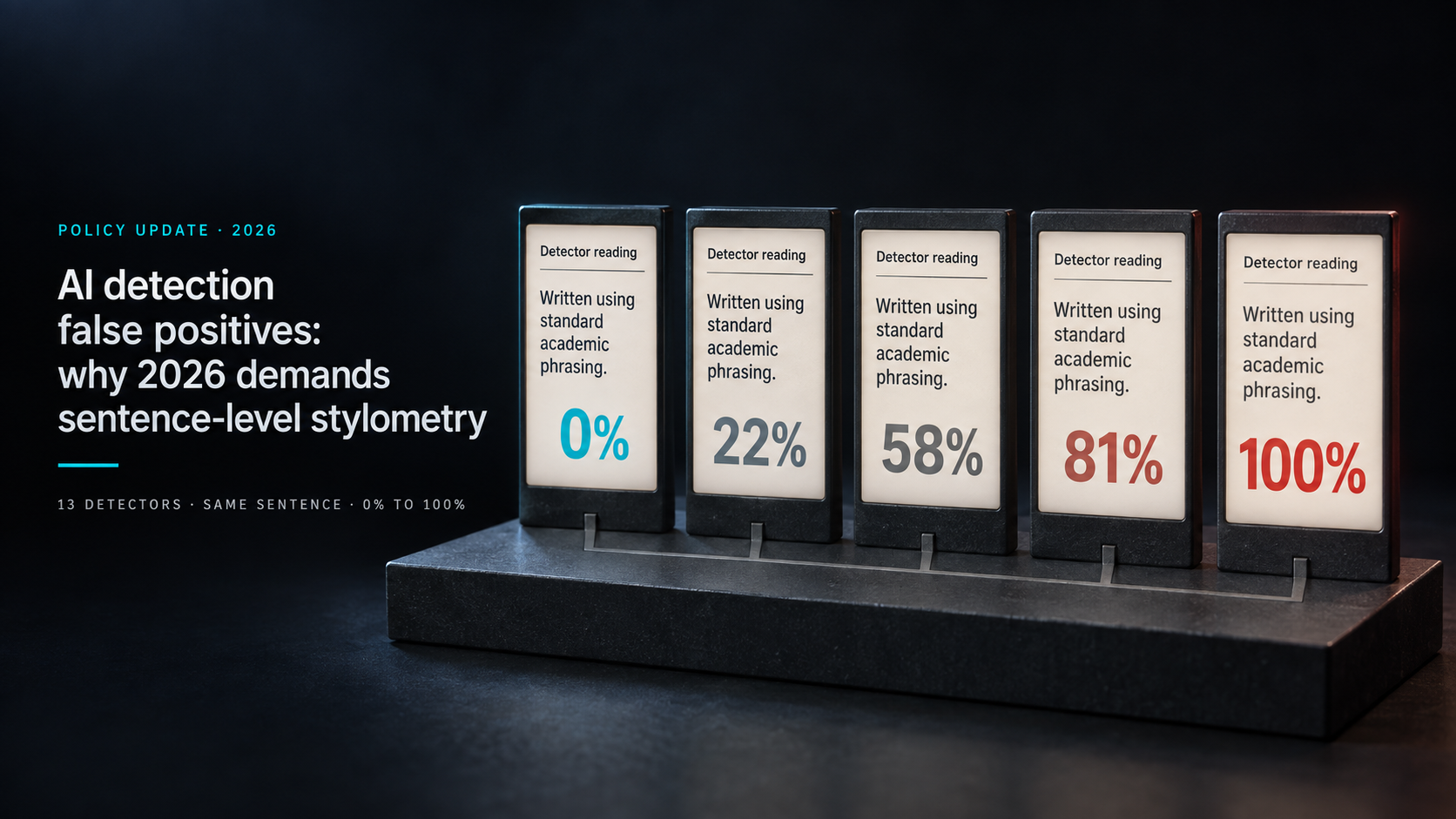
Detection tools create a second, more subtle risk: false confidence. Nature reported in July 2026 on independent testing of AI-detection services such as Pangram and GPTZero, finding that while these tools generally flag human-written content as human, no detector is perfect and results vary by technique and text type.5 That is a meaningful warning against using a single automated score as proof of misconduct.
The equity implication is acute for ESL/EFL scholars. Formal, conventional, or highly polished academic language can attract suspicion when a detector is used without context. Fair review requires a layered assessment: discuss the result with the author, inspect drafting and revision history where appropriate, verify sources and methods, and evaluate a documented AI-use statement. Detection should inform human editorial review — not replace it. For a practical framework researchers can use before submission, see our guide on why single aggregate AI scores fail.
Institutional governance and the EU AI Act
Publisher policies govern what enters the scholarly record. Universities and research institutions must manage the wider path that leads to that submission: how AI tools are procured, where data are processed, how student and researcher information is protected, and when research requires ethics review. This is where editorial compliance connects directly to institutional governance.
The EU AI Act is frequently described as if it regulates every use of AI in a research setting. The position is more precise. Article 2(6) excludes AI systems and models, including their outputs, that are specifically developed and put into service solely for scientific research and development. The Act's recitals emphasize that it should support innovation and respect freedom of science.6
That research-and-development exclusion does not eliminate other responsibilities. A university still needs to consider data protection, contractual terms, intellectual property, information security, institutional policy, and the ethics of deploying AI in real-world processes. The compliance landscape becomes more demanding when an AI tool touches identifiable participant data, assists recruitment or eligibility decisions, contributes to analysis, or influences decisions that affect people.
For IRBs and research-ethics committees, the practical question is therefore not whether an LLM corrected prose. It is whether AI changed the study's risk profile, handled sensitive data, influenced participant-facing decisions, or generated inferences that require methodological scrutiny. For journal editors, the parallel question is whether the manuscript makes those uses visible enough for scientific claims to be evaluated and reproduced.
Five-step pre-submission compliance checklist
Map every AI touchpoint. Record the tool, version where available, date of use, purpose, and manuscript component affected — such as drafting, language editing, coding, literature synthesis, figure preparation, analysis, or interpretation.
Classify the use by materiality. Distinguish proofreading from AI that changed claims, argument structure, methods, code, figures, or scientific interpretation. If the distinction is uncertain, disclose the use.
Verify the scholarly record. Check every citation against the original source and DOI. Validate quotations, numerical values, tables, code, figure labels, data transformations, and claims. Never regard an AI-generated reference as verified merely because it appears plausible.
Apply the target journal's exact rule. Use the required declaration location and wording — Methods, acknowledgments, a dedicated statement, or a submission-form declaration. Check the destination journal's current author guidance immediately before submission.
Protect confidential and sensitive material. Do not upload unpublished manuscripts, reviewer files, participant data, or protected datasets into public AI tools. Confirm the tool's privacy, retention, security, and intellectual-property terms before use.
Building an evidence framework
In this environment, a pre-submission compliance and evidence layer is most useful not as a way to evade detection, but as a way to identify where a manuscript needs more human review, stronger source validation, or a clearer declaration before it reaches an editor.
SciCampus's AI Detector provides sentence-level probability bands — ≥99%, ≥96%, and ≥93% — alongside a dual-score stylometry view that distinguishes raw AI-generated signals from AI-paraphrased signals. Used responsibly, these signals guide an author toward passages that deserve inspection, redrafting, or disclosure. They should not be treated as a final verdict on authorship; responsible editorial decisions require context and human judgment.
SciCampus's DOI-linked similarity checks add a different form of assurance. They enable authors and editors to connect similarity findings to identifiable scholarly sources, inspect potential overlap, and verify that citations point to real, relevant research. Downloadable PDF evidence reports can then document the review process for supervisors, editorial teams, or research-integrity offices.
The Journal Finder strengthens the workflow before submission by helping researchers compare suitable outlets across quartiles, SJR, and other bibliometric and peer-review indicators. That makes it easier to identify a credible target journal early, then align the manuscript's AI declaration and evidence package with that journal's requirements. For a full walkthrough of that process, see our guide on choosing the right Q1/Q2 journal.
The objective is not to "prove" human authorship through a detector. No standalone score can do that reliably. The stronger evidence framework combines transparent declarations, accountable human review, DOI-level source checking, accurate journal targeting, and a documented pre-submission audit trail.
Build your evidence trail before you submit. SciCampus is free to start — no card required. Review sentence-level stylometry, DOI-linked similarity, and journal fit in one workflow. Create a free account.
Frequently asked questions
Do publisher AI policies set a maximum percentage of AI-written text?
No. None of the major publisher policies reviewed here — Nature Portfolio, Elsevier, IEEE, or Cell Press — define compliance by a numerical share of AI-generated prose. They assess whether the use was material, whether it was disclosed, and whether human authors verified and take responsibility for the result.
Does the EU AI Act regulate AI tools used in academic research?
Article 2(6) excludes AI systems developed and used solely for scientific research and development from the Act's scope. This does not remove other obligations — data protection, confidentiality, and institutional ethics review still apply, particularly when a tool touches identifiable participant data or influences decisions that affect people.
Can an AI detector prove that a paper wasn't written by AI?
No detection tool can reliably prove authorship in either direction. Independent testing has found meaningful variation in accuracy and false-positive rates across detection services. A detector result is evidence to investigate, not a standalone verdict.
What should a research team disclose if AI only helped with grammar?
Most major publishers, including Nature Portfolio and Elsevier, distinguish basic language and grammar correction from substantive content generation, and generally do not require disclosure for the former. Confirm the exact threshold in your target journal's current author guidance, since practices differ.
References
Nature Portfolio. "Using AI responsibly in scientific publishing." Nature Methods 23, 271 (2026). https://doi.org/10.1038/s41592-026-03020-1
Elsevier. "Updated generative AI policies for journals: supporting responsible use while protecting trust." Elsevier Connect, 18 August 2026. elsevier.com/connect
IEEE Author Center. "Submission and Peer Review Policies." Accessed 3 September 2026. journals.ieeeauthorcenter.ieee.org
Cell Press. "Information for authors: The Innovation." Accessed 3 September 2026. cell.com/the-innovation/authors
McKie, A. "Universities are relying on AI-detection software to catch cheating. How well do the programs work?" Nature 655, 535–537 (2026). https://doi.org/10.1038/d41586-026-01358-2
European Union. Regulation (EU) 2024/1689 (Artificial Intelligence Act), Article 2(6). Official Journal of the European Union. eur-lex.europa.eu