Short answer: Methods should record what investigators planned and did, in enough detail to trace every decision. Results should report what followed—counts, estimates and uncertainty—without causal, mechanistic or evaluative language the analysis cannot support. Interpretation belongs in the Discussion, where assumptions and limits are stated openly.
What Does Overclaiming Look Like in a Results Section?
Consider a hypothetical manuscript reporting an observational study of environmental exposure and respiratory disease. The Methods identify the cohort, exposure model, exclusions, covariates and sensitivity analyses. The Results show that participants with greater exposure had a higher estimated risk. Then one sentence changes the paper’s evidentiary status:
“These findings demonstrate that the exposure damages the lungs by activating an inflammatory pathway.”
The study may establish an association. Unless its design and assumptions support causal identification, it does not show that the exposure produced the outcome, and unless the pathway was measured, it does not establish a mechanism. One sentence has converted an estimate into a causal and mechanistic conclusion.
A reviewer must now ask whether the language reflects the analysis or whether the analysis was built after the pattern appeared. Was the mechanism prespecified? A local wording problem can expose a deeper uncertainty about how the authors classified their own evidence, and the loss of confidence may extend well beyond the offending sentence.
Why Should Methods, Results and Discussion Stay Separate?
Methods describe what investigators planned and did, Results report what followed, and Discussion examines meaning, alternative explanations, limitations and generalizability. This structure lets readers trace each conclusion to an analysis and each analysis to a documented decision. (“Methods” is the appropriate section name; “methodology” more properly refers to the study and justification of methods.) If you are still mapping the whole manuscript, start with the IMRAD roadmap for scientific writing.
The International Committee of Medical Journal Editors (ICMJE) places information available when a study was planned in Methods, observations obtained during the study in Results, and interpretation in Discussion (ICMJE, n.d.). The APA Journal Article Reporting Standards apply the same traceability principle to quantitative, qualitative and mixed-methods research (Appelbaum et al., 2018; Levitt et al., 2018).
The separation also protects exploratory work. An analysis may be valuable even when conceived after the data were examined, but its status must remain visible. Three practices erode that visibility:
HARKing (hypothesizing after the results are known) presents a result-informed hypothesis as though it preceded the analysis (Kerr, 1998).
Selective reporting hides outcomes or analytical paths that produced less favorable findings (Chan et al., 2004).
P-hacking varies exclusions, outcomes, stopping rules or models and reports the combinations that yield small p-values (Head et al., 2015; Simmons et al., 2011).
Preregistration helps distinguish prediction from postdiction, though it cannot replace sound design or honest disclosure of deviations (Nosek et al., 2018). Registered Reports go further by reviewing the question and Methods before results are known and offering in-principle acceptance based on methodological merit (Chambers & Tzavella, 2022).
How Do You Write a Reproducible Methods Section?
A reproducible Methods section lets a qualified reader understand the design, assess its vulnerabilities, and repeat the procedures or analysis when access permits. Reproducibility concerns decision provenance as much as technical detail.
Publisher-level resources set broad expectations, but the target journal’s instructions control. Elsevier, Springer Nature, Wiley and Taylor & Francis maintain general author or editorial resources, yet journals within a portfolio can differ (Elsevier, n.d.; Springer Nature, n.d.; Taylor & Francis, n.d.; Wiley, n.d.). Nature Portfolio requires a data-availability statement in original research articles, and relevant journals use a reporting summary for design and analysis information (Nature Portfolio, n.d.). Before drafting, shortlist your target journals with the SciCampus Journal Finder and read each one’s author instructions.
Which Decisions Must Methods Make Visible?
Study population and setting. Identify the population, material or data source; recruitment or sampling route; setting and dates; eligibility rules; interventions or exposures; outcomes; covariates; instruments; thresholds; and time points.
Sample-size reasoning. Report the power or precision objective and its assumptions (anticipated effect, variance, error rates, attrition). If the achieved sample differed from the plan, explain why.
Exclusions and preprocessing. State each exclusion rule, when it was applied, how many observations it removed, and whether the decision preceded inspection of the relevant outcomes. For computational and image-based work, document preprocessing, normalization, augmentation, segmentation, quality thresholds and manual interventions.
Bias controls. Describe randomization, allocation concealment, blinding, controls, replication, calibration, and procedures for detecting contamination or batch effects. When full blinding was impossible, identify what remained masked.
Measurement validity. Explain whether instruments and operational definitions were validated for the population and purpose. Reliability alone does not show that a measure captures the intended construct.
Statistical analysis. Define the estimand, model, covariates, missing-data strategy, multiplicity control, assumptions, sensitivity analyses and subgroup rules. Report software, versions, parameters and random seeds when they could affect the result.
Protocol changes. Link the protocol, registration record and analysis plan. Date amendments, explain them, disclose whether outcome data were available, and distinguish prespecified from exploratory analyses.
Ethics and governance. Report ethics approval, consent or waiver, biosafety oversight, funding, competing interests, permissions and access restrictions.
Data, code and materials. State what is available, where it can be found, and under what conditions it may be accessed. The FAIR principles encourage research objects that are findable, accessible under stated conditions, interoperable and reusable (Wilkinson et al., 2016).
Image adjustment must not obscure or manufacture information, and original files should remain available.
How Should AI Use Be Disclosed in Methods?
The ICMJE states that AI tools cannot qualify as authors and that human authors remain responsible for the work. Relevant use should be disclosed in the cover letter and in the manuscript section where it applies; use involving data, analysis or figures belongs in Methods (ICMJE, n.d.). A useful disclosure names the tool, the purpose and the human verification. For a broader view of acceptable practice, see our guide to AI academic writing ethics and the 2026 traceability standard in journal AI policies.
Which Reporting Guideline Fits Your Study?
Choose the checklist that matches your design, then confirm that your target journal accepts or requires it.
Study typeReporting guidelineSourceRandomized trialsCONSORT 2025Hopewell et al., 2025Trial protocolsSPIRIT 2025Chan et al., 2025Observational epidemiologySTROBEvon Elm et al., 2007Systematic reviewsPRISMA 2020Page et al., 2021Animal experimentsARRIVE 2.0Percie du Sert et al., 2020Diagnostic-accuracy studiesSTARDBossuyt et al., 2015Prediction models (regression or machine learning)TRIPOD+AICollins et al., 2024Economic evaluationsCHEERS 2022Husereau et al., 2022Case reportsCAREGagnier et al., 2014Interviews and focus groupsCOREQTong et al., 2007Qualitative research (broader range of approaches)SRQRO’Brien et al., 2014
Qualitative evidence is interpreted during analysis, so reflexivity and the route from transcript to theme are part of transparent reporting.
Outside clinical research, the Materials Design Analysis Reporting (MDAR) framework addresses materials, design, analysis and reporting in the life sciences (Macleod et al., 2021). The Transparency and Openness Promotion (TOP) Guidelines provide modular transparency standards for empirical research across disciplines (Nosek et al., 2015). Research Resource Identifiers (RRIDs) help identify reagents, organisms, software and other resources whose names or catalog descriptions may be ambiguous (Bandrowski et al., 2016).
Field-specific expectations add to these frameworks:
Engineering and materials science: material provenance, synthesis conditions, specimen preparation, calibration and failure criteria.
Physics: detector configuration, uncertainty propagation and selection criteria.
Ecology: spatial and temporal sampling, effort and detection probability.
Machine learning: data provenance, train-validation-test separation, leakage controls, hyperparameter search, random seeds, compute resources, baselines, ablations and variability across runs.
How Should Results Be Reported Without Advocacy?
Begin with participant, specimen, record or sample flow: how many units were screened, excluded, assigned, measured and analyzed, with reasons at each stage. A flow diagram helps when attrition or exclusions occur at several points.
Next, describe the analytic sample and missingness: missing values by variable and group, which observations entered each analysis, and whether estimates came from complete cases, imputation, weighting or another procedure. A claim that data were missing at random should explain the assumption and its role.
Primary outcomes should generally precede secondary, subgroup, sensitivity and exploratory results, and exploratory analyses should be labeled where they occur. Negative and inconclusive findings deserve the same numerical reporting as favorable ones; omitting them from the narrative creates selective emphasis even when a value survives in a supplement.
ICMJE recommends reporting absolute numbers alongside percentages (ICMJE, n.d.). CONSORT 2025 asks trial authors to report group-level results, effect estimates and precision, and STROBE calls for unadjusted and adjusted estimates with the adjustment variables identified (Hopewell et al., 2025; von Elm et al., 2007).
Results can state that 42 observations were excluded under a prespecified quality threshold; Discussion should consider whether that limits generalizability. Likewise, Results can report an adjusted association, while Discussion addresses residual confounding, mechanism and transfer to other settings.
Why Report Effect Sizes and Uncertainty, Not Just p-Values?
A p-value does not provide effect magnitude, practical importance, or the range of estimates reasonably compatible with the model. Statistical significance also does not prove that an effect is real, important or reproducible (Greenland et al., 2016; Wasserstein & Lazar, 2016).
Consider an illustrative comparison using hypothetical numbers:
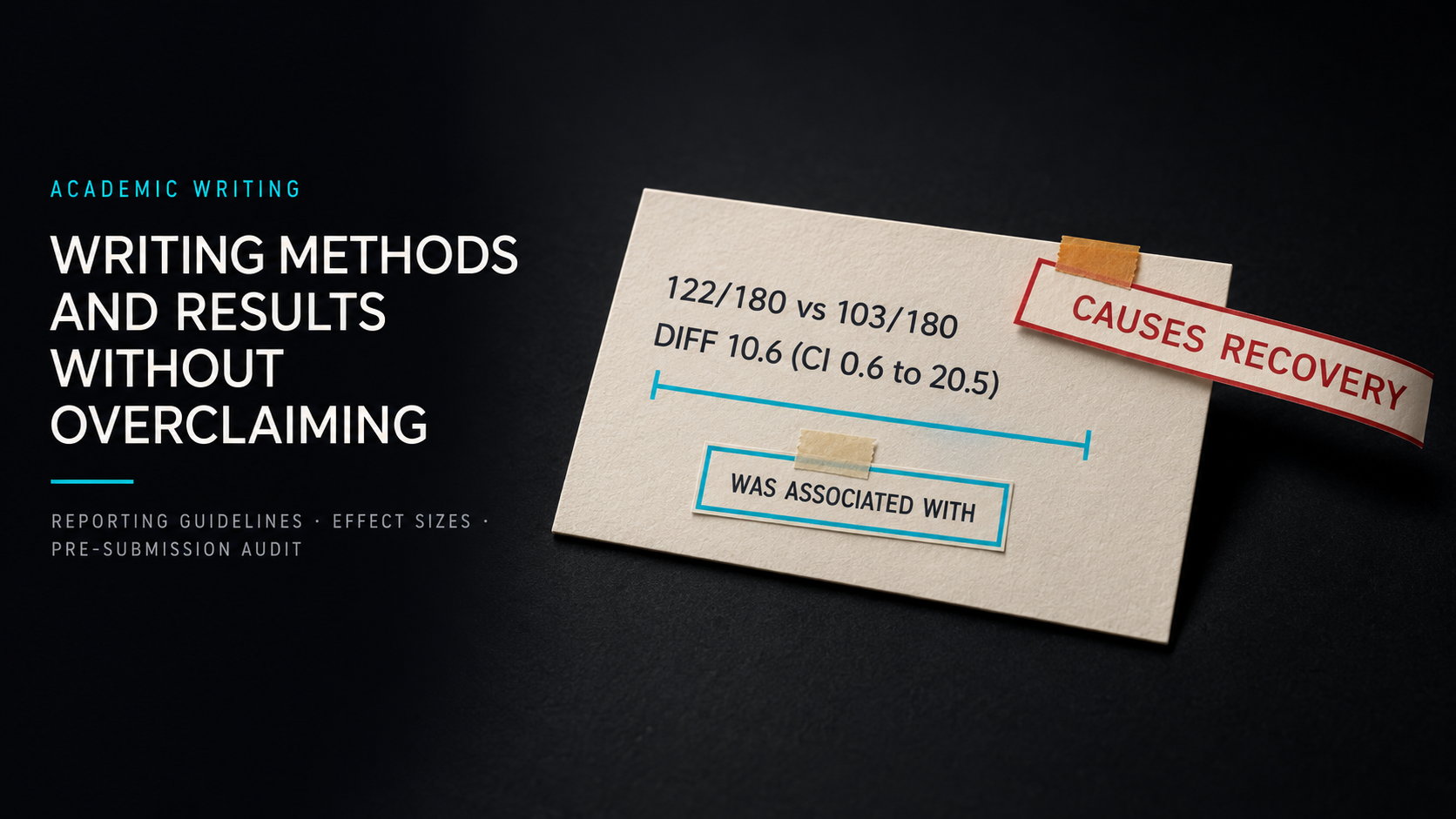
“Recovery occurred in 122 of 180 participants in the intervention group and 103 of 180 in the comparator group: 67.8% versus 57.2%, a risk difference of 10.6 percentage points (unpooled Wald 95% CI, 0.6 to 20.5; Pearson chi-square p = .039).”
The sentence reports denominators, event counts, absolute effect, uncertainty and the test, so readers can judge whether estimates near either limit would support different decisions. Saying only that recovery “significantly improved” does not allow that judgment.
Use “was associated with” when the analysis estimates an association. Reserve “caused,” “led to” and “prevented” for designs and analyses that justify causal claims. Observational data are not automatically excluded from causal inference, but the claim must match an explicit causal estimand and defensible assumptions (Hernán, 2018).
How Should Figures and Tables Be Handled?
A figure should reveal a distribution, trajectory, model fit or comparison that prose cannot show efficiently, without hiding distributions or influential observations. Captions should state denominators, units, transformations, uncertainty measures, adjustments and exclusions.
Tables should preserve values that readers may need to inspect or reuse, while the text identifies the principal observation without reciting every cell.
Where Does Data Reporting End and Interpretation Begin?
The boundary can be clear at paragraph level and blurred within a sentence. As a practical heuristic, ask:
Can the substantive claim be verified from the reported data and the analyses as labeled, whether prespecified or exploratory?
If the sentence requires an unmeasured mechanism, value judgment, causal assumption, comparison with outside literature or recommendation, interpretation has begun. The test guides editorial judgment rather than imposing a universal prohibition.
What Do Five Neutral Rewrites Look Like?
The numbers in these examples are hypothetical and were constructed for illustration.
Clinical outcome
Interpretive (avoid in Results): “The treatment produced a clinically meaningful improvement in fatigue.”
Neutral (report this): “Among 100 participants per group, mean fatigue scores decreased by 6.2 points in the treatment group and 2.1 points in the comparator group; the adjusted between-group difference was −4.1 points (95% CI, −6.0 to −2.2).”
What changed: Removes the unsupported judgment “clinically meaningful,” which requires a defensible threshold or external criterion.
Materials science
Interpretive (avoid in Results): “The new curing process substantially strengthened the composite.”
Neutral (report this): “Across 30 specimens per condition, mean tensile strength was 412 MPa with the new curing process and 389 MPa with the standard process, a mean difference of 23 MPa (95% CI, 8 to 38).”
What changed: Reports the property, units, sample size, difference and uncertainty.
Prespecified subgroup
Interpretive (avoid in Results): “The program was ineffective in older participants because adherence was poor.”
Neutral (report this): “In the prespecified subgroup aged 65 years or older, completion occurred in 45 of 78 program participants and 39 of 75 controls, a risk difference of 5.7 percentage points (95% Wald CI, −10.1 to 21.4); the treatment-by-age interaction test gave p = .64.”
What changed: The original asserts both absence of effect and an adherence mechanism; the revision reports the imprecise estimate and interaction test without explaining it.
Machine learning
Interpretive (avoid in Results): “The new architecture clearly outperformed the baseline and should replace it.”
Neutral (report this): “On the held-out test set of 2,000 records, the new architecture achieved an area under the receiver operating characteristic curve (AUROC) of 0.842 versus 0.831 for the baseline; the paired bootstrap difference was 0.011 (95% CI, −0.004 to 0.026).”
What changed: The interval includes no difference, and deployment would also require evidence on calibration, external validation, fairness and cost.
Ecology
Interpretive (avoid in Results): “Habitat restoration caused biodiversity to recover.”
Neutral (report this): “Mean species richness was 18.6 across 42 restored sites and 16.9 across 39 unrestored sites; the adjusted mean difference was 1.7 species (95% CI, 0.3 to 3.1).”
What changed: Reports the observed contrast; causal interpretation depends on assignment, site selection and confounding control.
Can Results and Discussion Be Combined?
A combined Results and Discussion section may be appropriate when the target journal permits it or when iterative interpretation is integral to the research form. Publisher ownership alone does not establish acceptability, so authors should consult the journal’s instructions.
Even then, each unit should preserve a recognizable sequence: result, evidentiary qualification, interpretation and connection to prior work. Qualitative findings often combine themes with interpretation because themes are analytical constructions.
Roth et al. (2023) offer an example of documented qualitative procedures: they interviewed 21 nurses who were state-qualified in Germany, used purposive sampling supplemented by snowball sampling, analyzed transcripts with qualitative content analysis, and reported following COREQ.
What Do Real Cases Teach About Reporting?
Which Trials Report Their Evidence Transparently?
SPRINT reported 243 primary composite events among 4,678 participants assigned to intensive treatment and 319 among 4,683 assigned to standard treatment. These counts let readers inspect the event evidence before considering clinical implications (SPRINT Research Group, 2015).
In RECOVERY, dexamethasone’s estimated effect differed by respiratory-support category. Among participants receiving no respiratory support at randomization, the rate ratio for 28-day mortality was 1.19 (95% CI, 0.91 to 1.55). The point estimate lies above 1 and the interval is wide, so this subgroup result cannot be summarized as a simple null (RECOVERY Collaborative Group, 2021).
ACTT-1 originally specified clinical status on day 15, measured on an eight-category ordinal scale, as its primary endpoint. It changed the endpoint to time to recovery and retained the former endpoint as a key secondary outcome. The change was proposed on March 22, 2020, after 72 participants had enrolled, by statisticians who were unaware of treatment assignments. It was finalized on April 2, and the data and safety monitoring board reviewed results on April 27 (Beigel et al., 2020). The dated, disclosed sequence is what makes the change auditable.
Roth et al. (2023), described above, likewise show how documented sampling and analysis procedures let readers examine how a qualitative interpretation was produced.
What Happens When Reporting Is Disputed?
Study 329 randomized adolescents with major depression to eight weeks of paroxetine, imipramine or placebo. An independent reanalysis, part of the BMJ’s Restoring Invisible and Abandoned Trials initiative, found no statistically or clinically significant benefit over placebo on any prespecified primary or secondary efficacy outcome. It also found increased harms, including suicidal ideation and behavior with paroxetine (Le Noury et al., 2015). The reanalysts reported that the original 2001 publication introduced new outcome measures, conflated primary and secondary outcomes, and downplayed a nonsignificant difference on a primary outcome. A BMJ article by Doshi (2015) noted that the original paper had not been corrected or retracted at that time.
The PACE trial is a second, more contested case. Its 2011 report named fatigue and physical-function scores as the primary outcomes (White et al., 2011). A published reanalysis reported that cognitive behavioral therapy and graded exercise therapy did not significantly outperform the control group after the reanalysts corrected for the number of comparisons specified in the trial protocol, and that protocol-defined recovery rates were low and did not differ significantly across groups (Wilshire et al., 2018). The PACE investigators responded that the reanalysis gave no reason to change the trial’s conclusions (Sharpe et al., 2019). Presenting both publications keeps the disagreement visible.
How Common Are Spin and Selective Reporting?
Chan et al. (2004) compared trial protocols with publications and documented selective outcome reporting. Boutron et al. (2010) found spin in reports of randomized trials whose primary outcomes were statistically nonsignificant.
Olarte Parra et al. (2021) examined abstracts from 60 eligible observational studies published in The BMJ in 2018. Twelve abstracts, or 20%, were classified as inconsistent in their causal language; 11 of those 12, or 92%, were already inconsistent at submission. The sample came from one journal, and the authors stated that it could not estimate prevalence more broadly.
What If the Underlying Data Are Unreliable?
Reporting discipline cannot rescue unreliable underlying data. An ivermectin meta-analysis (Hill et al., 2021) included a study posted as a preprint on Research Square. That study was withdrawn because of fraudulent data, according to contemporaneous integrity reporting (Retraction Watch, 2021).
The original meta-analysis was subsequently retracted (Hill, Garratt, et al., 2022). A replacement analysis concluded that the apparent survival benefit depended largely on poor-quality studies (Hill, Mirchandani, et al., 2022). Problems in primary evidence can propagate into synthesis.
Journals rely on guidance from the Committee on Publication Ethics (COPE) when deciding whether a defective article warrants retraction. COPE updated its retraction guidelines in 2025; they set out when a retraction should be considered and sit alongside separate guidance on expressions of concern (COPE, 2025). For the wider integrity picture, see our analysis of journal indexing risks in 2026.
What Should You Check Before Submitting?
Use this self-audit as a final gate:
Can a reader reconstruct sampling, exclusions, attrition and the final analytic population?
Does the sample-size justification state its assumptions, and are deviations explained?
Are protocol amendments, outcome changes and altered analysis decisions dated and justified?
Are randomization, blinding, controls, measurement validity and calibration reported where relevant?
Does the analysis identify its estimand, missing-data strategy, multiplicity approach, assumptions and sensitivity tests?
Are confirmatory, subgroup and exploratory analyses labeled consistently in the text, displays, abstract and supplement?
Do all named primary and secondary outcomes appear, including unfavorable, negative and statistically inconclusive results?
Are software, versions, code, random seeds, RRIDs and data-access conditions specific enough to support reuse?
Do effect estimates include denominators, units and uncertainty intervals rather than relying on significance labels?
Can each substantive Results claim be verified from the reported data and the analyses as labeled?
Do captions explain exclusions, transformations, uncertainty and adjustments without forcing readers to search the prose?
Do the manuscript, protocol, registration, analysis plan, repository and abstract tell the same methodological story?
Then run the technical checks in our 10-minute pre-submission audit, and pair the abstract with the Results using the four-function abstract model. Free-to-start checks are available: try the SciCampus AI Detector or the Similarity checker on your draft—no card required.
How Can Labs and Institutions Make This Routine?
For research directors and department heads, separating observation from interpretation is a governance responsibility. A manuscript that blurs the boundary may signal weak protocol control, analysis provenance, supervision or incentives. Correction at the end of a project is expensive and may arrive after questionable claims have shaped decisions.
Institutions can intervene earlier:
Build reporting-guideline selection into study initiation.
Before submission, require a protocol-to-manuscript reconciliation that accounts for every outcome, exclusion, amendment and exploratory analysis.
Add an internal review gate in which one reviewer examines reproducibility and another marks causal, mechanistic and evaluative claims that exceed the reported evidence.
Begin training with early-career researchers and include senior investigators; rewriting real Results sentences in short exercises often teaches more than lectures on style.
Expect preregistration when appropriate, with Registered Reports considered for confirmatory questions.
A laboratory-level AI policy is also necessary: permitted uses, a ban on entering confidential information into unauthorized systems, human verification, preserved records when AI affects analysis, and disclosure expectations. AI-assisted prose must never conceal an undocumented analytical choice or introduce an unverified citation. Our manuscript integrity SOP for multi-author labs shows how to put such rules into practice.
Two indicators make the policy measurable: the share of submissions accompanied by a completed, design-appropriate reporting checklist, and the share that pass internal reconciliation without unexplained outcome or analysis changes.
Conclusion
Methods should expose the decisions that generated the evidence, Results should present that evidence precisely enough to inspect, and interpretation can then proceed openly, with assumptions and limits in view. If language polishing is part of your workflow, keep it to style: the SciCampus AI Humanizer can help with tone, but every number, estimate and claim still needs human verification against your analysis.
References
Appelbaum, M., Cooper, H., Kline, R. B., Mayo-Wilson, E., Nezu, A. M., & Rao, S. M. (2018). Journal article reporting standards for quantitative research in psychology: The APA Publications and Communications Board task force report. American Psychologist, 73(1), 3–25. https://doi.org/10.1037/amp0000191
Bandrowski, A., Brush, M., Grethe, J. S., Haendel, M. A., Kennedy, D. N., Hill, S., Hof, P. R., Martone, M. E., Pols, M., Tan, S., Washington, N., Zudilova-Seinstra, E., & Vasilevsky, N. (2016). The Resource Identification Initiative: A cultural shift in publishing. F1000Research, 4, 134. https://doi.org/10.12688/f1000research.6555.2
Beigel, J. H., Tomashek, K. M., Dodd, L. E., Mehta, A. K., Zingman, B. S., Kalil, A. C., Hohmann, E., Chu, H. Y., Luetkemeyer, A., Kline, S., Lopez de Castilla, D., Finberg, R. W., Dierberg, K., Tapson, V., Hsieh, L., Patterson, T. F., Paredes, R., Sweeney, D. A., Short, W. R., … Lane, H. C. (2020). Remdesivir for the treatment of COVID-19—Final report. The New England Journal of Medicine, 383(19), 1813–1826. https://doi.org/10.1056/NEJMoa2007764
Bossuyt, P. M., Reitsma, J. B., Bruns, D. E., Gatsonis, C. A., Glasziou, P. P., Irwig, L., Lijmer, J. G., Moher, D., Rennie, D., de Vet, H. C. W., Kressel, H. Y., Rifai, N., Golub, R. M., Altman, D. G., Hooft, L., Korevaar, D. A., & Cohen, J. F. (2015). STARD 2015: An updated list of essential items for reporting diagnostic accuracy studies. BMJ, 351, h5527. https://doi.org/10.1136/bmj.h5527
Boutron, I., Dutton, S., Ravaud, P., & Altman, D. G. (2010). Reporting and interpretation of randomized controlled trials with statistically nonsignificant results for primary outcomes. JAMA, 303(20), 2058–2064. https://doi.org/10.1001/jama.2010.651
Chambers, C. D., & Tzavella, L. (2022). The past, present and future of Registered Reports. Nature Human Behaviour, 6, 29–42. https://doi.org/10.1038/s41562-021-01193-7
Chan, A.-W., et al. (2025). SPIRIT 2025 statement: Updated guideline for protocols of randomized trials. Nature Medicine. https://doi.org/10.1038/s41591-025-03668-w
Chan, A.-W., Hróbjartsson, A., Haahr, M. T., Gøtzsche, P. C., & Altman, D. G. (2004). Empirical evidence for selective reporting of outcomes in randomized trials. JAMA, 291(20), 2457–2465. https://doi.org/10.1001/jama.291.20.2457
Collins, G. S., et al. (2024). TRIPOD+AI statement: Updated guidance for reporting clinical prediction models that use regression or machine learning methods. BMJ, 385, e078378. https://doi.org/10.1136/bmj-2023-078378
Committee on Publication Ethics. (2025). Retraction guidelines. https://publicationethics.org/guidance/guideline/retraction-guidelines
Doshi, P. (2015). No correction, no retraction, no apology, no comment: Paroxetine trial reanalysis raises questions about institutional responsibility. BMJ, 351, h4629. https://doi.org/10.1136/bmj.h4629
Elsevier. (n.d.). Policies and guidelines for authors. https://www.elsevier.com/researcher/author/policies-and-guidelines
Gagnier, J. J., Kienle, G., Altman, D. G., Moher, D., Sox, H., & Riley, D. (2014). The CARE guidelines: Consensus-based clinical case reporting guideline development. Journal of Clinical Epidemiology, 67(1), 46–51. https://doi.org/10.1016/j.jclinepi.2013.08.003
Greenland, S., Senn, S. J., Rothman, K. J., Carlin, J. B., Poole, C., Goodman, S. N., & Altman, D. G. (2016). Statistical tests, P values, confidence intervals, and power: A guide to misinterpretations. European Journal of Epidemiology, 31, 337–350. https://doi.org/10.1007/s10654-016-0149-3
Head, M. L., Holman, L., Lanfear, R., Kahn, A. T., & Jennions, M. D. (2015). The extent and consequences of p-hacking in science. PLoS Biology, 13(3), e1002106. https://doi.org/10.1371/journal.pbio.1002106
Hernán, M. A. (2018). The C-word: Scientific euphemisms do not improve causal inference from observational data. American Journal of Public Health, 108(5), 616–619. https://doi.org/10.2105/AJPH.2018.304337
Hill, A., Garratt, A., Levi, J., Falconer, J., Ellis, L., McCann, K., Pilkington, V., Qavi, A., Wang, J., & Wentzel, H. (2021). Meta-analysis of randomized trials of ivermectin to treat SARS-CoV-2 infection. Open Forum Infectious Diseases, 8(11), ofab358. https://doi.org/10.1093/ofid/ofab358
Hill, A., Garratt, A., Levi, J., Falconer, J., Ellis, L., McCann, K., Pilkington, V., Qavi, A., Wang, J., & Wentzel, H. (2022). Retraction to: Meta-analysis of randomized trials of ivermectin to treat SARS-CoV-2 infection. Open Forum Infectious Diseases, 9(3), ofac056. https://doi.org/10.1093/ofid/ofac056
Hill, A., Mirchandani, M., & Pilkington, V. (2022). Ivermectin for COVID-19: Addressing potential bias and medical fraud. Open Forum Infectious Diseases, 9(2), ofab645. https://doi.org/10.1093/ofid/ofab645
Hopewell, S., et al. (2025). CONSORT 2025 statement: Updated guideline for reporting randomised trials. BMJ, 389, e081123. https://doi.org/10.1136/bmj-2024-081123
Husereau, D., et al. (2022). Consolidated Health Economic Evaluation Reporting Standards 2022 statement. BMJ, 376, e067975. https://doi.org/10.1136/bmj-2021-067975
International Committee of Medical Journal Editors. (n.d.). Recommendations for the conduct, reporting, editing, and publication of scholarly work in medical journals. https://www.icmje.org/recommendations/
Kerr, N. L. (1998). HARKing: Hypothesizing after the results are known. Personality and Social Psychology Review, 2(3), 196–217. https://doi.org/10.1207/S15327957PSPR0203_4
Le Noury, J., Nardo, J. M., Healy, D., Jureidini, J., Raven, M., Tufanaru, C., & Abi-Jaoude, E. (2015). Restoring Study 329: Efficacy and harms of paroxetine and imipramine in treatment of major depression in adolescence. BMJ, 351, h4320. https://doi.org/10.1136/bmj.h4320
Levitt, H. M., Bamberg, M., Creswell, J. W., Frost, D. M., Josselson, R., & Suárez-Orozco, C. (2018). Journal article reporting standards for qualitative primary, qualitative meta-analytic, and mixed methods research in psychology. American Psychologist, 73(1), 26–46. https://doi.org/10.1037/amp0000151
Macleod, M., et al. (2021). The MDAR framework for transparent reporting in the life sciences. Proceedings of the National Academy of Sciences, 118(17), e2103238118. https://doi.org/10.1073/pnas.2103238118
Nature Portfolio. (n.d.). Reporting standards and availability of data, materials, code and protocols. https://www.nature.com/nature-portfolio/editorial-policies/reporting-standards
Nosek, B. A., Alter, G., Banks, G. C., Borsboom, D., Bowman, S. D., Breckler, S. J., Buck, S., Chambers, C. D., Chin, G., Christensen, G., Contestabile, M., Dafoe, A., Eich, E., Freese, J., Glennerster, R., Goroff, D., Green, D. P., Hesse, B., Humphreys, M., … Yarkoni, T. (2015). Promoting an open research culture. Science, 348(6242), 1422–1425. https://doi.org/10.1126/science.aab2374
Nosek, B. A., Ebersole, C. R., DeHaven, A. C., & Mellor, D. T. (2018). The preregistration revolution. Proceedings of the National Academy of Sciences, 115(11), 2600–2606. https://doi.org/10.1073/pnas.1708274114
O’Brien, B. C., Harris, I. B., Beckman, T. J., Reed, D. A., & Cook, D. A. (2014). Standards for reporting qualitative research. Academic Medicine, 89(9), 1245–1251. https://doi.org/10.1097/ACM.0000000000000388
Olarte Parra, C., Bertizzolo, L., Schroter, S., Dechartres, A., & Goetghebeur, E. (2021). Consistency of causal claims in observational studies: A review of papers published in a general medical journal. BMJ Open, 11(5), e043339. https://doi.org/10.1136/bmjopen-2020-043339
Page, M. J., et al. (2021). The PRISMA 2020 statement: An updated guideline for reporting systematic reviews. BMJ, 372, n71. https://doi.org/10.1136/bmj.n71
Percie du Sert, N., et al. (2020). The ARRIVE guidelines 2.0: Updated guidelines for reporting animal research. PLoS Biology, 18(7), e3000410. https://doi.org/10.1371/journal.pbio.3000410
RECOVERY Collaborative Group. (2021). Dexamethasone in hospitalized patients with COVID-19. The New England Journal of Medicine, 384(8), 693–704. https://doi.org/10.1056/NEJMoa2021436
Retraction Watch. (2021, August 10). Ivermectin meta-analysis to be retracted, revised, say authors. https://retractionwatch.com/2021/08/10/ivermectin-meta-analysis-to-be-retracted-revised-say-authors/
Roth, C., Breckner, A., Wensing, M., Mahler, C., Krug, K., & Berger, S. (2023). Barriers and enabling factors for workplace integration of internationally qualified nurses: A qualitative study of perceptions of German nurses. Nursing Open, 10(8), 5225–5235. https://doi.org/10.1002/nop2.1760
Sharpe, M., Goldsmith, K. A., & Chalder, T. (2019). The PACE trial of treatments for chronic fatigue syndrome: A response to Wilshire et al. BMC Psychology, 7, 15. https://doi.org/10.1186/s40359-019-0288-x
Simmons, J. P., Nelson, L. D., & Simonsohn, U. (2011). False-positive psychology: Undisclosed flexibility in data collection and analysis allows presenting anything as significant. Psychological Science, 22(11), 1359–1366. https://doi.org/10.1177/0956797611417632
Springer Nature. (n.d.). Editorial policies. https://www.springernature.com/gp/policies/editorial-policies
SPRINT Research Group. (2015). A randomized trial of intensive versus standard blood-pressure control. The New England Journal of Medicine, 373(22), 2103–2116. https://doi.org/10.1056/NEJMoa1511939
Taylor & Francis. (n.d.). Writing your paper. https://authorservices.taylorandfrancis.com/publishing-your-research/writing-your-paper/
Tong, A., Sainsbury, P., & Craig, J. (2007). Consolidated criteria for reporting qualitative research: A 32-item checklist for interviews and focus groups. International Journal for Quality in Health Care, 19(6), 349–357. https://doi.org/10.1093/intqhc/mzm042
von Elm, E., Altman, D. G., Egger, M., Pocock, S. J., Gøtzsche, P. C., & Vandenbroucke, J. P. (2007). The Strengthening the Reporting of Observational Studies in Epidemiology statement. PLoS Medicine, 4(10), e296. https://doi.org/10.1371/journal.pmed.0040296
Wasserstein, R. L., & Lazar, N. A. (2016). The ASA statement on p-values: Context, process, and purpose. The American Statistician, 70(2), 129–133. https://doi.org/10.1080/00031305.2016.1154108
White, P. D., Goldsmith, K. A., Johnson, A. L., Potts, L., Walwyn, R., DeCesare, J. C., Baber, H. L., Burgess, M., Clark, L. V., Cox, D. L., Bavinton, J., Angus, B. J., Murphy, G., Murphy, M., O’Dowd, H., Wilks, D., McCrone, P., Chalder, T., & Sharpe, M. (2011). Comparison of adaptive pacing therapy, cognitive behaviour therapy, graded exercise therapy, and specialist medical care for chronic fatigue syndrome (PACE): A randomised trial. The Lancet, 377(9768), 823–836. https://doi.org/10.1016/S0140-6736(11)60096-2
Wiley. (n.d.). Preparing your manuscript. https://authorservices.wiley.com/author-resources/Journal-Authors/Prepare/index.html
Wilkinson, M. D., et al. (2016). The FAIR Guiding Principles for scientific data management and stewardship. Scientific Data, 3, 160018. https://doi.org/10.1038/sdata.2016.18
Wilshire, C. E., Kindlon, T., Courtney, R., Matthees, A., Tuller, D., Geraghty, K., & Levin, B. (2018). Rethinking the treatment of chronic fatigue syndrome—A reanalysis and evaluation of findings from a recent major trial of graded exercise and CBT. BMC Psychology, 6, 6. https://doi.org/10.1186/s40359-018-0218-3