Short answer: The Discussion section turns reported results into interpretation. To keep it defensible, state what the findings show, test the preferred explanation against realistic alternatives, let uncertainty and limitations narrow the claim, and make every implication no broader than the evidence supports.
A research paper can report its results accurately and still reach an indefensible conclusion. The problem often appears in small transitions. An observed association becomes an effect. A plausible mechanism becomes the explanation. Evidence from one institution becomes a recommendation for an entire sector. A statistically nonsignificant result becomes proof that nothing happened. None of these shifts may look dramatic on its own, yet together they can carry the argument beyond what the study supports.
Authors must interpret their findings, compare them with previous evidence, consider alternative explanations, acknowledge consequential limitations and explain why the study matters. The challenge is to do this without making the claim broader, more causal, more certain or more general than the evidence permits.
What Is the Hidden Decision Inside a Discussion Section?
The Results establish the reported empirical record. The Discussion determines what that record permits the reader to infer. Publisher and university guidance commonly assigns interpretation, comparison with previous research, limitations and implications to the Discussion (Springer Nature, n.d.; UNC Writing Center, n.d.). Listing those elements, however, does not tell an author how strongly each one may be stated.
Imagine a study reporting that patients who received automated appointment reminders attended more scheduled visits than patients receiving usual communication. The observed difference does not determine the conclusion by itself.
If patients were randomly assigned, the design may support an estimate of the effect of assignment to the reminder system under the trial conditions. That interpretation still depends on adherence, missing data, interference between participants, measurement quality and the analysis used.
If clinics chose whether to implement the system, differences in staffing, patient populations, scheduling practices or baseline attendance may also explain the association.
The numerical difference could be identical in both studies. The warranted interpretation would not be.
Our guide to scientific writing and IMRaD structure explains the wider functions of the manuscript sections. The narrower task here is to determine how far the Discussion may take a result before the argument exceeds its evidentiary support. If you are still working on the preceding section, start with writing Methods and Results without overclaiming.
Where Does a Finding Become an Interpretation?
A Discussion should begin from the research question and principal result, but interpretation requires more than restatement. It connects an analytical result to a defensible scientific claim. Consider this illustrative hypothetical trial:
Patients assigned to automated reminders attended more scheduled appointments over six months than patients assigned to usual communication. Under the study conditions, the analysis supports an effect of offering the reminder system on recorded attendance.
The sentence identifies the comparison, outcome, direction and scope. It does not claim that reminders work in every clinic, that they improved attendance by increasing motivation, or that greater attendance led to better health. Those are progressively broader propositions, each requiring additional evidence.
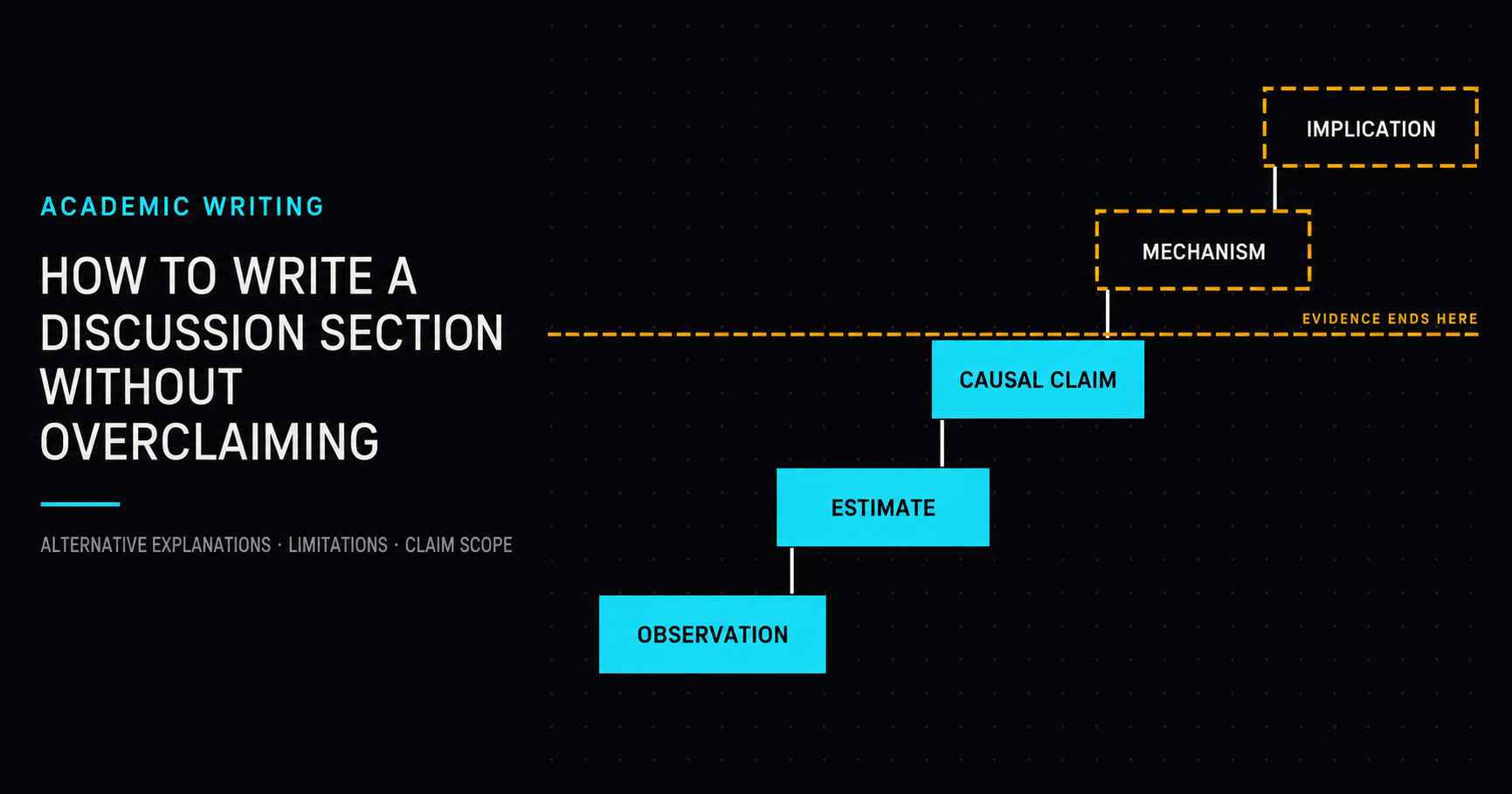
Which Levels of Reasoning Are Hidden in One Result?
Observation
Statement in the reminder example: The study observed a difference in recorded attendance between the assigned groups.
What it requires: Accurate measurement and reporting.
Estimate
Statement in the reminder example: The analysis estimated the difference associated with assignment to the reminder system.
What it requires: A defined estimand and appropriate analysis.
Causal interpretation
Statement in the reminder example: The randomized design may support a causal interpretation for the effect of assignment.
What it requires: The study’s assumptions and implementation hold.
Mechanism
Statement in the reminder example: Reduced forgetting is a plausible explanation.
What it requires: Suitable measurement, temporal ordering and an analysis addressing alternative pathways.
Implication
Statement in the reminder example: Adoption in similar clinics is a possible practical implication.
What it requires: Evidence on cost, feasibility, harms and applicability.
These statements are connected, but they are not interchangeable. The outcome difference does not establish the mechanism. Even if forgetting was measured, showing that it changed would not automatically prove that it mediated the attendance effect.
Operationalization also matters. If the study measures “engagement” through portal logins, the reported results concern login behavior as defined by that measurement system. They do not establish every broader meaning that the word engagement might carry.
Qualitative interpretation has comparable boundaries. A recurring theme is an analytical interpretation produced through a particular sampling, data-generation and coding process. Claims about credibility and transferability should reflect the context, researcher–participant relationships, analytical decisions and reflexive account of the research process (O’Brien et al., 2014).
Interpretation must therefore be anchored in the research question and constrained by the study design and analysis. Precise language can reveal those constraints. It cannot compensate for weak measurement or unsupported inference.
How Do You Test an Interpretation Against Alternatives?
An explanation becomes more persuasive when it survives realistic alternatives. The aim is not to catalogue every conceivable weakness. Concentrate on alternatives that could materially alter the direction, magnitude, mechanism, certainty or scope of the conclusion.
Return to the reminder study. If it was nonrandomized, patients who enrolled in the reminder program might already have been more likely to attend. Clinics using the system might have had better administrative support. Attendance could also have changed because of a simultaneous scheduling reform. Those possibilities change whether the observed difference can reasonably be attributed to the reminder system.
Replacing “the system increased attendance” with “the system was associated with attendance” avoids one unsupported causal statement, but it does not resolve the inferential problem. If the research aim is causal, the Discussion should identify the intended causal contrast and discuss the assumptions that connect the analysis to it.
Hernán (2018) argues that avoiding causal words while retaining a causal objective can obscure rather than improve causal reasoning. In an observational study, authors should state the causal question when one exists and explain the relevant temporal ordering, confounding control, selection processes, measurements and remaining uncertainty. Declaring a causal aim does not make the necessary assumptions credible.
Randomization also has limits. It can protect against baseline confounding when implemented appropriately, but it does not automatically solve nonadherence, attrition, missing outcomes, interference, measurement bias, selective reporting or limited applicability outside the study population.
The relevant editorial question is concise: which plausible alternative could materially change the preferred interpretation? Typical candidates include:
A ceiling effect that explains a smaller-than-expected improvement.
Attrition that changes the composition of the comparison groups.
Implementation failure that makes an effective intervention appear ineffective.
Multiple analyses that reduce confidence in an isolated positive finding.
In computational research, overlap between training and evaluation data that inflates apparent generalization.
If an alternative was examined through a prespecified sensitivity analysis, the Discussion may explain what that analysis contributes. If it was not tested, present it as an unresolved possibility rather than a confirmed explanation.
How Should the Literature Do Analytical Work in a Discussion?
Literature comparison should test the present interpretation, not decorate it with citations. A study-by-study list transfers the work of synthesis to the reader. A stronger Discussion explains where the evidence converges, where it diverges and what the current study adds. These are reasoning questions rather than paragraph headings or a mandatory formula.
Convergence requires specificity. Two studies may agree in direction while differing in effect magnitude, population, comparator, measurement or follow-up. “Our findings agree with previous research” conceals those distinctions. In an illustrative hypothetical comparison, an author might write:
The higher attendance estimate is directionally consistent with earlier reminder studies, but the present intervention combined text messages with simplified rescheduling. The result therefore supports the broader pattern while leaving the contribution of each component unresolved.
The literature strengthens confidence in the general pattern. It does not establish that the present intervention worked through the same mechanism or that every component was necessary.
Divergence also needs analysis. Findings can differ because studies enrolled different populations, used different baseline risks or comparators, measured outcomes at different times, implemented the intervention with different fidelity, or estimated different quantities. Precision may differ as well.
Suppose the current study reports a smaller attendance improvement than earlier research. A defensible Discussion might identify a more active comparison condition, higher baseline attendance and shorter follow-up as possible explanations. Unless the study tested those explanations, it should not select one as the established reason for the discrepancy.
What Counts as a Contribution?
A contribution need not depend on novelty in the narrow sense:
Replication can strengthen confidence in a result.
A larger study may improve precision.
Robustness analyses can show whether an estimate depends heavily on analytical choices.
Better measurement can clarify what construct was studied.
External validation can test whether performance persists in another dataset or setting.
Literature comparison has done useful work when it changes the interpretation. Convergent evidence may increase confidence in a pattern. Contradictory evidence may expose a boundary condition or unresolved inconsistency. A successful replication may improve precision or external support. Citations that leave the claim unchanged may belong in the Introduction or may not be needed.
How Should Uncertainty and Limitations Change the Claim?
Statistical significance cannot carry the Discussion by itself. A p-value does not measure effect size, practical importance or the probability that a hypothesis is true, and scientific conclusions should not depend solely on whether a conventional threshold has been crossed (Greenland et al., 2016; Wasserstein & Lazar, 2016; Wasserstein et al., 2019).
A nonsignificant result may accompany a small, precisely estimated difference or an estimate too imprecise to distinguish meaningful benefit from harm. Those situations do not support the same conclusion.
Does a Nonsignificant Result Mean “No Effect”?
No. Consider two illustrative hypothetical studies of the reminder system. Before analysis, both define a 3-percentage-point change as the smallest effect of practical interest.
First
Estimated difference: 0.1 percentage points
95% confidence interval: −0.6 to 0.8
What the interval allows: Incompatible with effects as large as the prespecified threshold in either direction.
Second
Estimated difference: 0.3 percentage points
95% confidence interval: −4.5 to 5.2
What the interval allows: Compatible with a meaningful increase, a meaningful decrease and a negligible difference.
Both results may be statistically nonsignificant, and the interpretations above hold under the specified models and assumptions. Calling both results “no effect” erases the difference in precision.
A confidence interval should not be read as proof that the parameter lies between its endpoints. It provides information about precision and about effect sizes compatible with the observed data under the model and estimation procedure. Bias, measurement error, model misspecification and selective analysis remain relevant to its interpretation (Greenland et al., 2016).
Failure to reject a null hypothesis also does not establish equivalence. Equivalence requires a justified margin and an appropriate analysis, such as equivalence testing, designed to assess whether the effect is sufficiently small for the study’s purpose (Lakens, 2017).
How Do You Write Limitations That Actually Matter?
Limitations should alter the interpretation with the same precision. Mentioning a weakness does not neutralize it. For each consequential limitation, the Discussion should explain:
What the limitation is.
How it could affect the inference.
What was done to assess or reduce its impact.
Which part of the claim must become narrower or less certain.
Consider an illustrative study that recruited 64 volunteers from a single clinic:
Volunteer recruitment may have selected patients already receptive to digital communication, potentially inflating estimated uptake. The sample also leaves subgroup estimates imprecise. We therefore restrict the interpretation to volunteers in comparable clinical settings and avoid conclusions about differences among demographic groups.
The limitation now changes the conclusion. Selection affects population inference and may also bias the estimate. The small sample affects precision. Detailed reporting and cautious subgroup interpretation can help readers assess these problems, but they do not remove them.
Different limitations affect different dimensions of a claim:
LimitationWhat it weakensConfoundingCausal interpretationMeasurement errorEstimated magnitude, or the meaning of the constructShort follow-upConclusions about persistenceMultiplicityConfidence in isolated positive resultsSingle setting or datasetGeneralization
Reporting guidance reflects this logic. CONSORT 2025 asks randomized-trial authors to discuss limitations and generalizability, and STROBE asks observational-study authors to consider sources of bias or imprecision and, where possible, their likely direction and magnitude (Hopewell et al., 2025; von Elm et al., 2007). The most useful editorial test is direct: if the limitation matters, which sentence in the Discussion must change?
How Far Can an Implication Travel?
Implications explain what the findings may mean beyond the immediate estimate. They may concern theory, measurement, practice, clinical care or policy. Each is another inference and therefore needs its own support.
A statistically significant difference may be too small to matter in practice. A potentially important estimate may remain too imprecise to guide a decision. Costs, harms, feasibility, implementation conditions and a defensible threshold for practical importance may all affect the conclusion (Wasserstein et al., 2019).
Suppose the reminder trial finds a precisely estimated 1-percentage-point increase in attendance. The small p-value would not establish whether that improvement justifies the system’s cost or workload. Those judgments require additional evidence.
Scope matters as well. A study at one well-resourced specialist clinic would rarely justify immediate system-wide adoption. A proportionate implication might support a monitored pilot in clinics with similar patient populations and administrative capacity.
The same restraint applies to policy recommendations. Moving from a study result to policy may require evidence about implementation, unintended effects, equity, cost and performance across settings. A Discussion should make clear when the study informs that decision and when it settles only one part of it. Journal expectations for how far implications may go also differ, so use the SciCampus Journal Finder to shortlist target journals and read their author instructions before finalizing this section.
How Do You Write a Useful “Future Research” Statement?
Future research is most useful when it targets a specific uncertainty:
If residual confounding limits the causal interpretation, future work should improve the comparison or measurement of key confounders.
If the estimate is imprecise, a larger study may help.
If studies disagree because outcomes were measured at different times, future research should align or deliberately vary the timing.
“More research is needed” leaves the inferential problem unnamed. A focused recommendation states what remains uncertain, why it remains uncertain and what evidence would reduce that uncertainty.
How Do You Protect the Interpretation During Revision?
Interpretive claims can become stronger during editing. “Is consistent with” becomes “demonstrates.” An association becomes an effect. A possible mechanism becomes an established pathway. A recommendation loses the sentence restricting it to comparable settings.
AI-assisted rewriting can accelerate this drift because fluent revisions may sound more authoritative while preserving less of the original uncertainty. Our guide to preventing semantic drift in academic paraphrasing addresses the broader problem, and the AI academic writing ethics guidelines explain how to use such tools responsibly.
For the Discussion, compare revised sentences with the reported results, design, analysis plan and cited evidence. Pay particular attention to causal verbs, mechanism claims, interpretations of nonsignificant findings, novelty statements, limitations and recommendations. If you use a tool such as the SciCampus AI Humanizer to improve style, treat its output as a draft: re-check every qualifier against your analysis. Better prose should clarify the inference rather than strengthen it silently.
What Is the Final Test for a Discussion Section?
Read the finished Discussion as a sequence of inferences. For each major claim, identify the reported result supporting it, the assumptions required and the alternatives that remain possible. Then examine the directions in which the argument may have expanded:
Association to causation.
Finding to mechanism.
Sample to population.
Statistical result to practical recommendation.
Replication to novelty.
Uncertainty to certainty.
Qualifications defining the population, setting, comparison, timing, precision or remaining threats are part of the scientific meaning. Preserve them when the argument is compressed elsewhere in the manuscript, such as the abstract. Before submission, run the checks in our 10-minute pre-submission audit, and scan the draft with the SciCampus AI Detector or the Similarity checker—free to start, no card required.
A strong Discussion does not make a finding sound larger. It makes clear exactly what the study established, what remains uncertain, and why the contribution still matters.
Related reading
The Scientific Writing Roadmap: From a Research Idea to a Clear, Credible IMRAD Manuscript
The Funnel Formula: How to Structure an Introduction and Actually Find Your Research Gap
References
Greenland, S., Senn, S. J., Rothman, K. J., Carlin, J. B., Poole, C., Goodman, S. N., & Altman, D. G. (2016). Statistical tests, P values, confidence intervals, and power: A guide to misinterpretations. European Journal of Epidemiology, 31(4), 337–350. https://doi.org/10.1007/s10654-016-0149-3
Hernán, M. A. (2018). The C-word: Scientific euphemisms do not improve causal inference from observational data. American Journal of Public Health, 108(5), 616–619. https://doi.org/10.2105/AJPH.2018.304337
Hopewell, S., Chan, A.-W., Collins, G. S., et al. (2025). CONSORT 2025 statement: Updated guideline for reporting randomised trials. BMJ, 389, e081123. https://doi.org/10.1136/bmj-2024-081123
Lakens, D. (2017). Equivalence tests: A practical primer for t tests, correlations, and meta-analyses. Social Psychological and Personality Science, 8(4), 355–362. https://doi.org/10.1177/1948550617697177
O’Brien, B. C., Harris, I. B., Beckman, T. J., Reed, D. A., & Cook, D. A. (2014). Standards for reporting qualitative research: A synthesis of recommendations. Academic Medicine, 89(9), 1245–1251. https://doi.org/10.1097/ACM.0000000000000388
Springer Nature. (n.d.). Discussion and conclusions: Writing a journal manuscript. Springer Nature Author and Reviewer Tutorials. https://www.springer.com/gp/authors-editors/authorandreviewertutorials/writing-a-journal-manuscript/discussion-and-conclusions/10285528
UNC Writing Center. (n.d.). Scientific reports. University of North Carolina at Chapel Hill. https://writingcenter.unc.edu/tips-and-tools/scientific-reports/
von Elm, E., Altman, D. G., Egger, M., Pocock, S. J., Gøtzsche, P. C., & Vandenbroucke, J. P. (2007). The Strengthening the Reporting of Observational Studies in Epidemiology (STROBE) statement: Guidelines for reporting observational studies. BMJ, 335(7624), 806–808. https://doi.org/10.1136/bmj.39335.541782.AD
Wasserstein, R. L., & Lazar, N. A. (2016). The ASA statement on p-values: Context, process, and purpose. The American Statistician, 70(2), 129–133. https://doi.org/10.1080/00031305.2016.1154108
Wasserstein, R. L., Schirm, A. L., & Lazar, N. A. (2019). Moving to a world beyond “p < 0.05.” The American Statistician, 73(sup1), 1–19. https://doi.org/10.1080/00031305.2019.1583913