Most manuscripts are rejected before they ever reach peer reviewers. The bottleneck is not always the science; it is often where you submit and how you introduce the work.
If you learn to choose the right journal and to write a cover letter that speaks to an editor's reality, you dramatically increase the odds that your paper survives editorial triage and moves into external review.
The Quiet Reality of Desk Rejection
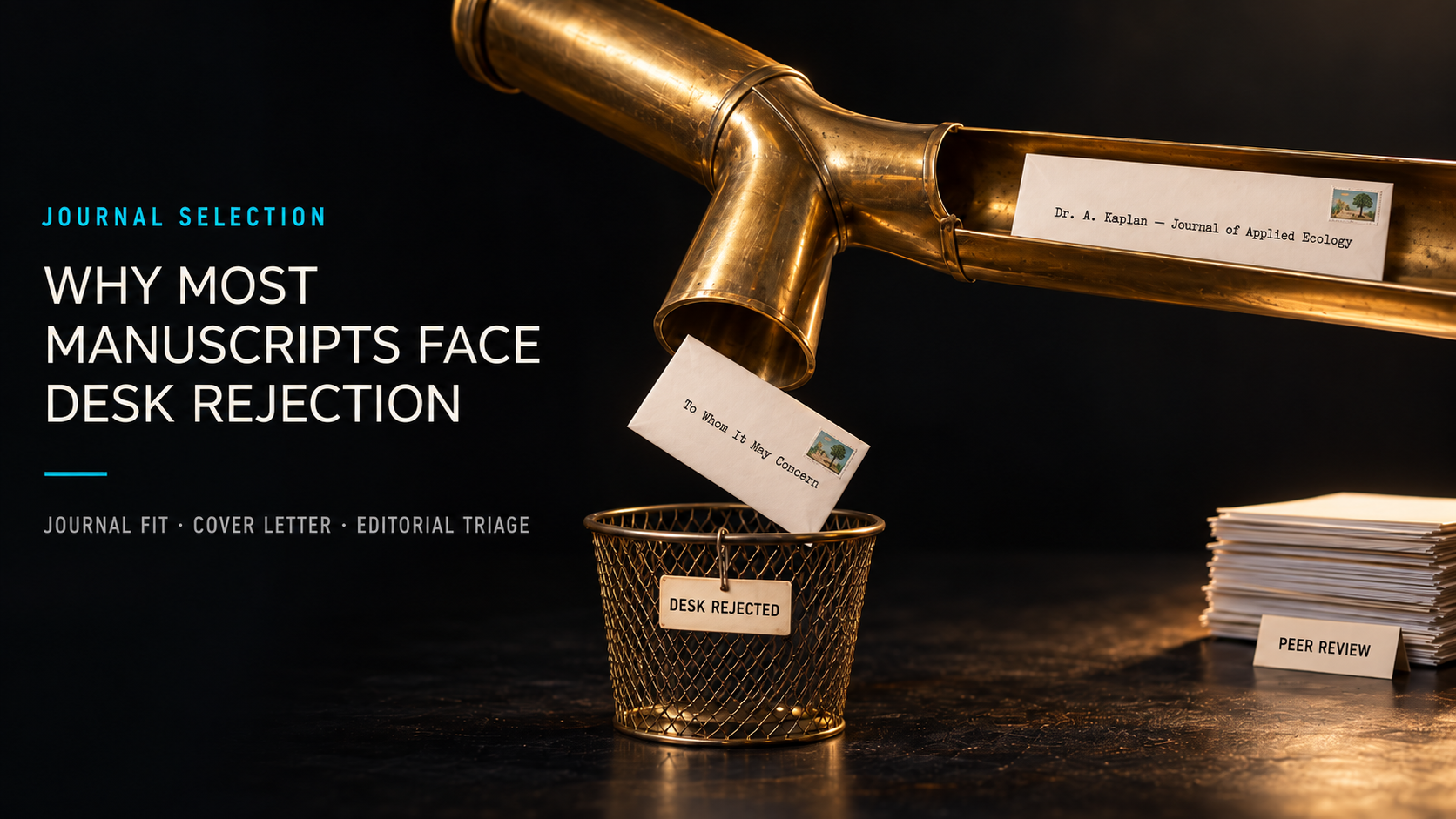
Desk rejection means your manuscript is declined without being sent to external reviewers. In many reputable journals, a large share of submissions never move beyond this first gate.
Editors make this decision quickly. They read your title, abstract, cover letter, and sometimes skim the figures, all while juggling hundreds of submissions and limited time. In those first few minutes, they are silently asking:
Does this paper clearly fit our aims, scope, and readership?
Is the contribution strong and clearly articulated enough for this journal?
Has the author respected our guidelines and ethics?
If any answer feels like “probably not,” your manuscript is declined and moves out of the queue. Two elements shape those answers more than anything else: strategic journal selection and the cover letter.
Pillar 1: Strategic Target Journal Selection
Why “Fit” Beats Impact Factor
The most common reason for desk rejection is brutally simple: scope mismatch. Good papers are frequently sent to journals whose topic, methods, or audience do not match the work. Before worrying about metrics, ask yourself:
Does my central research question sit clearly inside the journal's stated scope?
Does the journal regularly publish the type of article I am submitting?
Are my methods and disciplinary angle in line with what the journal typically accepts?
Is my paper pitched at the same level of specialization as the journal?
If you cannot answer “yes” with confidence, you are inviting desk rejection, even if your study is technically sound.
Working principle: aim for the best-fit journal, not automatically the highest-impact one. Editors care far more about whether their readers will value your paper than about the maximum metric you could chase elsewhere.
Making Sense of Impact Factor vs. CiteScore
Impact metrics help you calibrate ambition, but they are tools, not goals. They should support a thoughtful strategy rather than drive impulsive journal choices.
Impact Factor focuses on citations to selected “citable items” over two years.
CiteScore looks at citations to a broader set of documents over four years.
Other metrics such as SJR and SNIP add different perspectives on journal influence.
Instead of obsessing over a single number, ask whether the journal is respected and visible in your field, whether publishing here will genuinely help the audience you want to reach, and whether the acceptance standards are compatible with the real strength of your work right now. Our guide to choosing a Q1/Q2 journal by SJR and quartile walks through how to weigh these metrics against each other rather than chasing one in isolation.
Smart move: use metrics to compare realistic options, not to justify Hail-Mary submissions to journals that clearly sit far above your current contribution.
Readership, Audience, and the Question “Who Needs This?”
Editors are custodians of their journal's readership. When they look at your manuscript, they are thinking about the people who open that journal every month. The key question is simple: who needs this paper? If your main beneficiaries are clinicians making treatment decisions, policy makers designing guidelines, methodologists developing tools and theory, or educators shaping curricula, choose a journal whose readers match that primary group and write your paper accordingly.
Practical exercise: read 10–15 recent articles from each candidate journal. Notice the typical questions, methods, and level of detail. Ask whether your paper feels like it “belongs” in that conversation. If your manuscript would feel out of place alongside recent papers, treat that as a warning sign — editors will sense the mismatch within seconds.
Predatory vs. Reputable Journals: Avoiding the Trap
Predatory or fake journals promise quick acceptance, but they damage your CV, your credibility, and sometimes your ability to reuse your own work. As pressure to publish grows, this risk has become more real for early-career researchers.
To protect yourself, look for clear editorial board information with recognizable names and affiliations, transparent peer-review processes and realistic timelines, indexing in established databases relevant to your field, and membership in recognized ethical bodies with clear publication policies.
Warning signs include journal names deliberately mimicking famous titles, vague or missing peer-review descriptions, aggressive mass emails that ignore your field, and overly broad, unfocused scopes (“International Journal of Everything”). If a journal cannot show who its editors are, how review works, and where it is indexed, do not submit. For a closer look at how indexing gaps and journal-hijacking risk show up in practice, see our piece on verifying a journal's Q1/SJR indexing before you trust it. You are investing your best work; treat journal choice as carefully as you treat your experiments.
Scope Mismatch Warning Signs Editors Spot Instantly
Several forms of mismatch are obvious to editors from the title and abstract alone:
Article-type mismatch — case reports sent to journals that only publish original research or systematic reviews.
Local vs. global mismatch — narrowly local data sent to journals that focus on global or multi-country comparisons.
Methodological mismatch — qualitative studies submitted to heavily quantitative outlets without a clear argument for fit.
Disciplinary drift — interdisciplinary work sent to journals with a very narrow disciplinary conversation.
Editors do not need reviewers to identify these problems. They can see them from the very first screen, which is why scope mismatch is the fastest route to desk rejection.
A Practical 5-Step Journal Selection Workflow
Instead of choosing a journal on a tired Friday evening, treat selection as a structured mini project.
Define your target audience. Who needs your findings most: clinicians, basic scientists, policy makers, educators, or a specific methodological community?
Build a shortlist. Use your reference list, a journal-finder tool such as SciCampus Journal Finder, and databases to identify journals that regularly publish similar work.
Interrogate aims, scope, and recent issues. Read the aims and scope statement, the author guidelines, and at least 10 recent papers to check subject, article type, and methodological fit.
Check ethics, indexing, and metrics. Confirm where the journal is indexed, how peer review works, what its key metrics are, and whether it follows established publication ethics.
Choose one journal and commit. Most reputable journals do not allow simultaneous submission. Pick the best-fit journal after careful comparison and prepare your submission specifically for that venue.
Your cover letter will later need to demonstrate that you actually went through these steps rather than picking a journal at random.
Pillar 2: The Art and Psychology of the Cover Letter
What Editors Actually Use the Cover Letter For
Many authors treat the cover letter as a bureaucratic formality. Editors do not. The cover letter is often the first focused read of your submission — a confidential space where you can give the editor context the abstract cannot carry. Editors use cover letters to grasp, in plain language, why the work matters; decide whether the paper fits their journal's aims, scope, and readership; check key ethical and practical declarations; see your suggestions for potential reviewers and any necessary exclusions; and understand any related manuscripts, companion papers, or preprints.
If your cover letter is weak, generic, or incomplete, it quietly biases the editor's entire impression of your work.
Core Elements of a Strong, Ethical Cover Letter
Think of the cover letter as a compact narrative plus a set of essential declarations. A robust letter usually includes:
Basic manuscript information
Full title and article type
Journal name and date of submission
Corresponding author's details
Mini-abstract focused on contribution
Brief summary of what was done
Clear statement of the main findings
One or two sentences on what changes for the field or practice
Journal fit argument
Short explanation of how the paper fits the journal's aims and scope
Why the journal's readers will benefit from this particular study
Ethics, originality, and authorship
Confirmation that the manuscript is original and not under consideration elsewhere
Statement that all authors have approved the submission and meet authorship criteria
Funding and conflict-of-interest disclosures — increasingly, some journals also expect a brief note on material AI-assisted writing or analysis here; see our overview of 2026 journal AI-policy and traceability requirements if you are unsure what your target journal expects
Related work and reviewer suggestions
Transparent mention of any related manuscripts, preprints, or overlapping data
Thoughtful suggestions of potential reviewers, with clear reasoning where appropriate
Optional exclusions of reviewers when there are obvious conflicts
When these pieces are missing, editors not only lack information; they also start doubting how carefully the rest of the submission was prepared.
Why Generic Cover Letters Trigger Desk Rejection
Generic letters are easy to spot and hard to trust. Common problems include simply copying the abstract instead of offering editorial framing or significance; using boilerplate lines that could be sent to any journal, with no mention of specific scope or readers; relying heavily on hype words like “novel” and “groundbreaking” without evidence; skipping required declarations on originality, authorship, and conflicts of interest; and leaving reviewer suggestions blank when the journal clearly requests them.
From the editor's point of view, a generic cover letter signals that the author has not truly engaged with the journal. That alone can be enough to tip a borderline submission into desk rejection.
Building a High-Impact Cover Letter That Survives Editorial Triage
Here is a practical structure for a focused, one-page cover letter.
Opening — one sentence of consequence and fit. Start with a sentence that makes the central advance and its consequence visible. Go beyond “We did a study” and show what changes or becomes possible because of your work.
Manuscript identification. Introduce the manuscript title, article type, and journal name. Keep this crisp and professional.
Mini-abstract focused on contribution. Summarize what you did, your main findings, and what they add to current knowledge or practice. Avoid detailed methods and long background; the editor can get those from the manuscript.
Journal fit. Explain explicitly how the paper fits the journal's aims and scope. Mention themes or article types from recent issues and show why the journal's readers will benefit.
Ethics, originality, and authorship. Include the key declarations: originality, non-duplicate submission, authorship approval, conflicts of interest, and funding. This shows you understand and respect standard publication ethics.
Related work and reviewers. Highlight any related manuscripts or preprints and clarify how this paper differs. Suggest several potential reviewers and mention any exclusions if there are obvious conflicts.
Closing line. Thank the editor for considering your manuscript and restate, in one sentence, why it belongs in this journal.
This architecture respects the editor's time, gives them the information they need for triage, and presents you as a careful, ethical, and journal-aware author.
Show, Don't Tell: Weak vs. Strong Opening Examples
Let's compare two typical openings.
Weak, generic opening: “Dear Editor, We hereby submit our manuscript entitled 'A Study of Biomarker X in Disease Y' for consideration. This study is novel and important and we believe it will be of interest to your journal's readers. The manuscript has not been published or submitted elsewhere.”
This feels generic because “novel and important” is claimed but not demonstrated, nothing in the paragraph explains what actually changes for readers, and the text could be sent to almost any journal without modification.
Stronger, high-impact opening: “Dear Dr [Editor's Name], We submit our original research article, 'Biomarker X predicts early treatment response in Disease Y across three independent cohorts,' for consideration in [Journal Name]. Our findings show that Biomarker X identifies responders within two weeks of therapy, offering a pragmatic tool for clinicians to avoid unnecessary toxicity in non-responders, which directly aligns with your journal's focus on evidence-based clinical decision-making.”
This feels targeted because the advance and its consequence are clear and specific, the fit with the journal's focus and readership is explicit, and the editor can immediately see why their community might care. Rewrite your opening until a colleague can clearly say, “I understand what changed and why this journal is the right home.”
Another Example: Interdisciplinary Work
Interdisciplinary papers are often desk rejected because editors cannot easily place them inside the journal's conversation.
Weak interdisciplinary pitch: “Our interdisciplinary study combines sociology and machine learning to analyze health behaviors. We believe this novel approach is suitable for your journal.”
This is vague. The editor cannot see what actually happens, who benefits, or how it fits the journal's mission.
Strong interdisciplinary pitch: “Our study combines sociological theory with machine-learning analysis of two million health records to reveal how neighborhood-level social factors predict treatment adherence. For [Journal Name], which bridges clinical outcomes and health policy, this work translates complex social determinants into actionable risk stratification tools for clinicians and planners.”
Here you make the scale and methods clear, show the concrete consequence, and connect the work directly to the journal's identity. That is the difference between “we think it fits” and “here is why it clearly fits.”
Advanced Cover Letter Moves Editors Appreciate
Tailoring for Different Journal Tiers
Highly selective journals and strong specialist journals have different expectations, and your cover letter should reflect that.
For very selective, flagship journals: focus on one major cross-field consequence in the opening, anchor the advance clearly in broader scientific or clinical debates, and avoid over-claiming — editors are allergic to exaggeration that the data cannot support.
For specialist journals: emphasize depth and rigor inside the specific field, show that you know the journal's recent discussions and that your paper extends them, and highlight why your methods or dataset are particularly valuable for that community.
In both cases, the key is respect: you are writing to a specific journal, not to “whatever will take it.”
Handling Related Manuscripts, Preprints, and Overlap
Many researchers worry that mentioning related work will harm their chances. In reality, editors care far more about transparency than about perfectly clean publication histories.
Best practice: identify any paper, preprint, or conference proceeding that shares data or analyses with your submission, explain briefly how the new manuscript extends or differs from the previous work, and make it clear why this is not duplicate publication and why the new paper deserves independent review.
Honest, precise explanations build trust. Attempting to hide overlap, on the other hand, is a fast way to damage your reputation and the paper's prospects.
Reviewer Suggestions: Strategic, Not Random
When journals invite reviewer suggestions, they are asking for insight into your field, not a popularity list. Helpful reviewer suggestions include experts who have recently published on similar topics, reflect the journal's usual geographical and disciplinary diversity, and avoid close collaborators, co-authors, or anyone with obvious conflicts.
Think of this as curating a small, high-quality panel in your mind. You are telling the editor, “Here are people who understand this area and can give you a fair, rigorous assessment.”
Integrating Journal Selection and the Cover Letter Into Your Pre-Submission Checklist
Desk rejection is often the result of several small, avoidable choices rather than one dramatic failure. A simple checklist can catch many of these problems before you click “Submit.”
Confirm journal fit one more time. Re-read the aims and scope, recent articles, and your abstract. Ask whether your manuscript truly belongs in that conversation.
Align structure and format with guidelines. Check word limits, section headings, reference style, figure requirements, and any special sections such as data availability or ethics statements.
Run a clarity and language review. Ask a colleague or supervisor to read your abstract and introduction. If they struggle to understand the main point, an editor will too.
Check ethics and transparency. Make sure you have included ethics approvals where relevant, conflict-of-interest disclosures, funding acknowledgments, and statements about authorship and originality.
Craft and tailor the cover letter. Do this after you have some distance from the manuscript draft. Focus on one clear consequence, explicit journal fit, and complete declarations.
Final fit test. Share only the title, abstract, and cover letter with someone outside your subfield. If they cannot tell you what your main claim is and why you chose this journal, keep refining.
Key takeaway: treat the pre-submission phase as part of the research project, not as rushed admin. The quality of your journal choice and cover letter is one of the strongest predictors of whether your paper will reach peer review.
Bringing It All Together
Desk rejection rarely means your research is worthless. It usually means your paper was not the right fit for that journal, in that form, at that moment. What you can control is how clearly and honestly you present your work and where you choose to present it.
You can make sure that, in an editor's first three minutes with your submission, they see a specific, believable advance; a well-argued fit with their journal and readership; a submission that respects guidelines and ethics; and a cover letter written to one journal and one editor, not to “whom it may concern.”
If you can deliver that consistently, desk rejections will stop feeling mysterious and personal. They will become rare, understandable signals that help you retarget quickly and build a publishing record that genuinely reflects the value of your work.
Building your shortlist is often the slowest part of this process. SciCampus Journal Finder can help you compare scope, quartile, and indexing across candidate journals before you invest a week writing a cover letter for the wrong one — free to start, no card required.
Related reading (topic ideas for future posts)
How to write reviewer-suggestion emails editors actually take seriously
Reading a journal's aims-and-scope page like an editor would
What to do when two journals both seem like a good fit
Handling a desk rejection: revise, resubmit, or retarget?