Skip to content
SciCampus guides

Academic writing and research guides

Practical guides to academic writing, research integrity and journal selection. Learn how to review a manuscript with our academic AI Detector, inspect source matches with the Similarity Checker, or shortlist journals with Journal Finder.

Anatomy of a Structured Abstract: A Four-Function Model for Writing an Abstract Editors Can Interpret
Academic Writing

Anatomy of a Structured Abstract: A Four-Function Model for Writing an Abstract Editors Can Interpret

For most research articles, the abstract is the first, and sometimes the only, substantial contact an editor or database user has with a study. This guide presents a four-function model, Background for relevance, Methods for interpretability, Results for evidence, Conclusion for bounded meaning, with reporting-guideline specifics, before-and-after rewrites, and a final audit checklist.

How to Check Academic Paper Originality in 2026: SciCampus vs. Turnitin vs. GPTZero
Academic Integrity

How to Check Academic Paper Originality in 2026: SciCampus vs. Turnitin vs. GPTZero

Before submitting a manuscript, researchers face one question: will this be flagged? This guide compares three distinct pre-submission approaches — Turnitin's institution-led similarity workflow, GPTZero's accessible self-service AI checker, and SciCampus's research-first diagnostic model — covering pricing, AI-detection method, ESL false-positive risk, and DOI-linked citation verification.

Standard Operating Procedure for Research Labs: Protecting Multi-Author Manuscripts from Semantic Drift and Unattributed AI Edits
Academic Integrity

Standard Operating Procedure for Research Labs: Protecting Multi-Author Manuscripts from Semantic Drift and Unattributed AI Edits

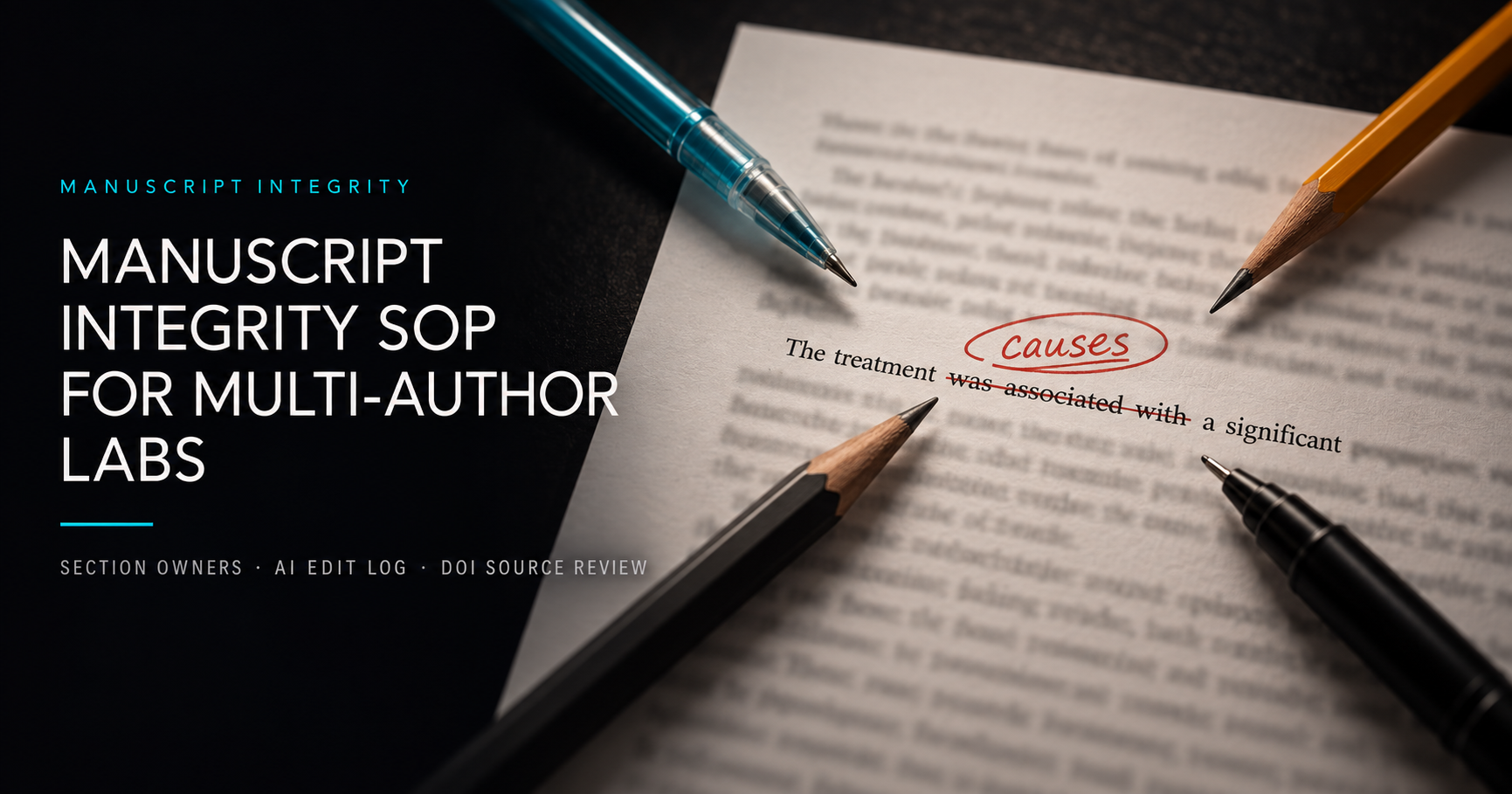
A multi-author manuscript can lose integrity long before it reaches a journal, since responsibility is distributed while accountability remains shared. This SOP gives corresponding authors, PIs, postdocs, and doctoral candidates a practical system: assign an owner to every claim, log AI-assisted edits, run DOI-grounded source review, and archive a highlighted PDF audit report before submission.