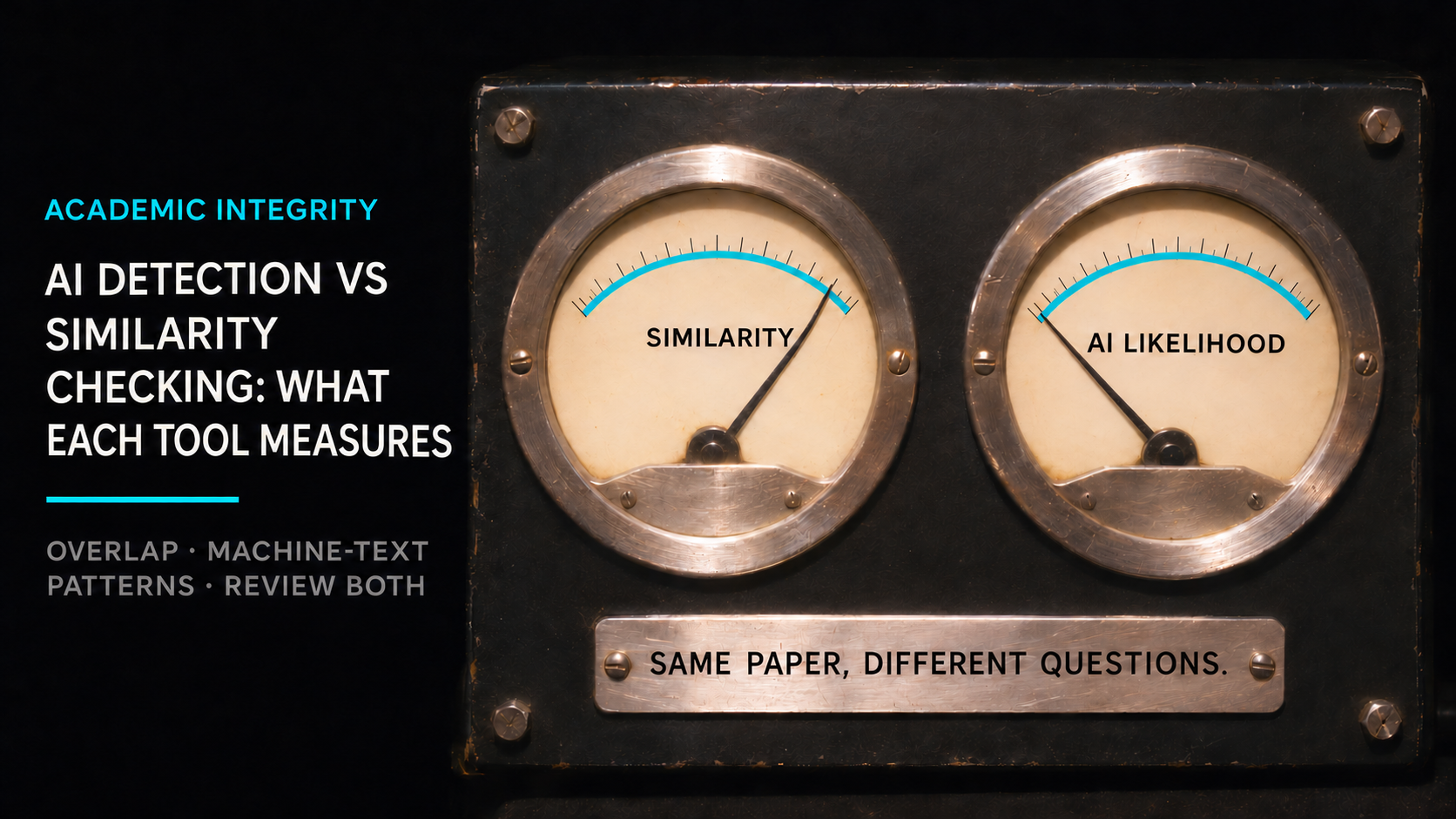
Short answer: a similarity checker measures overlap between your text and existing sources. An AI detector estimates whether the writing itself resembles machine-generated text. They answer different questions, so a clean result from one says nothing about the other. Neither can establish plagiarism or authorship on its own: both produce evidence that a person must review, with the source passages, the journal's rules and your own writing record in hand.
What does a similarity checker actually measure?
A similarity checker finds passages that match or closely resemble text in other sources. Some systems use lexical matching, which looks for similar wording, and some add semantic matching, which looks for related meaning expressed in different words. A report typically offers matched passages, candidate sources and a similarity score.
The score summarises overlap; it is not a verdict. Quotations, standard terminology and common method descriptions can all produce matches without any misconduct. A study that tested 15 text-matching systems across eight languages found that such software can help identify some plagiarised text but misses some, sometimes flags text that is not plagiarised, and works only as a support tool for spotting similarity (Foltýnek et al., 2020). Humans decide what a match means.
Read a report by passage, not by percentage:
What you find | Likely action |
|---|---|
Properly quoted and cited text | Check that the quotation is marked and referenced |
Standard terminology or a common method phrase | May stay; consider whether it needs a citation |
Source-dependent sentence with no citation | Add the citation |
Paraphrase that follows the source's wording closely | Rewrite more independently, keeping the meaning and the attribution |
Overlap with your own earlier publication | See the section on text recycling below |
The SciCampus Similarity Check compares text with published academic sources using lexical and semantic scoring, and shows passage-level matches with source links and an overall percentage. It does not search private student-paper repositories, and coverage depends on what each source makes accessible. A lack of matches therefore does not prove a passage is original. For a comparison with older tools, see SciCampus vs legacy similarity checkers.
How is similarity different from plagiarism?
Similarity describes overlap between texts. Plagiarism means presenting another person's words, ideas or contributions as your own without appropriate acknowledgment, and it applies to paraphrased material as well as copied wording. A similarity report only shows you where to look. Whether a passage needs a citation, a quotation or a rewrite depends on its context. Replacing words with synonyms is not enough; understand the source, express its ideas accurately and attribute them. Our guide to semantic drift in paraphrasing covers this in detail.
When is reusing your own text acceptable?
Harriman and Patel (2014), in a BMC Medicine editorial, use the term "text recycling" for reuse of one's own text and treat it differently from plagiarising others. Their view: reusing a description of an established method is generally acceptable, especially when it is cited; reuse in an introduction can be acceptable with citation; overlap in results usually amounts to duplicate publication and is nearly always unacceptable. The key requirement is transparency: cite the reused text and tell the editor at submission. It is one editorial's position, and journals set their own rules, so check your target journal's policy.
What does an AI detector actually measure?
An AI detector looks at patterns within the writing, not at what other documents say. It does not compare your text with a source list. Approaches include statistical methods, which examine how predictable a sequence of words is to a language model, and trained classifiers.
GLTR (Gehrmann, Strobelt & Rush, 2019) applies simple statistical tests to expose generation artefacts and visualises them. In a human-subjects study, its annotation scheme raised human detection of fake text from 54% to 72%.
DetectGPT (Mitchell et al., 2023) is a zero-shot method based on probability curvature. Text sampled from a language model tends to lie in regions of negative curvature of the model's log probability. It reported improved detection of fake news generated by a 20-billion-parameter model, from 0.81 to 0.95 AUROC, on its test settings.
These are research results on specific models and test sets. They do not tell you how any current product performs on your manuscript.
Why can't a detector prove authorship?
Because a score is an estimate, and estimates can be wrong. Liang and colleagues (2023) found that seven widely used GPT detectors flagged, on average, 61.22% of 91 TOEFL essays written by non-native English speakers as AI-generated, while performing almost accurately on essays by US eighth-graders. That study tested detectors available in 2023, so it shows a risk to guard against, not how current tools behave. See our posts on why aggregate AI scores fail and false positives and sentence-level analysis.
The SciCampus AI Detector classifies each sentence as human, AI-generated or AI-paraphrased, with probabilities, plus a document-level score and a downloadable report. It states that its results are estimates, not proof, and should prompt a review. Treat flagged passages as places to check against your drafting history, not as findings.
Why do publishers care about AI disclosure?
Generative AI can help with language, structure and drafting, and publishers distinguish between kinds of help. Policies differ, so follow your target journal's current rules.
Elsevier (policy updated June 2026): basic checks of grammar, spelling and punctuation need no declaration statement, but substantive AI changes to sentence structure or text organisation should be disclosed. AI used in the research process must be described in the Methods section.
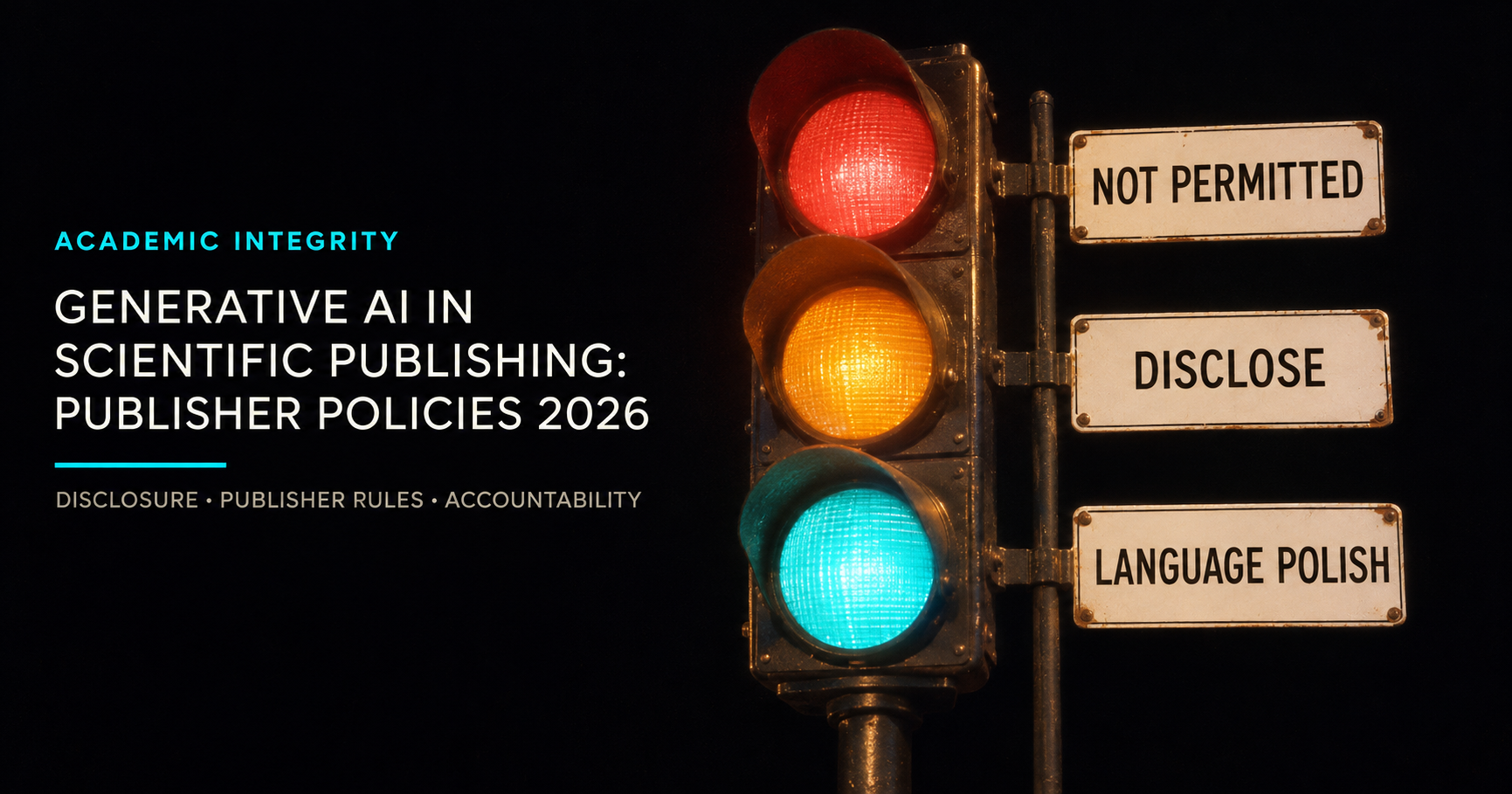
Springer Nature (August 2026 version of its policy, which we read in a copy hosted by a journal site) applies a three-level risk framework. Lower-risk uses such as language polishing are encouraged to be disclosed; medium-risk uses such as suggesting analytical approaches require oversight, verification and disclosure; high-risk uses, including fabricating data or citations and delegating peer review to AI, are not permitted.
For a wider comparison, see Generative AI in Scientific Publishing and responsible AI use in research.
Similarity checking vs AI detection: what is the difference?
DimensionSimilarity checkingAI detectionQuestion answeredDoes this text overlap with existing sources?Does this writing resemble machine-generated text?What it compares againstA pool of published or accessible sourcesLearned or statistical language patternsTypical outputMatched passages, source links, overlap percentageScores or classifications, sometimes per sentenceIntegrity issue it informsCitation, attribution, paraphrasing, text recyclingAI-use transparency and journal policyMain cautionA low score is not proof of originality; a high score is not proof of plagiarismA score is an estimate, not proof of authorship
The two can disagree, and that is expected. A human-written paper full of properly cited quotations may show high similarity and low AI likelihood. An AI-generated passage may match nothing in the literature yet still look machine-written. A paraphrase of a source may be both similar and fluent.
In SciCampus, the Similarity Check runs inside an AI Detector analysis, so one document gives you both views. Use them together, but read each on its own terms.
How should you use both tools before submission?
Verify references and claims. Confirm each source supports the statement attached to it.
Review similarity matches by passage. Open each important match, read the source and decide: quote, cite or rewrite.
Review AI-flagged sections. Compare flagged passages with your drafting history and decide whether any AI assistance should be disclosed.
Check the journal's policies. Look at AI, plagiarism and text-recycling rules.
Do a final read. Confirm the paper represents your work, separates your contribution from earlier work and includes the necessary citations and declarations.
The goal is not a perfect number on either report. It is a manuscript you can explain, source and defend. If a flag ever turns out to be wrong, see our guide to defending a manuscript against a false AI flag.
Related Reading (Topic Ideas for Future Posts)
How to read a similarity report passage by passage, with worked examples.
Text recycling in methods sections: what journals accept and how to disclose it.
Building a drafting-history file that supports your authorship.
What an AI-detector score does and does not tell an editor.
References
Foltýnek, T., Dlabolová, D., Anohina-Naumeca, A., Razı, S., Kravjar, J., Kamzola, L., Guerrero-Dib, J., Çelik, Ö. & Weber-Wulff, D. (2020). Testing of support tools for plagiarism detection. International Journal of Educational Technology in Higher Education, 17, 46. doi:10.1186/s41239-020-00192-4
Harriman, S. & Patel, J. (2014). Text recycling: acceptable or misconduct? BMC Medicine, 12, 148. doi:10.1186/s12916-014-0148-8
Gehrmann, S., Strobelt, H. & Rush, A. (2019). GLTR: Statistical detection and visualization of generated text. Proceedings of ACL 2019: System Demonstrations, 111–116. doi:10.18653/v1/P19-3019
Mitchell, E., Lee, Y., Khazatsky, A., Manning, C. D. & Finn, C. (2023). DetectGPT: zero-shot machine-generated text detection using probability curvature. Proceedings of the 40th International Conference on Machine Learning, 202, 24950–24962. arXiv:2301.11305
Liang, W., Yuksekgonul, M., Mao, Y., Wu, E. & Zou, J. (2023). GPT detectors are biased against non-native English writers. Patterns, 4(7), 100779. arXiv:2304.02819
Elsevier. Generative AI policies for journals (updated June 2026).
Springer Nature. Journal AI policies, August 2026 version (copy hosted by a journal site); confirm on Springer Nature's own AI policy page.