A generic similarity percentage cannot tell a corresponding author which sentence threatens a submission, whether the concern is textual overlap or AI-assisted phrasing, which source must be checked, or what evidence will satisfy an editor. For researchers about to submit, that gap is no longer acceptable.
SciCampus is designed for the final integrity decision before a manuscript enters peer review. Its workflow combines sentence-level stylometry, sub-classification of likely raw AI-generated versus AI-paraphrased writing, DOI-linked similarity investigation, and downloadable highlighted PDF audit reports. The result is not a vague score to explain after the fact; it is a structured evidence record that helps authors make, document, and defend scholarly decisions.
Why generic percentages fail
A score is not an editorial explanation
Legacy similarity systems were built primarily to locate overlapping strings of text in a reference corpus. That remains useful. However, a manuscript-wide percentage is only a screening statistic. It cannot distinguish a correctly cited quotation from a recycled methods paragraph, a standard phrase from a close paraphrase, or a self-overlap issue from unattributed borrowing. Nor can it tell an author whether an apparent AI signal reflects raw generated text, grammar-edited human prose, conventional technical writing, or a false positive.
That distinction matters most at the point of submission. Editorial offices and reviewers do not evaluate a manuscript by asking, "Is the score low enough?" They evaluate actual passages. They ask whether a claim is supported, whether a source is represented accurately, whether an author is accountable for the work, whether overlap is permissible and disclosed, and whether the manuscript complies with the journal's policies.
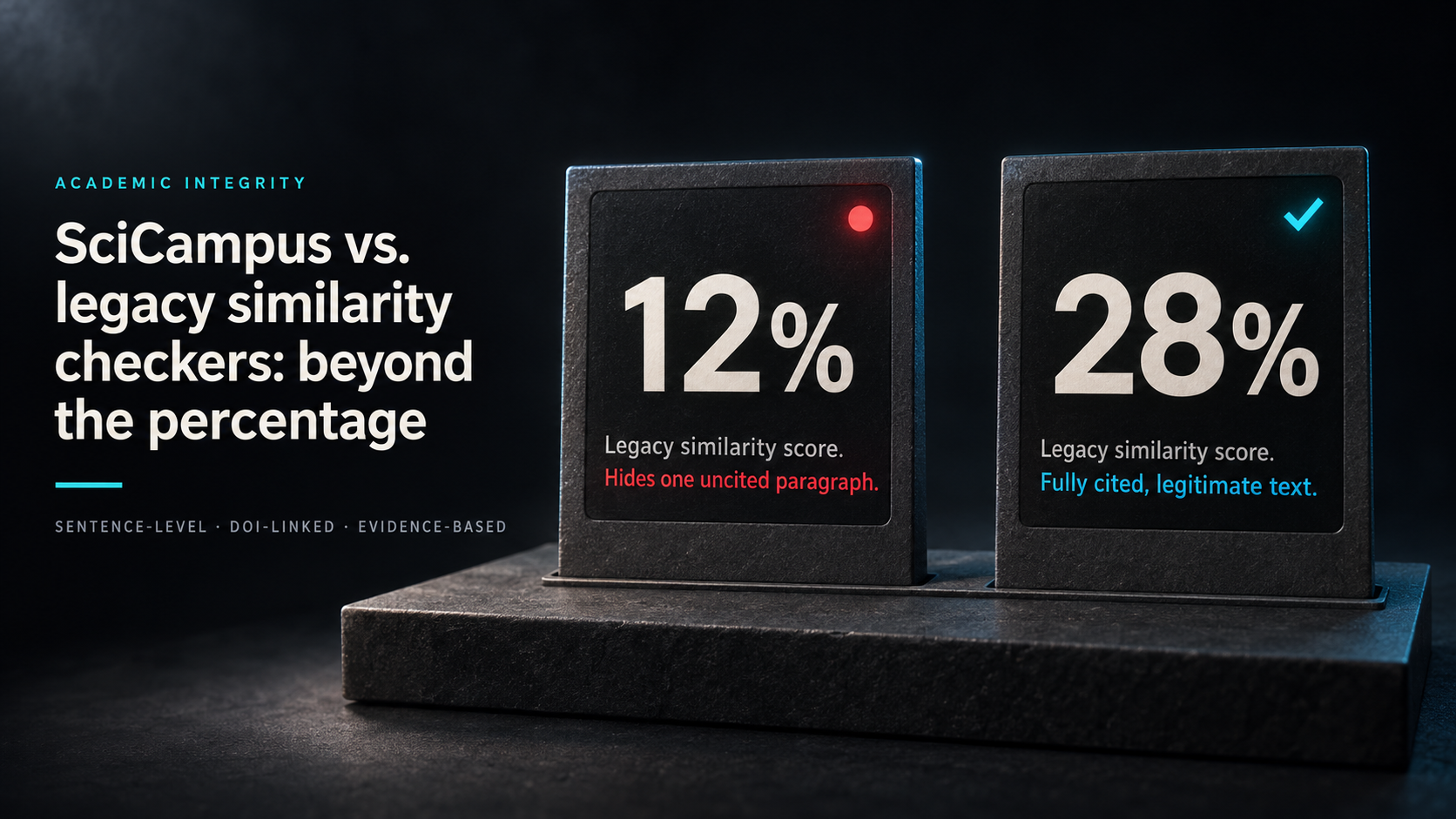
An overall 12% score can hide a serious problem: one uncited, source-dependent paragraph in the introduction. A 28% score can be largely legitimate: reference lists, standard regulatory wording, correctly quoted definitions, or disclosed text from a preprint. Without sentence-level and source-level review, authors may either miss material risk or waste time rewriting harmless content.
The cost of "fixing the number"
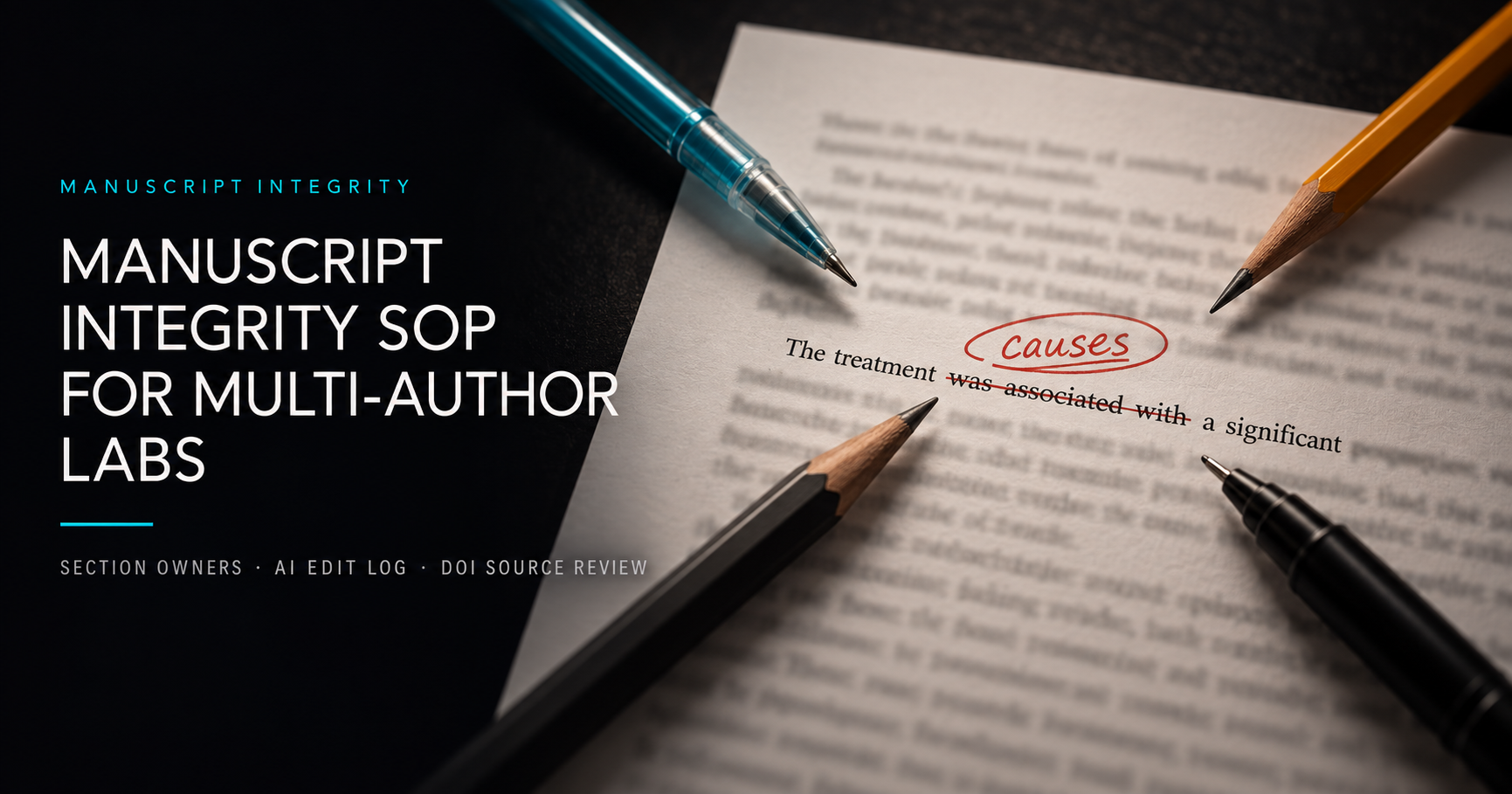
When a team is pressured by a deadline, it may treat a low percentage as the objective. That often leads to blind paraphrasing: replacing words, changing sentence order, or using multiple rewriters until the score declines. This is not a defensible integrity process.
Blind rewriting can:
Remove a qualifier that protects the paper from causal overstatement
Change an association into an intervention effect
Conceal a source's idea without correcting the missing citation
Degrade precise technical language into vague prose
Create a confusing draft history if an editor later asks how a passage developed
Similarity is evidence, not a definition of plagiarism. AI probability is evidence, not proof of authorship. A robust pre-submission workflow has to examine the exact passage, the underlying source, the scientific claim, the author's revision history, and the journal policy that applies.
Integrity is now submission readiness
Major publication-ethics guidance converges on a core principle: AI systems cannot take authorship responsibility, and human authors remain accountable for every part of a submitted manuscript. COPE states that AI tools cannot be authors because they cannot accept responsibility, declare conflicts, or manage copyright and licensing obligations. Elsevier requires human oversight of AI-supported work, including verification of accuracy, sources, privacy, intellectual-property considerations, and the manuscript's original contribution. IEEE requires disclosure of AI-generated content and identification of affected sections, while treating ordinary grammar assistance differently from substantive generation.
For the corresponding author, this changes the question from "Which checker should we use?" to "Can we show what we reviewed, why we retained or revised it, and how we verified the evidence?" For the full policy landscape, see our guide to ethics and disclosure guidelines for AI in academic writing.
What replaces the percentage
Sentence-level stylometry: a review queue
The SciCampus AI Detector begins where a single aggregate score stops. It identifies AI-style signals at the sentence level, allowing researchers to see the passages that require contextual review. The platform uses probability bands to prioritize attention:
Red: ≥99% — review first. Check the sentence's provenance, evidence, citations, and connection to the study's actual results.
Orange: ≥96% — investigate closely, particularly in the abstract, introduction, discussion, transitions, and claims of novelty.
Yellow: ≥93% — treat as a lower-priority signal that still warrants contextual review when the sentence is substantive.
These bands are not misconduct labels. A red sentence is not automatically AI-written; a yellow sentence is not automatically safe. They are a triage system that directs limited pre-submission time to passages where human editorial judgment is most valuable.
Read the manuscript at the level an editor will. The SciCampus AI Detector presents sentence-level probability bands rather than leaving authors with one opaque document-wide percentage. Review the flagged claim, nearby evidence, citations, and drafting history before deciding what to do.
Raw AI text and AI-paraphrased writing
Not every flagged sentence needs the same fix. SciCampus supports sentence-level sub-classification between probable raw AI-generated text and probable AI-paraphrased writing. That distinction is central to a defensible audit.
Probable raw AI-generated text often requires an evidence and authorship check. It may be broad, fluent, and authoritative sounding, yet disconnected from the study's actual methods or results. It can introduce fabricated citations, invented numerical details, unsupported causal language, or vague claims of broad significance. The appropriate response is to verify every assertion, replace generic text with study-specific reporting, and disclose substantive use when journal policy requires it.
Probable AI-paraphrased writing requires a source and attribution check. The language may be newly phrased, but it can retain the conceptual sequence, inferential structure, or distinctive conclusion of a source. The appropriate response is not simply to add synonyms. Locate the original source, assess whether the idea and expression are accurately attributed, and then cite, quote, independently reframe, or remove the passage.
Before: a generic, high-risk conclusion
"These significant findings demonstrate the urgent need for a comprehensive strategy to address this major challenge."
After: a specific, evidence-led conclusion
"After adjustment for age and baseline severity, lower baseline adherence was associated with reduced six-month follow-up attendance; implementation studies should test whether reminder systems improve attendance in comparable outpatient settings."
The revised sentence identifies the analytical basis, preserves non-causal language, and separates the observed finding from the recommendation for future research.
Before: source-dependent paraphrase
"Prestigious citations make journals more impactful, so SJR shows which journals are most influential."
After: a bounded, attributable formulation
"SJR weights citations according to the prestige of citing journals and reports journal standing within defined subject categories; it is one category-sensitive indicator to consider alongside editorial scope, audience, and article-type fit (Author, Year)."
The revision states what the metric does, avoids deterministic language, and signals that the claim must be supported by a legitimate source.
DOI-linked similarity: from overlap to evidence
A percentage without a source is difficult to defend. SciCampus provides a search-grounded similarity index that links meaningful matches to DOI-linked sources where available. This allows the author to move directly from a highlighted sentence to the source record and inspect the full scholarly context.
Use DOI-linked evidence to decide what a match means:
If the match is standard terminology or required methods language, retain it and record why it is legitimate.
If the match is a quotation, confirm quotation formatting, citation accuracy, and any permission requirements.
If the match is an attributed paraphrase but remains too close in wording or sequence, rebuild it around the current paper's analytical logic.
If the match is to a thesis, preprint, protocol, conference paper, or prior article from the team, check the target journal's policy and disclose or revise as appropriate.
If the match reveals unattributed language, ideas, or results, cite, reframe, or remove it before submission.
This is how a similarity checker becomes an integrity workflow. The author does not merely observe that overlap exists; the author investigates the source and documents the resolution.
Do not submit with unexplained percentages. Audit your manuscript on SciCampus — free to start, no card required. Review sentence-level signals, open DOI-linked sources, and resolve material findings before an editor has to ask. Create a free account.
The SciCampus workflow
Step 1: Freeze the candidate version
Before screening, save a clearly named version of the manuscript. Collect the files that establish provenance: draft history, tracked changes, reference library, analysis outputs, figure source files, author-contribution statement, and any log of substantive AI use. This baseline ensures that the team can later identify which text was actually audited.
Save the manuscript as "Submission Candidate – Date – Version." Retain the prior draft. Do not begin a final integrity audit on a document that co-authors are still rewriting simultaneously.
Step 2: Review signals in context
Run the relevant text through the AI Detector. Start with red sentences, then orange, then substantive yellow sentences. Do not review isolated fragments. Read each signal with its preceding and following sentences, citations, tables, figures, and the relevant portion of the study record.
Ask five questions of every material signal:
Is the claim supported by data, analysis output, or a verifiable source?
Is the language specific to this study, or could it appear unchanged in almost any manuscript?
Does the wording preserve the study design, setting, population, comparator, outcome, and limitations?
Is the passage likely raw generated language, AI-paraphrased source material, ordinary technical prose, or a likely false positive?
Can a named author explain how the sentence was drafted and edited?
For each material signal, choose one action: retain, substantiate, rewrite for precision, cite and reframe, disclose, or remove. Write one sentence explaining why. A documented resolution is more useful than a lower score with no rationale.
Step 3: Verify overlap at source level
Use SciCampus similarity evidence to examine relevant matches. Read the actual source — not only a short fragment — and check the surrounding argument, sample, methods, results, and conclusion. This prevents authors from citing a source for a claim it did not make or from treating a very small phrase match as a plagiarism finding.
Match the manuscript passage to its DOI-linked source. Then classify the relationship as standard language, quotation, attributed paraphrase, close paraphrase needing reframing, disclosed self-overlap, or material integrity concern. Record the source DOI and the final action in the project file.
Step 4: Recheck scientific meaning
Every editorial rewrite should be checked against invariant scientific content. A good revision can improve clarity without changing whether the finding is observational or experimental, whether the result is statistically adjusted, who was studied, what outcome was measured, or how far the authors can generalize.
Before: causal drift after "editing"
"The intervention reduced missed appointments."
After: design-faithful reporting
"Receipt of the intervention was associated with fewer missed appointments after adjustment for baseline attendance patterns."
The second version may be less dramatic, but it is more faithful to the study design and more defensible in peer review.
Step 5: Export a PDF audit report
Once the team has resolved material findings, download the highlighted PDF audit report. Store it with the final manuscript version, DOI checks, disposition notes, AI-use log, disclosure statement, and author approvals.
The PDF report is not an automated certificate that a manuscript is ethical or "human." Its value is evidentiary. It records the passages reviewed and supports a transparent explanation of the team's audit process if an editor, reviewer, institution, or funder asks for clarification.
Turn review into a case file. The downloadable PDF report preserves highlighted findings in a shareable format. Pair it with source notes and version history to show what the team reviewed, what evidence it consulted, and what it changed before submission.
Step 6: Confirm journal readiness
Before the corresponding author uploads the manuscript, verify the exact journal's current instructions. Check the policy on AI assistance, authorship, acknowledgements, data sharing, image handling, text reuse, preprints, conflicts of interest, reporting guidelines, supplementary files, and cover letters. Publisher policies provide useful principles, but the journal's own instructions control the submission.
If the research team is still deciding between venues, use the Journal Finder to support an evidence-informed shortlist. Journal metrics and indexing status provide context, but the final choice should be based on scope, recent accepted article types, reader audience, relevant SJR category and quartile, practical requirements, and policy fit. Our guide on choosing the right Q1/Q2 journal covers that decision in full.
Questions before registration
"What if the detector produces a false positive?"
The concern is valid. A responsible platform should never be treated as a black-box judge. SciCampus addresses this concern by providing passage-level evidence rather than asking authors to accept a document-wide conclusion.
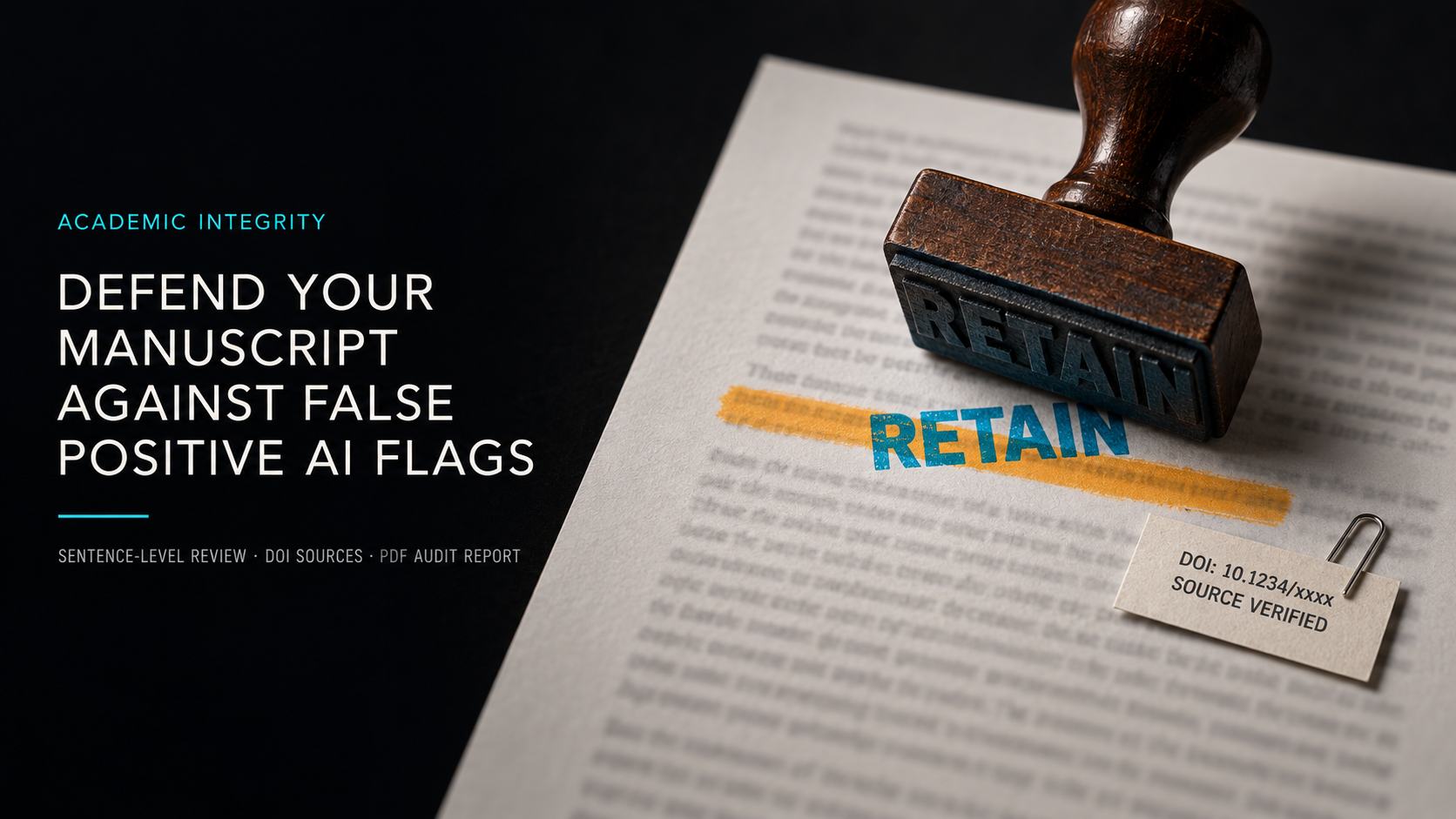
The practical response is contextual review. Verify the claim, inspect citations, assess source relationships, and preserve drafting evidence where needed. False positives are possible in highly conventional methods language, professionally edited text, non-native English writing, formulaic scientific prose, and short passages. A flagged sentence is a prompt to investigate — not proof of misconduct.
The author's decision remains central. If the sentence is accurate, author-owned, and supported, retain it and preserve relevant drafts, notes, or tracked changes.
"Our journal permits AI only for language editing."
Policy defines the boundary; it does not remove the duty to review. If AI assisted only with grammar and fluency, ensure it did not introduce new claims, citations, interpretation, or substantive organization. If it changed sentence structure or generated content, review the policy carefully and disclose use as required.
SciCampus helps distinguish a language-quality review from a provenance problem. Sentence-level evidence allows authors to inspect passages that may require human verification, while DOI-linked similarity makes it possible to check whether apparently polished prose is actually close to an external source.
"We already use a legacy similarity checker."
Keep it where institutional policy requires it. The issue is whether it completes the job. A legacy overlap report can identify matched strings, but SciCampus adds a final-decision layer: sentence-level stylometry, raw-versus-paraphrased sub-classification, DOI-grounded source investigation, and a downloadable audit record.
The workflow is complementary, not ideological. Use institutional tools for required screening and use SciCampus to interpret findings in the context that a corresponding author and editor need.
"Can we upload confidential or unpublished work?"
Confidentiality requires a deliberate decision. Before uploading any material to any platform, verify the applicable institutional, funder, collaborator, patient-data, sponsor, and journal restrictions. Do not submit personally identifiable information, restricted data, third-party confidential material, or documents under peer review to a service unless you have authority to do so and its terms support that use.
Use appropriate controls for author-owned drafts. Limit access to the relevant team, preserve version control, and apply the lab's data-classification policy. No integrity tool should be used in a way that breaches confidentiality.
"Will SciCampus replace our authors' judgment?"
No. SciCampus should make authors' judgment more informed and easier to document. The corresponding author remains accountable for every claim, citation, disclosure, and final submission decision. SciCampus makes the review workflow more granular and auditable; it does not outsource authorship, interpretation, or ethical responsibility.
Your final submission deserves more than a percentage. Try SciCampus — free to start, no card required — to audit the exact sentences, sources, and claims that could matter in editorial screening. Get started.
A lab-ready protocol
Assign accountability early
A laboratory should identify a manuscript integrity lead — typically the corresponding author, a senior postdoc, or a project manager. That person coordinates the audit but does not unilaterally decide technical content. Subject-matter authors should approve material changes to methods, analyses, results, limitations, and conclusions.
Maintain a concise decision log for each manuscript. For every material finding, record the passage, source or evidence checked, decision made, owner, date, and final manuscript version. The value is not administrative formality; it is traceability when co-authors, editors, or integrity offices ask why a sentence was retained or changed.
Use a shared, repeatable process
For labs handling multiple manuscripts, a common integrity-review environment helps allocate screening capacity across researchers while retaining a coherent history of reports and reviews. Use administrative features to support — not dilute — human accountability.
A concise laboratory SOP has five gates:
Baseline: Freeze the candidate version and gather the evidence record.
Signal review: Inspect sentence-level signals and identify possible raw AI, AI-paraphrased, source-dependent, or false-positive passages.
Source review: Use DOI-linked similarity evidence to classify and resolve meaningful matches.
Author approval: Confirm that content owners approve material wording changes and that required disclosures are accurate.
Archive: Retain the highlighted PDF report, decision log, sources, final manuscript, and submission confirmation.
Final pre-submission checklist
Manuscript claims and language
The title, abstract, key messages, and conclusion match the study design and actual results.
No association has been rewritten as causation without a defensible causal design and analysis.
Population, setting, comparator, outcome, timeframe, and limitations remain accurate after editing.
Generic claims of novelty, urgency, or broad impact have been replaced with evidence-specific language.
Each material sentence can be explained and defended by a named human author.
AI and stylometry review
The team has reviewed material sentence-level signals in the AI Detector.
Red, orange, and material yellow passages received contextual human review.
Probable raw AI-generated passages were verified for accuracy, specificity, and disclosure requirements.
Probable AI-paraphrased passages were checked for source dependence and attribution.
Possible false positives were retained only when authors could support provenance and scientific accuracy.
Similarity and citation review
Meaningful similarity matches were opened against DOI-linked sources where available.
All quotations are marked and cited accurately.
Paraphrases are independent in language and argument structure, with citation at the point of use.
Self-overlap with theses, preprints, protocols, conference outputs, or prior papers is disclosed or revised as journal policy requires.
No paraphrasing was performed solely to lower a percentage or evade a detector.
Evidence record and journal compliance
The target journal's current rules on AI, authorship, data, images, ethics, text reuse, and reporting have been checked.
Required disclosures, acknowledgements, contributor roles, and conflict statements are accurate.
The corresponding author has obtained approval for substantive revisions from relevant co-authors.
The highlighted PDF audit report is archived with the final candidate version.
DOI checks, source dispositions, audit notes, version history, and approvals are stored in the project record.
The submitted file is the exact manuscript version that completed the audit.
The decision before submission
A generic percentage can tell you that a manuscript deserves attention. It cannot tell you where the risk is, what kind of risk it is, whether the text is defensible, or how to respond. That is why high-intent authors are moving beyond legacy outputs toward granular evidence workflows.
SciCampus gives corresponding authors a practical final review: inspect sentence-level stylometry, distinguish probable raw generation from paraphrased source dependence, verify similarity through DOI-linked records, and retain a highlighted PDF report of the audit. This is not a promise that software will make a manuscript acceptable. It is a better way to ensure that the manuscript entering editorial review is accurate, attributable, transparent, and supported by an evidence record.
Submit with an audit trail, not an unexplained score. Create your SciCampus account — free to start, no card required — and review your manuscript before your next journal submission. Try it free.
Policy note: Publisher and journal requirements evolve. Always review the current instructions for the exact target journal before submission. Where its requirements are more restrictive than general guidance, the journal policy governs.