Short answer: there is no single publisher rule for generative AI in manuscripts. Most major publishers allow AI for basic language checks without disclosure, expect disclosure once AI substantively edits, generates or translates content, and require authors to stay fully accountable. The exact line differs by publisher, so check your target journal's current policy before you submit and describe your AI use accurately.
How common is AI-modified scientific writing?
Liang and colleagues (2025) analysed 1,121,912 preprints and published papers from January 2020 to September 2024 (arXiv, bioRxiv and 15 Nature Portfolio journals). Using shifts in word-frequency distributions, they estimated that by September 2024 about 22.5% of sentences in computer science abstracts and 8.9% of sentences in Nature Portfolio abstracts were LLM-modified. These are population-level estimates. The authors state the method does not detect individual cases of use, and it can over- or under-estimate depending on the rate.
What does the research-integrity debate say about AI declarations?
Generative AI can help with language, translation, organisation and drafting, but its contribution varies. A grammar fix plays a different role from developing an argument or interpreting results. A 2026 editorial in the Journal of Medical Ethics (Earp et al.) argues for requiring a "Generative AI Use Declaration" in every manuscript, whether or not AI was used. Authors would choose one of three options: no use, limited copyediting of human-written text, or substantive use with tools and purposes described. It was proposed for the Journal of Medical Ethics and JME Practical Bioethics and accompanied by a call for commentaries; it is a proposal, not a universal requirement.
Why does this matter? Self-reporting is imperfect. In an Oxford University Press survey of 2,606 researchers reported in September 2026, 46% of journal authors said they had not fully acknowledged AI's role in manuscript preparation, and 74% cited a general lack of clarity about what should be disclosed (Times Higher Education). That is a survey of self-reported behaviour, not a measure of misconduct.
How do major publishers regulate AI in manuscripts?
The table summarises each publisher's public guidance as we checked it. Policies change, and individual journals may add rules.
PublisherNo disclosure neededDisclosure neededNotable pointsElsevier (updated June 2026; announced 18 Aug 2026)Basic grammar, spelling and punctuation checksSubstantive AI changes to sentence structure or organisation, in a separate declaration naming tool, purpose and oversightAI used in the research process goes in Methods; AI cannot be an authorSpringer Nature (Aug 2026 version)Disclosure encouraged even for low-risk useAmber-level (medium-risk) use requires disclosure and oversightThree risk levels; red (not permitted) includes fabricated data or citations and delegating peer review to AIWileyTools used solely for spelling, grammar and general editingUsing AI to substantially edit, develop or translate any part of a manuscriptAuthors must verify all AI-generated content, including referencesTaylor & FrancisSee policy tableDeclaration with tool name and version, confirmation of accuracy and responsibilityDoes not allow generative AI to create a first draft of a manuscript or sections of itSageAssistive AI that improves your own work (language, grammar, structure)Generative AI affecting methodology, analysis, results or conclusions, at submissionDisclosed use alone is not grounds for rejection; undisclosed or inappropriate use can beIEEE (guidance dated 16 Apr 2024)Editing and grammar are generally outside the policy, though acknowledgment is recommendedAI-generated text, figures, images or code, in the acknowledgments sectionIdentify the AI system and affected sections, and the extent of usePLOSLanguage polishingAI that generates or revises content or supports the research; code and AI-assisted figuresPossible investigation, rejection, retraction or notifying the institution for undisclosed or unacceptable useOxford University PressNot verified from the policy pageSignificant AI use, across all work leading to books and journal articlesUpdated in 2026 (reported September 2026); check the current policy and your journalFrontiersNot verifiedName, version, model and source of the AI toolBased on a third-party summary; confirm against Frontiers' own policy
A few details are worth noting. Elsevier's reviewer rule is stricter than its author rule: reviewers should not upload a submitted manuscript or any part of it into an AI tool. Springer Nature applies the same risk framework to authors, reviewers and editors. Taylor & Francis is the clearest on drafting: generative AI may not write a first draft. Elsevier, Wiley and Sage distinguish basic language correction from more substantial AI-assisted changes. PLOS and IEEE focus on AI-generated content and research support.
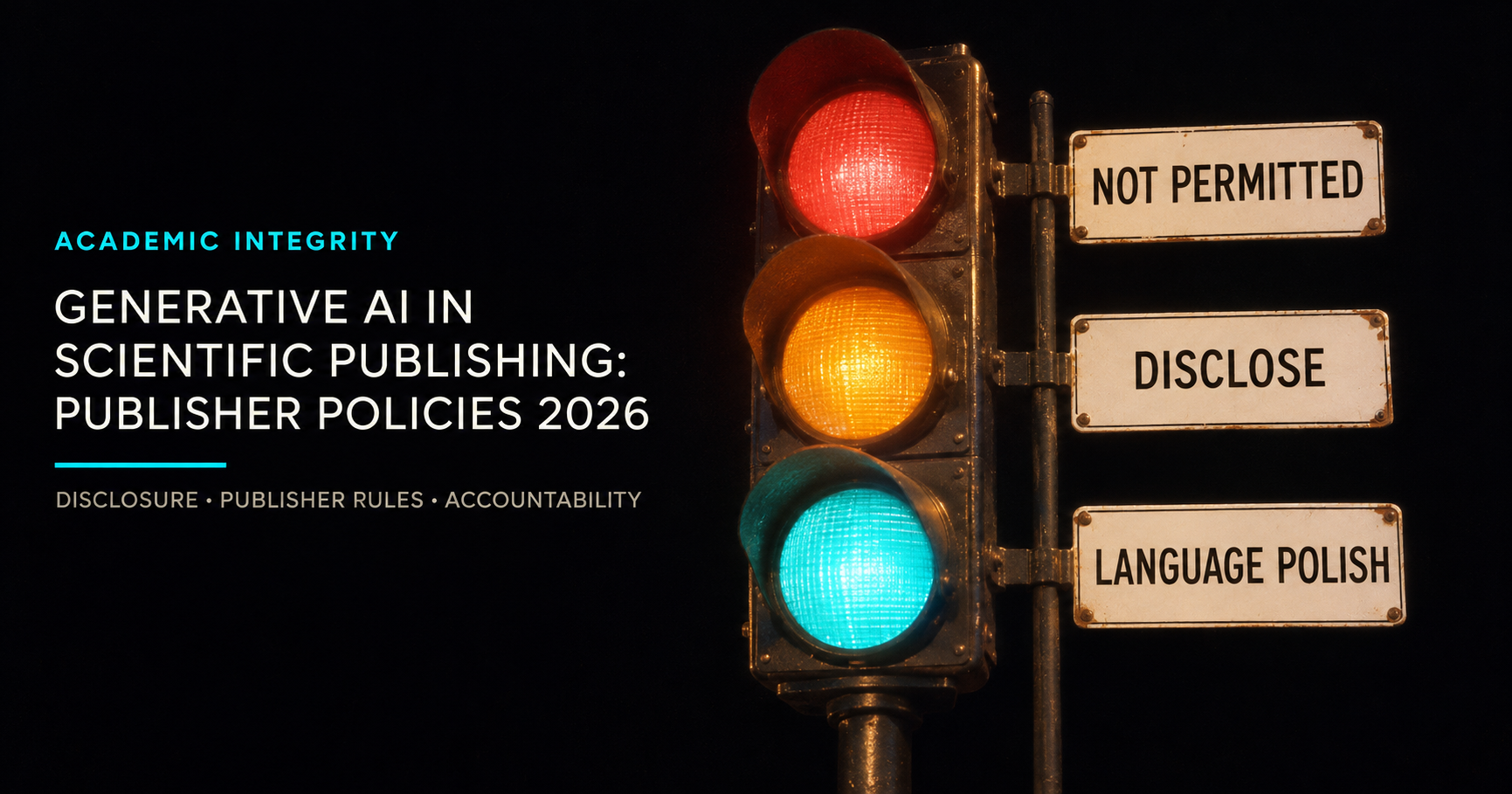
The pattern across these policies: language polishing is usually low risk, while generating text, analysis or interpretation triggers disclosure, and some uses are not permitted at all. For the researcher's side of this question, see our guide to responsible AI use in research and our earlier posts on AI writing ethics and journal AI policy and traceability.
Where does AI detection fit?
Disclosure depends on what you actually did, not on what a tool says. A detector cannot tell an editor whether you used AI, and it should not be used as proof either way. Studies have shown detectors can misclassify human text, and our posts on false positives and defending a manuscript against a false flag explain why.
The SciCampus AI Detector classifies each sentence as human, AI-generated or AI-paraphrased with probabilities, gives a document-level score and a downloadable report, and describes its results as estimates, not proof. Used before submission, it can help you review passages where you used AI help and compare them with what you plan to disclose. Your own record of how you used AI, and your target journal's policy, remain the basis for an accurate declaration.
What should you do before submitting?
Read the current AI policy of your target journal, not just the publisher's general page.
List every way you used AI: language, translation, drafting, coding, analysis, figures, literature search.
Match each use to the policy: not required, disclose, or not permitted.
Name the tool and, where required, the version and purpose.
Describe AI used in methods in the Methods section, if the policy requires it.
Verify all AI-generated content, especially references and numbers.
Keep records of how you used AI in case an editor asks.
Related Reading (Topic Ideas for Future Posts)
How to write an AI-use declaration: sample statements for language editing, translation and coding.
AI and peer review: what publishers allow reviewers and editors to do.
Using AI for figures and images: what journals permit and require.
Keeping an AI-use log during manuscript preparation.
References
Liang, W. et al. (2025). Quantifying large language model usage in scientific papers. Nature Human Behaviour. doi:10.1038/s41562-025-02273-8
Earp, B. D., Frith, L., Porsdam Mann, S., Sawai, T., Shahvisi, A. & Wangmo, T. (2026). Normalising transparency: an argument for requiring generative AI use declarations in all manuscripts, with a call for commentaries. Journal of Medical Ethics, 52(6). jme.bmj.com
Elsevier. Generative AI policies for journals (updated June 2026), and announcement, 18 August 2026.
Springer Nature. Journal AI policies, August 2026 version (copy hosted by a journal site). Confirm on Springer Nature's own page.
Wiley. Best Practice Guidelines on Research Integrity and Publishing Ethics.
Taylor & Francis. Using AI in your research and manuscript preparations.
IEEE. Author guidelines for AI-generated text (16 April 2024).
PLOS. Ethical publishing practice.
Times Higher Education (September 2026). Researchers "not fully disclosing" AI use, OUP survey reveals.