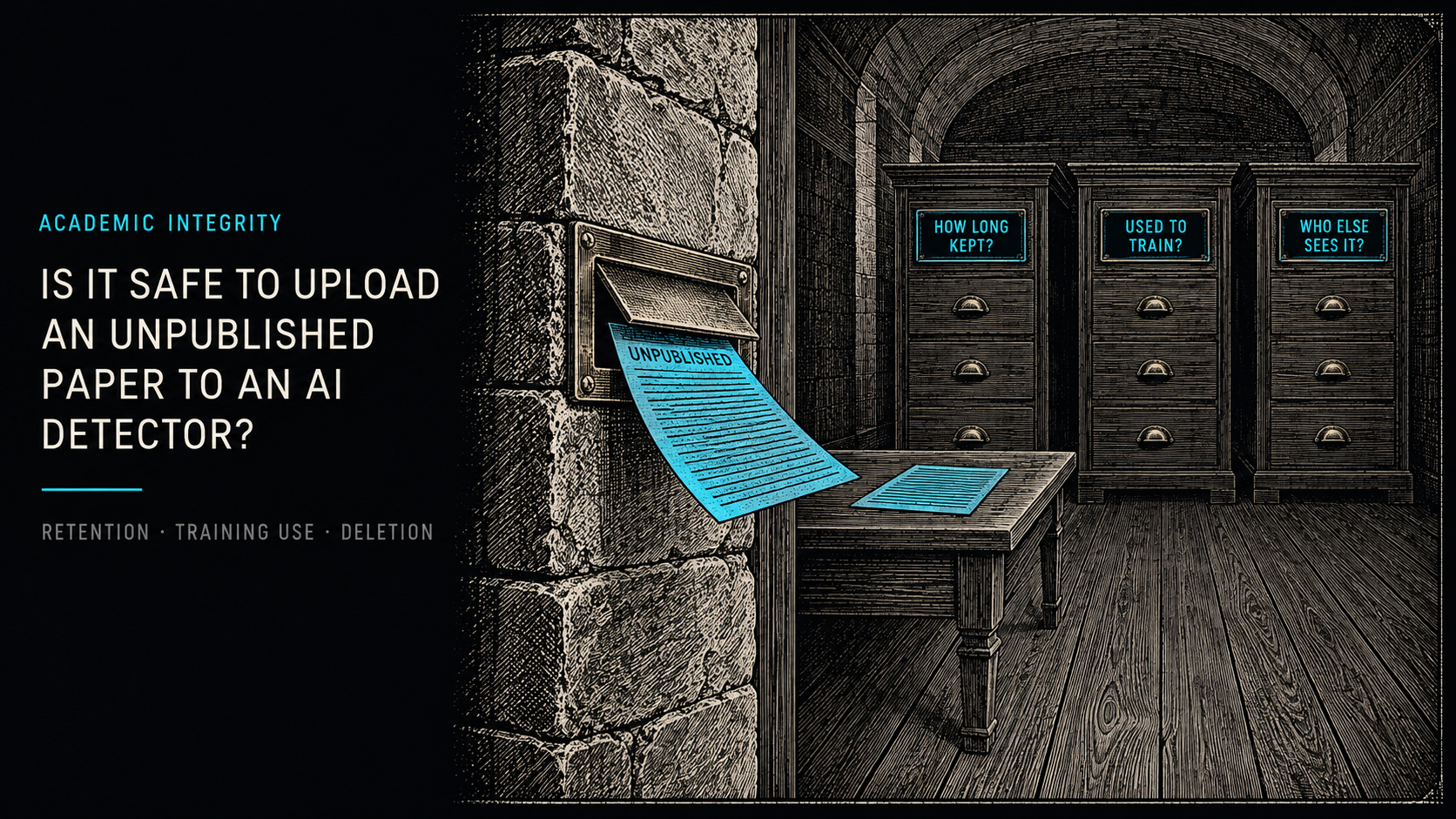
Short answer: It depends on three things: whose manuscript it is, what permissions you hold, and what the service documents about handling your text. If the paper is your own, the main risks are practical and contractual. If you were asked to review it, the safe default is not to upload it unless the journal has explicitly authorised that tool.
AI detector privacy is a confidentiality question, and it comes before any question about accuracy. This article offers a framework for deciding whether to upload, a list of questions to put to any service, and a pre-upload checklist. It is not legal advice; for data-protection questions, consult your institution’s research-data or data-protection office.
Why Does Confidentiality Come Before Accuracy?
An AI detector is a service that receives your text. Once you upload a draft, it is copied to someone else’s systems, processed, and possibly kept. Whether the result is accurate matters only after you have decided that the transfer is acceptable.
The order matters because the two risks behave differently. A poor result can be re-checked or set aside. Disclosure of unpublished work may be difficult or impossible to reverse. Accuracy, false positives and how to respond to a flag are covered elsewhere on SciCampus, including why aggregate AI scores fail, false positives and sentence-level stylometry, and our guidance on AI use in academic writing. This article deals only with the step before any of that: should this text be uploaded at all?
Is Your Manuscript Different From One You Were Asked to Review?
Yes. The obligations differ sharply between these two situations. Do not treat rules written for one as if they applied to the other.
Can You Upload Your Own Manuscript?
Uploading your own draft is generally not a breach of reviewer confidentiality, because you are not handling someone else’s confidential submission. The relevant questions are practical and contractual:
Do your co-authors agree?
Do institutional or funder rules restrict where drafts may be sent?
Does the text contain sensitive, identifiable or commercially confidential material?
What does the service say about retention, reuse and deletion?
Publisher guidance points in the same direction. Elsevier’s generative AI policies for journals tell authors to check the terms of any AI tool they use so that the privacy and confidentiality of their data and unpublished manuscripts is maintained. Elsevier does not say that authors may not use AI detectors; it asks them to check the terms and to protect confidentiality.
A manuscript is also rarely one person’s property. Springer’s journal policies make the corresponding author responsible for ensuring that all listed authors have approved the manuscript before submission, so agree with your co-authors before sending a shared draft to an external service.
Can You Upload a Manuscript You Were Asked to Review?
Here the position is far stricter. Each source below is described in its own terms, and they are not identical.
ICMJE
What it says: Reviewers should follow the journal’s stated AI policy or request permission before using AI to help with a review. Uploading a manuscript to AI software can breach confidentiality where confidentiality cannot be assured, unless the journal explicitly permits it. Reviewers who use AI should disclose it to the journal (ICMJE, n.d.).
Scope: Conditional: turns on whether confidentiality can be assured and whether the journal has permitted the use.
Nature Portfolio
What it says: Asks that “peer reviewers do not upload manuscripts into generative AI tools” and to declare transparently any AI tool that supported their evaluation (Springer Nature, n.d.).
Scope: A direct request to reviewers.
Elsevier
What it says: Reviewers must never upload a submitted manuscript, or any part of it, into an AI tool. Limited support for a report’s language is allowed only with private tools, disclosure and human oversight (Elsevier, n.d.).
Scope: Strict on uploading; narrow on support.
NIH
What it says: Notice NOT-OD-23-149, released 23 June 2023, prohibits NIH peer reviewers from uploading or sharing grant-application content to online generative AI tools, noting that such tools offer no guarantee of where data are “sent, saved, viewed, or used in the future” (NIH, 2023).
Scope: Grant applications and contract proposals, not journal manuscripts.
The sources differ in scope and strength, and policies also differ between publishers and between brands of the same publisher, so the journal’s own instructions take precedence.
Our conservative editorial recommendation, drawn from the strictest of these policies, is this: do not upload a manuscript under review to any external AI tool, including an AI detector, unless the journal has explicitly authorised that tool. None of the pages above names AI detectors specifically, and this rule is our reading, not a finding that all sources say the same. If the instructions are unclear, ask the handling editor before you upload anything. For the reviewer’s side of the process, see our guide to the peer review process, and for the latest publisher developments, our report on journal AI policy and the traceability standard.
What Should You Ask Any AI Detector About Privacy?
Whatever the manuscript’s status, put the same questions to a service. Look for answers in its privacy policy and terms, not in marketing copy.
Purpose
The question: Why is the text processed?
What a good answer looks like: Processing is tied to producing the result you requested.
Retention
The question: How long is the text kept, and does that cover copies, reports and run history?
What a good answer looks like: A period or a condition, such as “while the account is active.” “As long as necessary” alone is vague.
Secondary use and training
The question: Is your text used to train models, and for whom?
What a good answer looks like: A clearly scoped promise. A statement limited to “other users” leaves other uses unaddressed.
Deletion
The question: What can you delete, and what does deletion cover?
What a good answer looks like: Mentions reports, history and backups.
Third-party access
The question: Which providers can reach your content?
What a good answer looks like: Names are more informative than categories.
International transfers
The question: Where might processing take place, and what safeguards apply?
What a good answer looks like: Named safeguards, such as standard contractual clauses.
Security
The question: What measures are described?
What a good answer looks like: Specific measures, and an honest admission that no system is perfectly secure.
Accounts and visibility
The question: Who can see your history, and may accounts be shared?
What a good answer looks like: Clear rules on account sharing and access.
Do AI Detectors Store My Manuscript?
Some services may retain uploaded text, along with results and reports, and some may reuse it. Elsevier notes that many AI tools process and store what users upload. Whether a particular detector uses your text to train its models depends on that service’s own privacy policy and terms, and only those documents can tell you.
A documented answer is specific, scoped and checkable. A vague one is a reason to pause, to ask the provider in writing, or to use a different approach for that manuscript. Silence on a point is not reassurance. It means the point is undocumented.
What Permissions Do You Need Beyond the Tool?
A trustworthy privacy policy does not give you the right to upload. That comes from the people and rules attached to the manuscript.
Co-authors. Agree in advance that the shared draft may go to an external service, ideally in writing.
Institution and funder. Some research-data policies restrict where unpublished material may be sent. Check yours before assuming silence means permission.
Sponsors and commercial partners. Collaboration or sponsorship agreements may treat results as confidential until a set date.
Participants and sensitive data. Clinical details, interview extracts and small-sample demographics can identify people even without names.
Third-party material. If the draft includes text or figures you do not own, uploading them may be a rights question in its own right. Services often address this in their own terms: the SciCampus Terms and Conditions prohibit uploading content that you do not have the legal right to use.
Then minimise exposure. A detector needs prose, not your whole project. Upload only the sections you want checked, remove author names, affiliations, grant numbers and acknowledgements, and cut unpublished data tables or participant quotations that are not needed for the check. Keep a note of what you uploaded, when and to which service. The same discipline applies to any tool that receives your draft, including similarity checkers, paraphrasers and humanizers such as the SciCampus Similarity checker and the AI Humanizer. Our manuscript integrity SOP for multi-author labs shows how to build this into lab routine.
What Does SciCampus Document About Its AI Detector?
The facts below come from SciCampus’s own pages. Please read the documents themselves rather than relying on this summary. The SciCampus AI Detector accepts pasted text or PDF/DOCX files up to 20 MB, classifies sentences as human, AI-generated or AI-paraphrased with per-sentence probabilities and a document-level score, and describes its results as a prompt for review, not proof of authorship. It is free to start, no card required, and offers a downloadable report.
The Privacy Policy, last updated 19 October 2026, states that submitted content is processed to generate the requested results and to maintain run history, reports and uploaded files. Account information, uploaded content and run history are kept “for as long as your account remains active.” Users can delete individual files from their file manager, and can request account deletion through support@scicampus.com. Verified requests are actioned “within a reasonable timeframe,” except where certain information must or may be retained for legal, tax, fraud-prevention or dispute-resolution purposes. The documents do not say whether deleting a file also removes run history or reports.
On training, the policy says: “We do not sell your personal data, and we do not use the content of your academic documents to train AI models for other users or for purposes unrelated to providing you the Service.” Applying the scope test above, that covers training for other users and purposes unrelated to the Service. Beyond this sentence, the documents do not describe how content is used internally.
The policy also says SciCampus engages service providers for hosting and infrastructure, email delivery, customer-support tooling and a third-party cryptocurrency payment processor, contractually bound to use data only to provide services to SciCampus and to protect it appropriately. Information may be processed in other countries, with safeguards such as standard contractual clauses. Data may be disclosed where required by law, or transferred in a business transaction such as a merger or sale of assets. SciCampus.com is named as data controller for data protection purposes, including the EU/UK GDPR; that describes its role, not a compliance assessment. Security measures listed include encrypted transmission, hashed password storage and access controls, alongside a statement that no method of transmission or storage is completely secure.
The Terms and Conditions, also last updated 19 October 2026, say users keep ownership of what they submit but are solely responsible for having the necessary rights to submit it, and say accounts are personal and may not be shared. The AI Detector page describes similarity analysis as running “when enabled”; the documents do not specify how text is handled in that optional step.
Nothing in SciCampus’s documents authorises reviewers or editors to upload manuscripts under review; that permission can only come from the journal. For questions about any of this, contact support@scicampus.com.
Am I Permitted to Upload This Version? A Pre-Upload Checklist
Work through these items for the specific file you plan to send. Every answer should be yes. If any answer is no or not sure, stop and check before uploading.
Have I confirmed that this is my own manuscript and not one I received to review or edit?
Have all co-authors agreed to this upload?
Do my institution’s and funder’s rules permit sending unpublished drafts to external services?
Is there no sponsor or commercial confidentiality clause covering this text, or have I confirmed that it permits the upload?
Have I removed participant-level or identifiable data that the check does not need?
Do I hold the rights to every part of the text, including reused or third-party material?
Have I read the service’s current privacy policy and terms, noted their “last updated” dates, and found written answers on retention, training and deletion?
Have I removed names, affiliations, grant numbers and non-essential unpublished data, and limited the upload to the sections I need?
Do I know how to delete the file and the account afterwards, and have I recorded what I uploaded, when and to which service?
Related reading
Sources
Elsevier. (n.d.). Generative AI policies for journals. https://www.elsevier.com/about/policies-and-standards/generative-ai-policies-for-journals
International Committee of Medical Journal Editors. (n.d.). Recommendations: Use of AI by reviewers (Section V.B). https://icmje.org/recommendations/browse/artificial-intelligence/ai-use-by-reviewers.html
National Institutes of Health. (2023, June 23). The use of generative artificial intelligence technologies is prohibited for the NIH peer review process (NOT-OD-23-149). https://grants.nih.gov/grants/guide/notice-files/NOT-OD-23-149.html
Springer. (n.d.). Journal policies. https://link.springer.com/brands/springer/journal-policies
Springer Nature. (n.d.). Nature Portfolio editorial policies: Artificial intelligence. https://www.nature.com/nature-portfolio/editorial-policies/ai
SciCampus. (2026, October 19). Privacy Policy and Terms and Conditions. https://scicampus.com/privacy and https://scicampus.com/terms