Academic paraphrasing is not a word-substitution task and should never be used as a technique for hiding AI assistance or reducing a similarity score. It is a controlled scholarly act: the author changes the expression and rhetorical placement of material while preserving its evidence, scope, uncertainty, attribution, and inferential limits. When those elements shift, the result may be more fluent prose but it is no longer faithful scientific writing.
For doctoral researchers, postdoctoral fellows, faculty authors, and laboratory leaders, the pre-submission objective is therefore not simply to make a manuscript sound more natural. It is to ensure that every revision remains scientifically true, properly attributable, and defensible in peer review. This guide focuses on the central integrity challenge in academic paraphrasing: preventing semantic and evidentiary drift while improving readability.
Fluency is not meaning-neutral
The final revision stage is where many well-designed manuscripts become vulnerable. Authors are responding to co-author comments, peer-review feedback, journal style requirements, language concerns, and time pressure. In that setting, a rewrite that appears cosmetic can quietly change the scientific claim. A model may "improve" a sentence by making it more decisive; a co-author may remove a caveat for brevity; a paraphrasing tool may replace a careful description of an association with causal language.
Consider the difference between these statements: "higher exposure was associated with lower symptom scores," "higher exposure predicted lower symptom scores," "the intervention reduced symptoms," and "the intervention eliminated symptoms." The sentence structure is similar, but the evidentiary burden is radically different. The first may accurately describe an observational result; the last implies an effect that could require a well-controlled experimental design and substantially stronger evidence.
Scientific meaning resides in more than individual terms. It is carried by the population, setting, design, comparator, outcome definition, effect estimate, uncertainty, timeframe, analytical model, citation, and stated limitation. A revision that improves sentence rhythm but changes any of those elements can create semantic drift. When it also weakens or misstates the evidentiary basis of the claim, it creates evidentiary drift.
The integrity risk of "humanizing" prose
"Humanize" is often used as a benign editorial instruction, but it can be misunderstood. Ethical humanization means removing empty formulae, restoring study-specific language, clarifying logic, and ensuring that the author's analytical voice is evident. It does not mean adding stylistic irregularity to evade a detector, replacing precise technical language with vague prose, or using a paraphraser to make borrowed material difficult to trace.
Blind paraphrasing creates three distinct risks:
Meaning inflation: a nuanced or tentative claim becomes categorical, causal, generalizable, or novel.
Attribution erosion: another author's finding, interpretation, definition, or conceptual structure is retained but insufficiently cited.
Provenance concealment: authors optimize surface wording against a detector or similarity system rather than documenting what material was used and how it was revised.
The desired outcome is not a manuscript that appears less machine-like. It is one in which the authors can explain the origin, evidence, and purpose of every substantive sentence.
Why surface rewriting fails
Surface rewriting changes adjectives, verbs, and sentence order while leaving the intellectual architecture intact. This is why a passage can produce a low textual-overlap result yet remain a close paraphrase. If the source introduces the same finding, in the same order, with the same causal explanation and conclusion — and the new version merely swaps vocabulary — the author has not performed independent scholarly synthesis.
Another common error is citation laundering: attach a citation to a heavily reworded passage and assume the integrity issue is resolved. Citation acknowledges a source, but it does not automatically permit near-reproduction of distinctive expression. Conversely, a high overlap score does not automatically establish misconduct: standard methods terminology, formal definitions, quotations, legal language, and references may generate matches that are legitimate in context.
The appropriate unit of analysis is neither the aggregate score nor the isolated sentence. It is the sentence in relation to its source, the study evidence, the surrounding argument, and the author's documented revision process. For a fuller treatment of why aggregate scores mislead, see our guide on why single AI scores fail.
Q1/Q2 editorial stakes
High-selectivity journals screen for more than language errors. Editors assess whether claims are supportable, whether citations accurately represent the cited literature, whether limitations are adequately reported, whether duplicate or unattributed material is present, and whether the manuscript is compliant with authorship and AI-use policies. An abstract that overstates a result may be viewed as a reporting problem; an inadequately attributed literature passage can become a plagiarism concern; undisclosed substantive AI use can create a transparency issue.
COPE's guidance is clear that AI tools cannot hold authorship because they cannot accept responsibility. Named human authors remain accountable for all submitted material, including content created or modified with AI assistance. Elsevier likewise requires authors to retain critical oversight, verify AI-supported output, check sources, and make substantive use transparent. The safest principle is straightforward: no automated rewrite should be accepted until an author verifies its scientific and ethical meaning.
Four tasks that are not interchangeable
Paraphrasing, quotation, summary, and synthesis require different treatment. Confusing them is a primary source of integrity failures.
Quotation retains a source's language. Use it sparingly when exact phrasing matters — for example, a formal definition, a legally consequential statement, interview data, or text being analyzed. It requires clear quotation formatting and precise citation.
Paraphrasing restates a specific source's point in independent language and organization while preserving its meaning. It always requires attribution. A genuine paraphrase can change the entry point and sentence structure because it is written to serve the current paper's argument, not to mimic the source.
Summary condenses a broader study or body of literature. It must retain the source's relevant scope, caveats, and conclusion. A summary that selects only favorable findings while omitting limitations is not faithful.
Synthesis is the author's analytical integration of multiple sources. It should reveal patterns: agreement, conflict, methodological variation, untested assumptions, or research gaps. It is not a sequence of lightly rewritten source summaries.
Before revising, label which of these four tasks the passage is performing. This single step makes it much harder to commit accidental mosaic plagiarism or to turn a nuanced source conclusion into an overgeneralized manuscript claim.
The five conditions of an evidence-preserving paraphrase
A paraphrase should satisfy five conditions simultaneously.
Evidentiary fidelity means the revised statement reports what the data or source actually establishes. Verify against the original results table, statistical output, or source text. If the source reports an adjusted association, do not rewrite it as an intervention effect.
Scope preservation means retaining the limits that define applicability: population, sample size where relevant, country or care setting, outcome definition, time horizon, and inclusion criteria. A finding from one outpatient clinic cannot become a claim about all patients without additional evidence.
Modality preservation means retaining the strength of the inference. Hedges such as "may," "suggests," "is consistent with," and "was associated with" are not weak writing; they are calibrated scientific statements. Removing them may create a claim the study was not designed to support.
Attribution integrity means identifying the intellectual origin of findings, methods, concepts, and interpretations. A citation should be placed where the borrowed material is used, not merely at the end of a paragraph that contains several unrelated claims.
Independent authorial contribution means the revised wording and argument sequence are genuinely the author's. The manuscript should make clear why the cited evidence matters for the present research question, not recreate the source paragraph with substitutes.
If any condition fails, the revision is incomplete. Better grammar cannot compensate for distorted evidence; a citation cannot correct a causal overstatement; and a low similarity index cannot cure unacknowledged conceptual borrowing.
Five kinds of semantic drift to watch for
Semantic drift commonly enters through apparently helpful language edits.
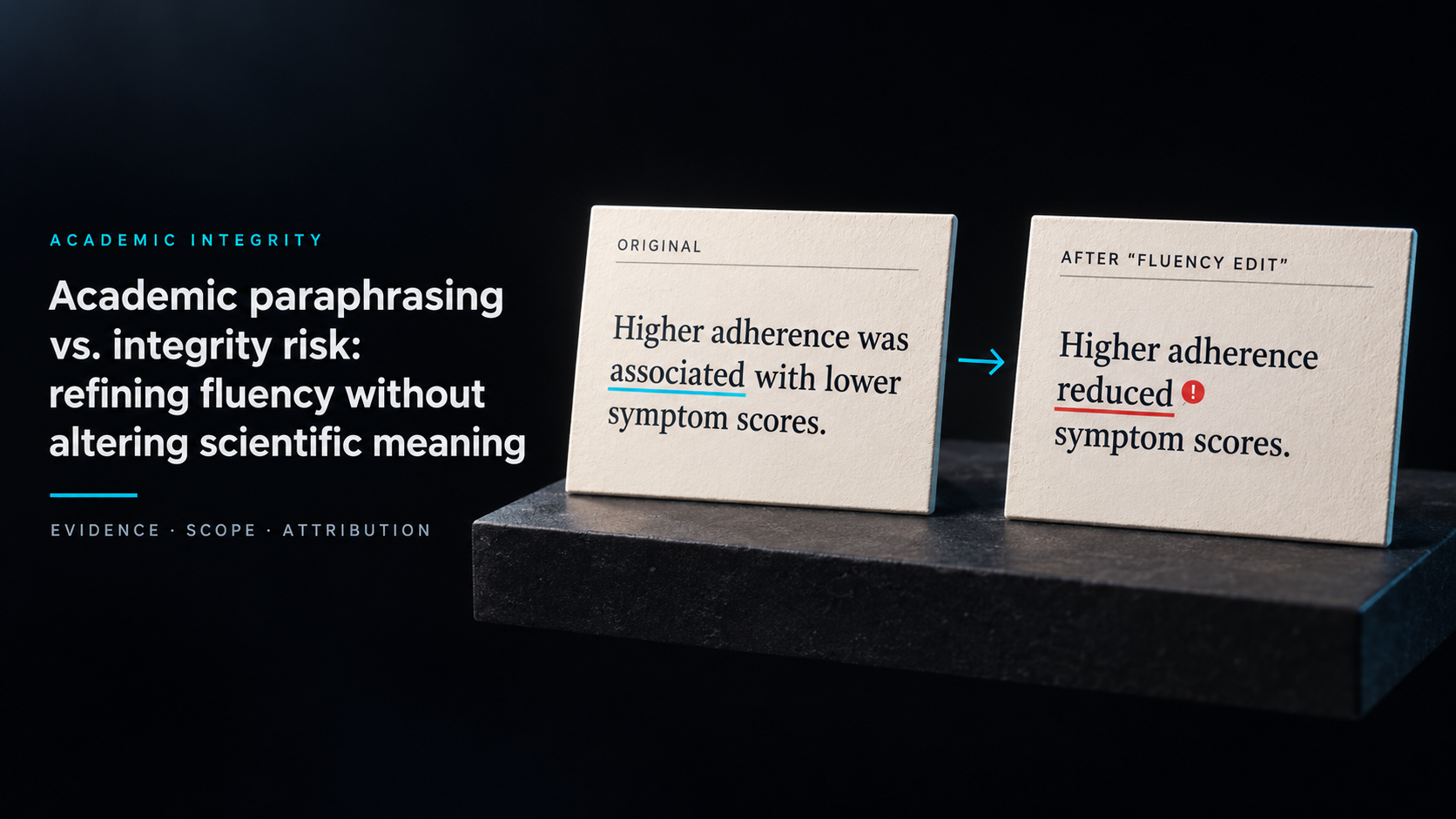
Causal drift occurs when correlational or observational language becomes causal. "Participants with higher adherence had lower symptom scores" should not become "adherence reduced symptoms" unless the design and analysis justify causal inference.
Quantifier drift occurs when a limited result becomes broad. "Most participants in this sample" differs from "patients generally." "A subgroup analysis found" differs from "the study established."
Modality drift occurs when uncertainty is removed. "May improve," "suggests," "is compatible with," and "requires replication" should not become "improves," "demonstrates," "proves," or "confirms" without new evidence.
Comparator drift occurs when the reference condition disappears. "Higher than usual care" is not equivalent to "effective." A relative difference, an absolute difference, and a change from baseline answer different questions.
Limitation drift occurs when caveats vanish. A revision may remove references to sample selection, missing data, lack of randomization, measurement uncertainty, or short follow-up because they make the sentence less elegant. In scientific writing, these qualifications are part of the result.
Similarity and stylometry: evidence, not editing targets
A similarity report and an AI-detection output can help authors direct attention, but neither should dictate revisions automatically. A whole-document score cannot explain whether the issue lies in conventional methods language, properly quoted material, a source-dependent literature paragraph, or unreviewed generated content.
The SciCampus AI Detector supports a more granular audit by surfacing sentence-level signals. Its probability bands — red at ≥99%, orange at ≥96%, and yellow at ≥93% — are triage indicators, not determinations of misconduct. They should trigger questions: Does this passage make a generic claim? Is it supported by the paper's data? Does it reproduce or paraphrase a source? Can the author explain its drafting history?
Its sentence-level sub-classification distinguishes probable raw AI-generated text from probable AI-paraphrased writing. Raw output may require an evidence check for generic claims, fabricated details, overconfident conclusions, or unsupported references. AI-paraphrased writing requires a different pathway: inspect source dependence, confirm attribution, and rebuild expression and argument where needed. This is the point of using a tool in an integrity workflow — not to make flags disappear, but to apply the correct human review.
DOI-linked source verification
Similarity should be reviewed at source level. SciCampus provides a search-grounded similarity index with DOI-linked sources where available, allowing authors to inspect the actual scholarly record behind a match. The reviewer should read the source passage in context, determine what is being borrowed, and record a disposition.
A defensible disposition is one of five outcomes: retain standard language or a properly quoted passage; add a missing citation; reframe a close paraphrase in independent language and reasoning; disclose permitted self-overlap; or remove unsupported or indefensible text. The objective is not the lowest possible percentage. It is accurate attribution and a transparent record of decision-making.
Edit for accuracy, not detector avoidance. Use the SciCampus AI Detector — free to start, no card required — to review language at sentence level, investigate DOI-linked sources, and focus revision on real evidentiary risks. Create a free account.
An eight-step revision workflow
Step 1: Identify provenance and rhetorical function
Do not rewrite a sentence until you know what it is doing. Is it reporting a result from the current study, defining a concept, summarizing a source, synthesizing literature, describing a method, or interpreting an implication? Then identify its provenance: original author draft, cited external source, prior publication by the team, co-author revision, professional edit, or AI-assisted output.
For source-based content, open the article through the DOI or publisher record and read the surrounding text. Record the specific intellectual material being used: a finding, numerical estimate, definition, theoretical proposition, methodological choice, or interpretation. This avoids rewriting a sentence without understanding the boundary of the original evidence.
Step 2: Write an invariant-content note
Before changing wording, capture the scientific elements that must remain unchanged. This note should state the population or dataset, design, exposure or intervention, comparator, outcome, effect direction and magnitude, uncertainty, timeframe, limitation, and source.
For example: "Single-site prospective cohort; 214 outpatients; baseline adherence; six-month attendance; adjusted negative association; not randomized; residual confounding possible." The final wording can differ completely from the note, but it must not contradict it.
Step 3: Reconstruct, do not substitute
Build the new sentence from the role the evidence plays in your own argument. Begin with the point your manuscript needs to establish, then integrate the source accurately. Do not retain the source's sequence of claim, explanation, and conclusion merely while swapping words.
Before: synonym-swapped, source-dependent paraphrase
"Earlier investigations found that electronic alerts significantly enhanced adherence, proving that digital interventions are highly successful."
This version risks several forms of drift. "Earlier investigations" conceals the specific evidence base; "enhanced" may imply causation without identifying the design; "proving" overstates inference; and "digital interventions" generalizes beyond the actual reminder system.
After: evidence-preserving, attributed paraphrase
"In a randomized study of outpatient reminder messages, participants allocated to the intervention reported higher medication-adherence scores than controls; the findings support evaluation of reminder systems in comparable care settings (Author, Year)."
The revised form identifies the design and comparison, attributes the result, avoids universalizing the finding, and frames the implication as an appropriate next step rather than a settled conclusion.
Step 4: Conduct a semantic-drift audit
Read the source or results record, the invariant-content note, and the revised sentence side by side. Then apply the following questions:
Has the subject expanded from the observed sample to a wider population?
Has the study design been softened, omitted, or changed?
Has an association become a causal claim?
Has a relative comparison become an absolute efficacy claim?
Have uncertainty, confidence intervals, qualifications, or limitations been removed?
Has the text merged the cited author's conclusion with the current paper's interpretation?
Is every borrowed concept, result, or definition attributed at the point of use?
If any answer indicates drift, correct the passage before moving on.
Before: correlation converted to causation
"Higher baseline adherence reduced the risk of missed follow-up appointments."
If the underlying study is observational, this sentence assigns a causal effect that the design may not establish.
After: design-faithful paraphrase
"Higher baseline adherence was associated with a lower probability of missed follow-up appointments after adjustment for age and baseline severity."
The revision preserves the analysis and does not imply that changing adherence will necessarily cause a reduction in missed appointments.
Before: limitation removed for fluency
"The intervention improved outcomes across the patient population."
This version omits essential boundary conditions: which patients, compared with what, over what period, and with what uncertainty.
After: limitation-preserving claim
"Among participants recruited from two urban outpatient clinics, the intervention group had higher three-month outcome scores than usual care; limited follow-up and single-region recruitment constrain generalizability."
The revision is longer but more accurate. Scientific fluency does not require eliminating the limits that allow readers to interpret a result responsibly.
Step 5: Use sentence-level audit signals responsibly
Review the manuscript with the AI Detector after substantive revisions, not before the authors understand the evidence. Prioritize red, orange, and yellow sentences only as review prompts. If a sentence is marked as probable raw AI output, test it for unsupported generalizations, fabricated detail, and weak linkage to the actual study. If it is marked as probable AI-paraphrased writing, use DOI-linked similarity evidence to investigate whether it has retained a source's distinctive expression or argument structure.
Do not rewrite a retained sentence simply to alter a probability band. A sentence that is scientifically precise, fully attributed, and author-owned may remain stylometrically regular. In that case, preserve the evidence supporting its provenance rather than degrading its clarity.
Step 6: Verify sources and classify each finding
Use the DOI-linked similarity record to compare potential matches in context. For each material match, make a written decision:
Retain when the passage is standard terminology, a legitimate quotation, or an independently written, accurately cited statement.
Cite when the idea, finding, method, or definition has an unacknowledged source.
Reframe when the wording or argument sequence remains too close despite citation.
Disclose when matching text arises from an earlier thesis, preprint, protocol, conference paper, or publication and the journal requires transparency.
Remove when the claim is unsupported, source-dependent beyond repair, inaccurate, or not essential.
This classification provides a clearer integrity record than a single similarity percentage.
Step 7: Obtain subject-matter approval
The author who understands the data, analysis, or cited source should approve material changes. The corresponding author can coordinate this process but should not silently accept a fluency edit that changes the interpretation of a co-author's work. Require explicit confirmation for revised abstract claims, statistical interpretations, methods descriptions, limitations, and conclusions.
Where AI use exceeds basic mechanical proofreading, prepare a truthful declaration consistent with the target journal's instruction. Describe the tool, purpose, scope, and human review. Disclosure is not a substitute for verification; it is evidence that the team has acted transparently.
Step 8: Retain a defensible revision record
When the audit is complete, download the highlighted PDF evidence report. Preserve it with the final manuscript version, invariant-content notes, source checks, author approvals, tracked changes, and any AI-use disclosure. The PDF does not prove that software established authorship. It documents the passages reviewed and supports an evidence-based account of how the team resolved material findings.
Make each revision defensible. Start a language and source audit on SciCampus — free to start, no card required — verify DOI-linked evidence, and keep a highlighted PDF record before your manuscript enters peer review. Get started.
Edge cases and pitfalls
Non-native English authors and professional language editing
Language support is legitimate. Non-native English-speaking scholars should be able to use grammar tools, translation support, and professional editing to communicate their research clearly. The integrity threshold is not whether a sentence sounds highly polished; it is whether the author understands, approves, and can defend its scientific content.
Highly regular prose can produce stylometric signals, particularly after conventional editing. That is not proof of misconduct. Do not introduce grammatical errors or unnatural variation to look more human. Verify the sentence's evidence, retain relevant drafts and editing records, and respond to any inquiry with factual provenance.
Mosaic plagiarism with citations present
Citations do not always prevent mosaic plagiarism. A paragraph can cite its sources yet copy their sequence, transitions, and distinctive formulations too closely. This is common when authors draft directly beside a source document and revise sentence by sentence.
A practical safeguard is to close the source after taking notes, write the paragraph from the notes and the manuscript's own question, then reopen the source to check factual accuracy and citation placement. This reduces dependence on the original structure while preserving scholarly attribution.
Self-paraphrasing and redundant publication
Authors can inadvertently recycle their own language from dissertations, preprints, protocols, conference abstracts, grant applications, or published papers. Whether this is permissible depends on the source, copyright, journal policy, the amount of overlap, and whether prior dissemination is disclosed. Cite and disclose earlier work where required, and distinguish a genuinely expanded analysis from repackaged results.
Methods language is a frequent edge case. Some repetition may be necessary for reproducibility, but reuse should be proportionate and transparent. Explain procedures accurately, cite original protocols, and revise only where the new study differs — do not conceal overlap through automatic paraphrasing.
Multi-source synthesis without source flattening
A literature review should not treat all studies as interchangeable. When synthesizing, retain key differences in design, setting, participant population, effect measure, risk of bias, and certainty. Do not paraphrase several studies into a universal claim that none of them independently supports.
For example, a randomized trial, an observational cohort, and a qualitative interview study can inform a shared discussion but cannot be collapsed into the assertion that an intervention "works." State what each contributes and what remains uncertain.
Team coordination without bureaucratic overload
In multi-author projects, designate one integrity lead to maintain the source-review log and ensure that subject-matter authors review material claim changes. Keep the workflow simple: a shared document containing the original sentence, invariant-content note, revised sentence, DOI or data reference, disposition, and approver is usually sufficient.
A shared record should centralize DOI checks and highlighted reports rather than replace author accountability. The corresponding author remains responsible for ensuring that final revisions, disclosures, and submitted files are consistent.
Responding to an editor or committee inquiry
If questioned about paraphrasing, provide an organized case file rather than a general assurance that text was "only edited." Include the exact manuscript version; the questioned text; the source record and DOI; original and revised language; invariant-content notes; tracked changes; author approvals; disclosure statements; and, where available, the highlighted PDF report.
The aim is to make review fair and efficient. A contextual evidence file shows how the authors preserved meaning, corrected source dependence, and exercised human scholarly judgment.
Verification checklist and lab SOP
Meaning-preservation checklist
Identify the rhetorical function of each material revision: result, method, source paraphrase, summary, synthesis, interpretation, or quotation.
Create invariant-content notes for substantive claims: population, design, comparator, outcome, direction, magnitude, uncertainty, limitation, and source.
Check that no association has become a causal effect without appropriate design and analysis.
Check that population, setting, outcome definition, follow-up period, and analytical adjustment have not been broadened, removed, or altered.
Retain appropriate modality: do not replace "may," "suggests," or "was associated with" with "proves," "demonstrates," or "caused" unless justified.
Preserve limitations and boundary conditions in the abstract, results, discussion, and conclusion.
Attribution and similarity checklist
Verify every source-based passage against the original scholarly record through its DOI where available.
Cite borrowed ideas, results, methods, definitions, and interpretations at the point at which they are used.
Use quotation marks when language remains materially close to the source.
Rebuild paragraphs that preserve a source's argument order or distinctive transitions despite synonym changes.
Review self-overlap against theses, preprints, protocols, conference materials, and prior publications; disclose as journal policy requires.
Do not use paraphrasing solely to reduce similarity percentages.
Sentence-level review checklist
Treat whole-document AI and similarity scores as screening indicators, never as automatic integrity judgments.
Review sentence-level signals in their textual, evidentiary, and source context.
Investigate probable raw AI-generated passages for factual accuracy, specificity, and disclosure needs.
Investigate probable AI-paraphrased passages through DOI-linked source verification.
Retain accurate, human-authored, supported sentences even when they produce a possible false-positive signal; preserve supporting provenance.
Submission and archive checklist
Read the exact target journal's current instructions on authorship, AI, text reuse, data, figures, ethics, and reporting.
Obtain explicit approval from the relevant subject-matter author for substantive changed claims.
Prepare a truthful AI-use declaration if required by the journal.
Download and retain the highlighted PDF evidence report with the final manuscript identifier.
Archive the source log, DOI evidence, invariant-content notes, tracked changes, approvals, disclosures, and final audited manuscript.
Confirm that the uploaded submission is the exact version that completed the final audit.
A five-gate lab SOP
Classify: Identify the provenance and rhetorical function of every material source-based or AI-assisted revision.
Preserve: Write invariant-content notes before changing language for fluency.
Reconstruct: Draft in the manuscript's own logic, with accurate citation and explicit limits.
Verify: Compare against data and DOI-linked sources; investigate material sentence-level signals contextually.
Archive: Retain decisions, approvals, disclosures, the final manuscript, and the highlighted evidence report.
Publish with fluent prose and faithful evidence. Audit language and verify DOI-linked sources with SciCampus — free to start, no card required — before you submit. Try it free.
Frequently asked questions
Is paraphrasing with an AI tool allowed in academic writing?
Language assistance is generally legitimate, but it depends on the journal and on what the tool actually changed. If a rewrite alters a claim, its scope, or its certainty, that is a substantive change requiring author verification and possibly disclosure. Using a paraphraser to disguise borrowed material is never acceptable, regardless of policy wording.
Does adding a citation make a close paraphrase acceptable?
Not on its own. A citation acknowledges the intellectual source, but it does not license near-reproduction of another author's distinctive expression or argument sequence. If the wording remains materially close, quote it or rebuild the passage in your own analytical logic.
What is semantic drift and how do I catch it?
Semantic drift is a change in scientific meaning introduced by an edit that looks cosmetic — an association becoming a cause, a sample becoming a population, a hedge disappearing. The practical defence is an invariant-content note: record the population, design, comparator, outcome, magnitude, uncertainty, and limitation before you rewrite, then check the new sentence against it.
Should I remove hedging words to make my writing sound stronger?
No. Hedges such as "may," "suggests," and "was associated with" are calibrated to the evidence, not signs of weak writing. Removing them creates a claim your study design may not support, which is a reporting problem editors and reviewers look for.
My writing gets flagged as AI even though I wrote it. Should I rewrite it?
Not for that reason alone. Highly regular prose — common after professional editing or among non-native English writers — can produce stylometric signals without any misconduct. Verify that the sentence is accurate and attributed, keep your drafts and editing records, and leave clear writing intact rather than degrading it to look less regular.
Conclusion
Academic paraphrasing is a form of disciplined interpretation. Its quality cannot be measured by how different the new wording appears from the old, or by whether an aggregate detector score declines. The real test is whether the revised sentence preserves evidence, scope, modality, limitation, attribution, and the author's independent analytical role.
A strong pre-submission workflow makes semantic and evidentiary drift visible before peer review. It uses source-level DOI verification to protect attribution, sentence-level stylometry to target — not automate — review, and documented author approval to retain accountability. The outcome is not merely a smoother manuscript. It is a clearer and more credible scholarly record.
Policy note: Publisher and journal policies change. Consult the current instructions of the exact target journal before submission; where those requirements are stricter than this general framework, the journal's policy governs.