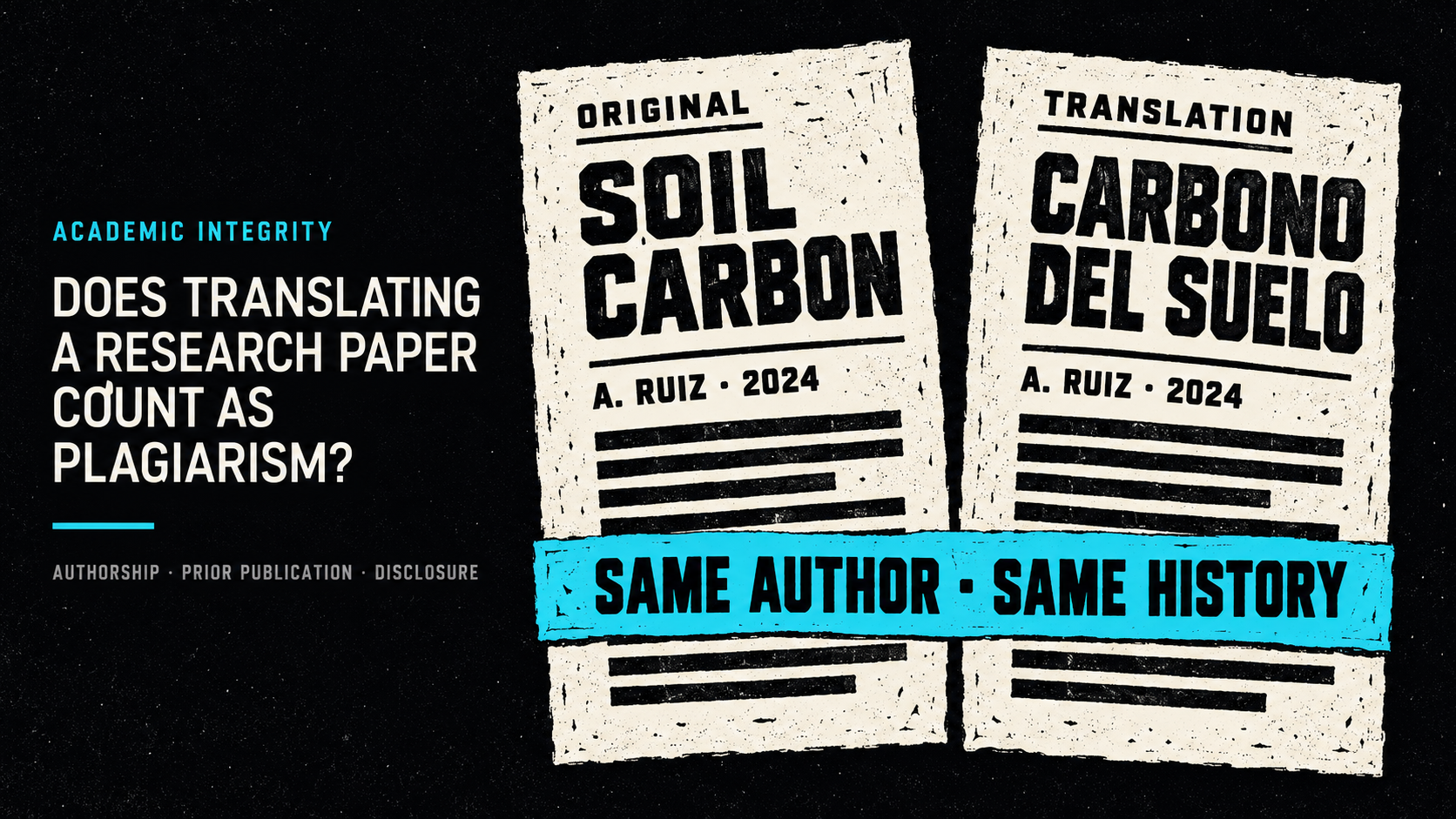
Short answer: It depends on whose text you translate, whether it has appeared before, and the receiving journal’s policy. Translation changes the language, not the source or the publication history. Another author’s contribution still needs acknowledgement; your own published article may require approval as a secondary publication rather than submission as new research. A low similarity result cannot resolve these questions.
Start with the source, the earlier version and the purpose of submission, not a percentage. The Taylor & Francis plagiarism policy is one publisher’s statement of these principles; other publishers differ.
What Is the Framework: Authorship, Publication History and Transparency?
Two questions organise the decision: whose contribution is being used, and what has already been communicated publicly?
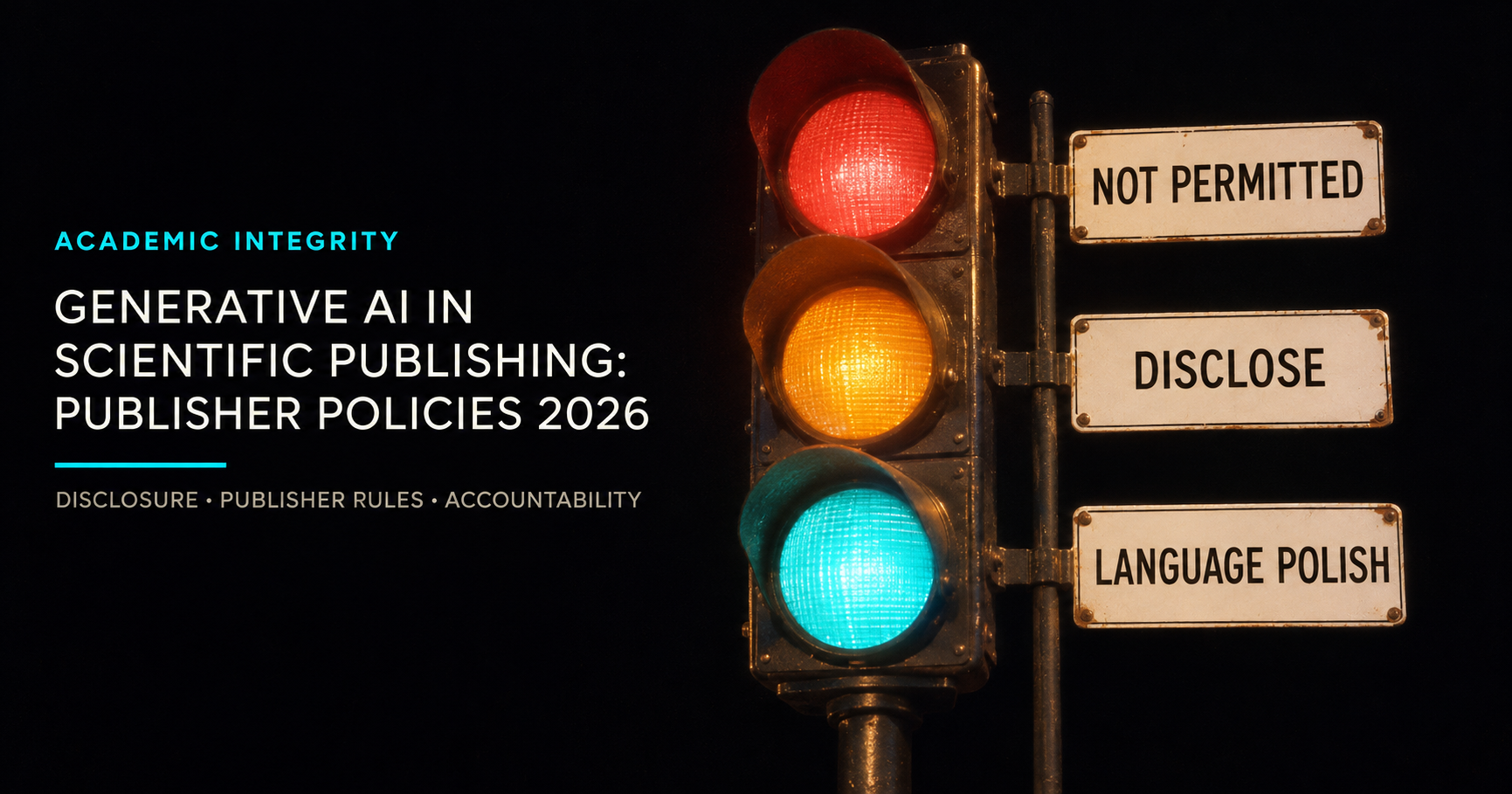
When you translate someone else’s work, its words, ideas and findings remain attributable to that author. When you translate your own work, the question is whether earlier material might be mistaken for a new contribution. Taylor & Francis defines self-plagiarism as the redundant reuse of your own work, “including text translated from another language, usually without proper citation.” This is that publisher’s stated position, not a universal rule governing every journal.
COPE-hosted text-recycling guidance, developed by BioMed Central, distinguishes reuse of an author’s text from redundant publication of data or ideas (COPE, n.d.). A translated extract and a translated research article therefore raise related but distinct editorial questions. For more on reuse, see our guide to proofreading and publication ethics after acceptance.
What Are the Four Common Situations?
A. Another author’s published text
Key question: Whose contribution is it?
What to do: Cite the source, identify translated passages, quote as the journal requires. Never republish a whole paper under your name.
B. Your own published article
Key question: Is it already in the literature?
What to do: Treat as secondary publication: disclose, get editorial approvals, cite and label it.
C. Your thesis, conference paper, report or preprint
Key question: What status did the earlier item have?
What to do: Classify it; check the receiving journal’s rule; disclose and cite.
D. Your never-published draft
Key question: Has anything been posted publicly?
What to do: Translation alone creates no duplicate; keep sources attributed and avoid simultaneous submission.
A. Do You Need to Cite a Paper You Have Translated?
Yes. For translated quotations or passages, cite the source, identify the material as translated and use quotation marks as the journal requires. Taylor & Francis requires acknowledgement of material used directly or indirectly. As editorial advice, agree the presentation of translated extracts with the editor if the journal’s instructions are unclear; the policy does not prescribe a specific format for translated quotations.
Republishing another author’s whole paper in English under your own name is a different matter. An editorial in Environmental Monitoring and Assessment states that publishing an English paper that is essentially a copy of an earlier manuscript in another language counts as plagiarism, whether the same or different authors are involved (Wiersma et al., 2026). This is that journal’s editorial position. Separately, Taylor & Francis reproduces COPE’s definition of plagiarism as presenting the work of others as if it were one’s own.
For a proposed authorised translation, contact the receiving journal and the rights holder first. This is editorial advice, not a claim that journals offer a general route for translating another author’s article.
B. Can You Translate Your Own Published Article and Submit It Elsewhere?
Possibly, but new English wording does not make it new research. Taylor & Francis expects authors to disclose potential overlap on submission, and an accepted secondary publication is labelled as a republication or translation of the primary one. Consideration is not automatic permission.
The ICMJE recommendations on overlapping publications set conditions for acceptable secondary publication:
The editors of both journals approve, and the secondary-publication editor has access to the primary version.
The primary publication keeps priority through an interval the editors and authors negotiate.
The secondary paper targets a different readership; an abbreviated version may be enough.
The secondary version faithfully reflects the authors, data and interpretations of the primary version.
The secondary version discloses the earlier publication and cites the primary reference.
The title shows that the paper is a secondary publication (complete or abridged republication, or translation).
ICMJE is a biomedical-journal body; other fields and publishers have their own wording, and the receiving journal’s instructions decide the applicable requirements. These recommendations are not a promise that every journal accepts translations.
Elsevier’s 2021 guidance, written for editors rather than as an author policy, says some editors permit English republication of work previously published in another language, provided there is clear acknowledgement of the earlier publication at submission and within the article, and an appropriate agreement with the copyright holder (Elsevier, 2021). This concerns republished translations of one’s own earlier work; it does not establish a rule for translating another author’s work under a new name. Choosing the right venue also matters; see our guide to journal selection and cover letters and try the SciCampus Journal Finder.
C. What About a Thesis, Conference Paper, Report or Preprint?
Earlier non-journal material needs classification, not a blanket exemption. Elsevier’s 2016 prior-publication clarification says an academic thesis, abstract or electronic preprint is not counted as prior publication, but notes different policies at some titles, so authors must check the receiving journal’s requirements (Elsevier, 2016). Taylor & Francis says posting an author’s original manuscript on a non-commercial preprint server is not considered duplicate publication, and asks authors to acknowledge acceptance on the preprint and update it after publication. These provisions do not address a translated preprint specifically; as editorial advice, disclose the earlier version to the journal.
A conference abstract is not equivalent to a full proceedings paper. Elsevier’s guidance explains that the status of conference outputs varies by discipline: in computer science, a conference presentation is often regarded as formal publication, while in other fields conference papers are seen as preliminary. Reports and working papers are hard to classify and may require editorial assessment (Elsevier, 2021). Do not assume that translating any of these formats removes its relevance.
Tell the editor what the earlier item was, where it appeared and how the submission relates to it. Cite relevant earlier material and check rights arrangements, in line with the COPE-hosted guidance’s call for declaration and citation of potentially overlapping publications.
D. Is Translating Your Own Never-Published Draft a Problem?
Translating a genuinely unpublished draft of your own research does not, by itself, create duplicate publication. ICMJE defines duplicate publication as publication of a paper that overlaps substantially with one already published, without clear, visible reference to the earlier publication (ICMJE, n.d.). A public preprint or thesis, however, belongs in the earlier-version assessment above, even without journal publication.
Keep the English draft’s borrowed contributions attributed. Also check submission status: ICMJE advises against submitting the same manuscript to more than one journal at the same time, in the same language or a different one. Translation does not create an independent submission.
How Do Citation, Permission and Disclosure Differ?
Citation
What it does: Tells readers whose contribution they are encountering and where to examine it.
What it does not do: Does not authorise republication.
Permission
What it does: Addresses whether reuse is authorised under the relevant rights arrangements. A previous copyright transfer or exclusive licence may require permission from a third party (Elsevier, 2021).
What it does not do: Is not settled by authorship or citation. Check the publishing agreement and publisher policy.
Disclosure
What it does: Gives the editor the publication history needed to assess a submission. ICMJE asks authors to say so clearly in the submission letter and provide copies of closely related material.
What it does not do: Does not replace the approvals required for secondary publication.
For a proposed secondary publication of your own article previously published in another language, the following is an illustration. Adapt the facts to your circumstances:
“We request consideration of this English-language manuscript as a secondary publication of our article previously published in another language; we provide the original article and full citation and ask you to confirm the required editorial approvals, labelling and rights permissions.”
Do not claim approvals or permissions that have not been obtained. The illustration is not wording guaranteed to satisfy a journal; the final arrangement must meet its applicable requirements.
Why Doesn’t a Low Similarity Result Settle the Question?
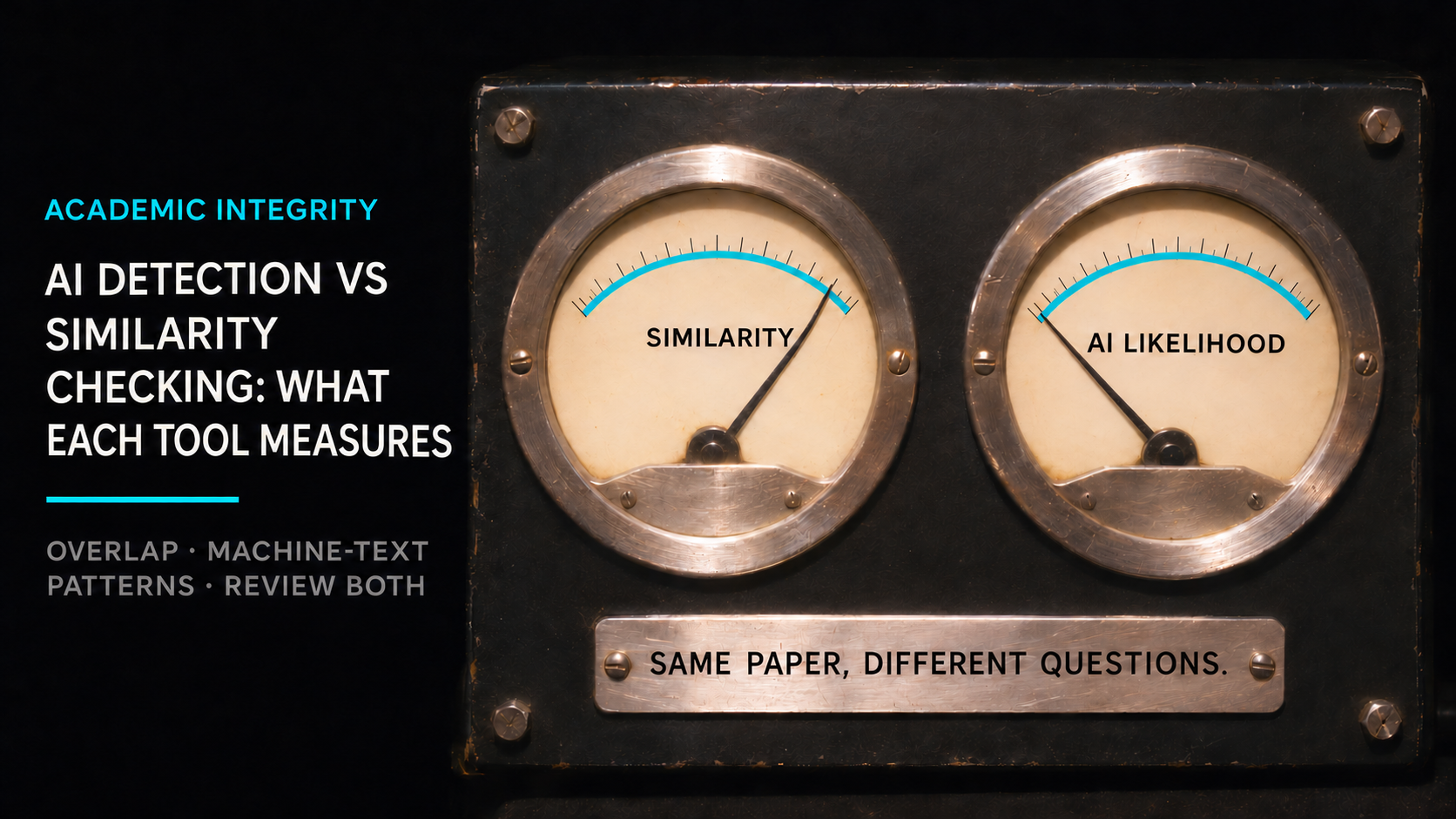
Similarity screening identifies material for examination, not an editorial verdict. Taylor & Francis explains that journals examine similarity-check results to distinguish plagiarism from legitimate overlap. A passage-level report shows where overlap sits, which is the information an editor weighs. The same result can require different decisions depending on attribution and publication history.
Translation changes the words available for direct matching. A low result cannot establish that a translated manuscript lacks an undisclosed source or earlier publication. Equally, a match to a preprint is not automatically problematic, because the Taylor & Francis preprint policy permits the specified earlier posting.
The question is therefore not simply whether a checker found the text. Authors still need to establish whether sources are acknowledged, earlier versions disclosed and any republication agreed. These obligations exist independently of a software result. For how legacy and newer checkers differ, see SciCampus vs legacy similarity checkers.
Can Plagiarism Checkers Detect Translated Text?
The available evidence does not support a universal answer. A study by Caner Dilber and İsmail Yoşumaz in the Journal of Academic Ethics examined ten English manuscripts published in 2023–2024, translated into Spanish, Portuguese and French, and tested with Turnitin, iThenticate and Grammarly (Dilber & Yoşumaz, 2026). The authors concluded that existing tools were largely ineffective at identifying plagiarism in translated texts. The scope is small: ten manuscripts, three destination languages and three tools. The tested direction was from English into three other languages, not into English, so it cannot establish performance for every tool, language pair or configuration.
There is a documented vendor counterpoint. Turnitin’s Translated Matching documentation describes an optional (beta) service that translates a non-English submission into English and matches it against activated English-language databases. The institution must request it, a Turnitin representative enables it, an account administrator turns it on, and instructors can then enable it for assignments (Turnitin, n.d.). This is a documented setting, not evidence of effectiveness.
The Environmental Monitoring and Assessment editorial adds one journal’s experience. Its editors report that translated duplicates usually come to light only when the original authors find the translation and notify the journal, leading to retraction, and they state that iThenticate demonstrates limited capacity to detect this type of duplication, citing Dilber and Yoşumaz (Wiersma et al., 2026). This is not a prevalence figure or a universal rule, and because the editorial cites the study, the two are not independent confirmation.
Where Does a Similarity Check Fit in a Translation Workflow?
A similarity report cannot decide whether a translation is permissible. It can support one practical step: showing which passages of your English draft overlap with published academic sources, so you can decide what to cite, quote, disclose or rewrite before you write your cover letter.
The SciCampus Similarity Check compares passages with published academic sources, including Crossref, OpenAlex, arXiv, PubMed and Semantic Scholar, and presents the matches for review. It does not search private student-paper repositories. It combines lexical checks, which look at overlap in words and short phrases, with semantic comparison concerned with related meaning. Results appear at passage level, with an overall matched percentage and source links, so you can open each source and judge the overlap yourself rather than rely on a single number. This is useful if you have reused your own earlier English text, such as an introduction, a methods description or a literature summary.
Two limits matter for translated work. The page lists cross-language matching among its features but does not explain how it works, so a clear result should not be read as clearance for translated text. And a similarity score does not by itself establish plagiarism, while a missing match does not establish originality. Treat the report as evidence to inspect, alongside your own record of earlier versions, permissions and approvals.
Similarity checking runs within an AI Detector analysis, so one upload also returns sentence-level AI detection results. If you also use machine translation or paraphrasing, read our guides on semantic drift in academic paraphrasing and AI academic writing ethics. The AI Detector is free to start, no card required.
What Should You Check Before Submitting a Translation?
Apply each question to relevant material. Treat “no” or “not sure” as a reason to stop and check the journal’s instructions or contact its editor before submitting.
Have I established who authored the original text and which contributions belong to other researchers?
Have I confirmed whether any earlier version, in any language, has been published, posted publicly or incorporated into another research output?
Have I cited translated material’s sources and distinguished translated extracts from my own discussion?
Have I checked the receiving journal’s rules for the specific earlier format?
Have I disclosed relevant earlier or overlapping versions, providing citations, links or copies as appropriate?
Have I checked the publishing agreement and publisher policy and obtained any required reuse permission?
Where secondary publication is proposed, have I obtained required editorial approvals and agreed its readership, timing, citation and labelling?
Have I confirmed that the manuscript is not simultaneously under consideration elsewhere in another language, unless an authorised joint-publication arrangement applies?
Have I assessed attribution and publication history independently of the similarity result?
Before you submit, run your English draft through the SciCampus Similarity Check to see which passages overlap with published sources. Then work through the checklist above for everything a similarity report cannot show: earlier versions, permissions and editorial approval.
Related reading
Academic Paraphrasing vs. Integrity Risk: Refining Fluency Without Altering Scientific Meaning
How to Check Academic Paper Originality in 2026: SciCampus vs. Turnitin vs. GPTZero
References
Committee on Publication Ethics. (n.d.). Text recycling guidelines for editors. https://publicationethics.org/guidance/endorsed-guidance/text-recycling-guidelines-editors
Dilber, C., & Yoşumaz, İ. (2026). The impact of language translation on plagiarism rates: Evidence from Turnitin, iThenticate, and Grammarly. Journal of Academic Ethics, 24, Article 4. https://doi.org/10.1007/s10805-025-09681-5
Elsevier. (2016). Clarification of our policy on prior publication. https://www.elsevier.com/connect/clarification-of-our-policy-on-prior-publication
Elsevier. (2021). I’ve seen this somewhere before: What counts as prior publication? https://www.elsevier.com/connect/ive-seen-this-somewhere-before-what-counts-as-prior-publication
International Committee of Medical Journal Editors. (n.d.). Overlapping publications. https://www.icmje.org/recommendations/browse/publishing-and-editorial-issues/overlapping-publications.html
Taylor & Francis. (n.d.). Plagiarism and Editorial policies. https://authorservices.taylorandfrancis.com/editorial-policies/plagiarism/
Turnitin. (n.d.). Enabling translated matching. https://guides.turnitin.com/hc/en-us/articles/23463581200781-Enabling-translated-matching
Wiersma, B., Elvir, J. A., Welschot, T., Herckes, P., & Ramachandran Nair, A. (2026). Editorial: Integrity in scientific publishing. Environmental Monitoring and Assessment, 198(7), 778. https://doi.org/10.1007/s10661-026-15528-2