A practical, research-first guide to similarity, AI signals, citations, and fair pre-submission review
The Originality Check Researchers Actually Need
Before a doctoral candidate submits a manuscript, one question can eclipse months of research: “Will this be flagged?” The fear is not limited to accidental plagiarism. A carefully edited literature review, a conventional Methods section, or an ESL/EFL author's polished scientific prose can attract an AI-detection signal even when the author has done the intellectual work and can defend every claim.
That is why originality review in 2026 needs to be more than a similarity percentage or a single “AI likelihood” label. It should help the researcher identify specific passages for review, trace claims back to reliable literature, confirm that citations are real and relevant, and retain evidence of human scholarly oversight.
The reliability concern is real. Nature reported that a 2025 GPTZero evaluation identified about 16% of human-written essays as AI-generated, while discussing prior evidence of much higher misclassification for writing by Chinese EFL students. A detector result should therefore trigger contextual review, not function as proof of misconduct.
This guide compares three distinct approaches: Turnitin's institution-led integrity workflow, GPTZero's accessible self-service AI and source-checking tools, and SciCampus's research-oriented diagnostic model.
Turnitin Review: The Institutional Standard
Turnitin is the established name in university similarity checking. Its core strength is its integration into institutional systems: instructors can review matched text in a Similarity Report, investigate the context of overlap, and administer submissions through a controlled academic workflow.
What Turnitin does well
Institutional familiarity. Many instructors, departments, and academic-integrity offices already use Turnitin reports in established processes.
Similarity review. The Similarity Report identifies matching text and linked sources so reviewers can distinguish quotation, citation, common phrasing, and potentially problematic overlap.
Centralized controls. Institutions can configure repository and account settings, making it useful for large-scale assessment and formal internal review.
Where researchers struggle
Access is usually institution-dependent. Turnitin's AI-writing function is part of the Originality add-on, and student visibility of AI reports depends on the institution's licensing and instructor settings.
It is not a self-service pre-submission tool for every independent researcher. An author may not be able to run the same screening before a supervisor, editor, or institution does.
Its AI-writing output is probabilistic. Turnitin says the AI report should not be the sole basis for adverse action and withholds an attributed percentage for scores in the 1–19% range because false positives are more likely there.
Turnitin is best understood as a strong institutional review system, not a final authorship judge. A similarity percentage does not by itself prove plagiarism, and an AI signal does not by itself prove AI authorship.
GPTZero Review: Accessible, Fast, and Useful Within Limits
GPTZero offers a far more accessible route for individual authors who want to screen a draft before submission. It provides a free tier, document upload and paste-in workflows, sentence-level highlighting, plagiarism checks, writing feedback, and source or citation-oriented tools. GPTZero says its free plan includes up to 10,000 words per month, with higher limits and additional functionality in paid plans.
What GPTZero does well
Low-friction access. Researchers can run a preliminary review without needing an institutional Turnitin account.
Readable interface. Its results are designed to show an overall finding while highlighting individual sentences or phrases that may deserve inspection.
Citation and claim support. Its Source Finder is intended to identify claims that may need stronger sourcing and flag potentially questionable citations.
Useful first-pass workflow. For general web writing, teaching, and early draft review, fast feedback has genuine value.
Where researchers should be careful
Do not reduce the report to its global score. Even with sentence flags, mixed authorship, formal academic prose, and heavily revised text can make attribution uncertain.
It is not a DOI-linked literature-audit system. Authors still need to open source records and verify that each DOI, paper title, author list, result, and quotation is correct.
Vendor accuracy claims are benchmark-specific. GPTZero reports a 99% accuracy figure and an up-to-1% false-positive rate in its own benchmark; those numbers should not be assumed to apply unchanged to multilingual or highly technical manuscript writing.
GPTZero is a capable self-service checker. It is most valuable when the author uses it to locate questions, not when they mistake a score for an answer.
SciCampus Review: The Research-First Alternative
SciCampus addresses a different pre-submission problem: how to create an inspectable evidence trail before a manuscript reaches a journal. It is designed as a diagnostic layer for researchers — not a shortcut for hiding AI use and not a substitute for editorial judgment.
Sentence-level diagnostics, not a blunt label
SciCampus presents probability bands sentence by sentence: ≥99% in red, ≥96% in orange, and ≥93% in yellow (confirm these current thresholds on the live product page before quoting exact percentages). This lets an author investigate the specific passage that needs attention. Was it drafted from a source? Was it generated and then edited? Does it need a clearer attribution, a more original paraphrase, or a disclosure under the target journal's AI policy?
A dual score for a mixed-authorship reality
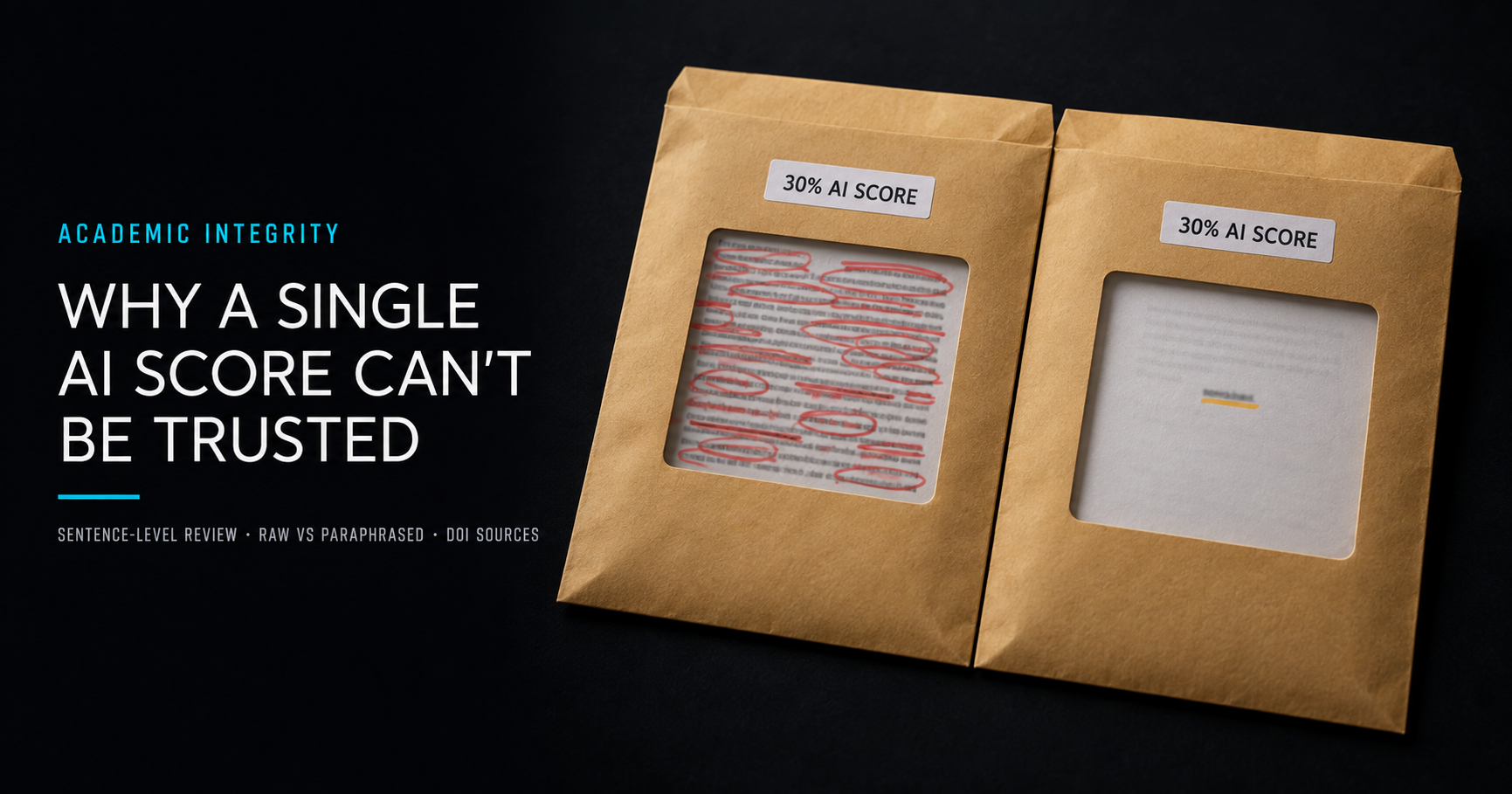
Its dual-score model distinguishes raw AI-generated signals from AI-paraphrased stylometry — the same distinction we cover in more depth in why aggregate AI scores fail. That distinction is important for ESL/EFL scholars who use grammar support or academic language tools. A human-authored sentence improved for clarity is not the same integrity question as an unreviewed AI-generated paragraph. The appropriate response is to inspect the passage, verify its scholarly basis, and disclose material assistance where required — not to punish an author for polished writing.
DOI-linked similarity that returns to the literature
SciCampus's DOI-linked similarity workflow is built around a question general detectors cannot settle alone: does the cited literature actually support the manuscript's claim? It helps authors review potential textual overlap against published sources, confirm that a citation resolves to real research, and identify possible hallucinated or mismatched references before an editor does.
Downloadable PDF reports can document that pre-submission review for co-authors, supervisors, and editors. They are evidence of a careful review process, not conclusive proof of human authorship. The author remains responsible for every claim, citation, table, figure, and conclusion.
The Ultimate Comparison
CriterionTurnitinGPTZeroSciCampusPrice / accessibilityInstitution-led licensing; report access depends on institutional configuration [3]Self-service free tier plus paid plans [5]Free to start, no card required — research-intelligence workflowAI detection approachAI-writing indicator and report within institutional workflow; low 1–19% range is not attributed as a percentage [4]Overall finding with sentence-level AI highlighting [6]Sentence-level probability bands: ≥99%, ≥96%, ≥93%False-positive mitigation for ESLAcknowledges false-positive risk; result should not be sole basis for adverse action [4]Useful flags, but formal and multilingual academic prose still requires contextual human review [1][8]Dual score distinguishes raw AI-generated from AI-paraphrased signals; designed for passage-level reviewCitation verificationMatched-source similarity review; author must verify scholarly claims [2]Source Finder and citation-oriented checks; author must still confirm original records [7]DOI-linked similarity and citation review against published literatureBest forUniversity-managed integrity and similarity workflowsFast independent screening, writing feedback, and preliminary source checksAcademic pre-submission review, DOI-grounded source checking, and a documented evidence trail
A Five-Minute Originality Workflow
Use the tools as a layered review process rather than a contest to obtain the lowest possible score. For a more granular, minute-by-minute version of this pass, see our 10-minute pre-submission audit checklist.
Run a similarity check early, before final formatting, and inspect every meaningful match in context.
Review any AI-detection flags at sentence level. Keep legitimate source-based wording only where it is quoted or properly attributed.
Open every cited source. Confirm title, authors, publication data, DOI, and most importantly that it supports the exact claim in your manuscript.
Keep version history, notes, data files, analysis scripts, and tracked revisions. These records are stronger evidence than any detector score.
Read the target journal's current AI and authorship policy. Declare material AI use accurately, and retain final human responsibility for the manuscript.
Conclusion: Originality Is Evidence, Not Optics
The best AI detector for academic papers is not necessarily the one with the boldest accuracy claim. It is the workflow that gives you useful evidence: where text needs review, which sources are involved, whether citations are trustworthy, and how you can document your own scholarly process.
Turnitin remains important inside institutional review. GPTZero offers accessible, fast preliminary checks. SciCampus is the modern alternative for researchers who want a more academic, source-aware pre-submission process: inspect sentences, separate raw AI signals from paraphrased patterns, verify DOI-linked literature, and submit a paper you can explain and defend.
Before submitting your next paper, test the draft in SciCampus — free to start, no card required — not to “beat” a detector, but to find the passages and references that need one final human review.
References
Nature. “Universities are relying on AI-detection software to catch cheating. How well do the programs work?” 6 July 2026. https://www.nature.com/articles/d41586-026-01358-2
Turnitin. “Understanding the similarity score.” Turnitin Guides. https://guides.turnitin.com/hc/en-us/articles/23435833938701-Understanding-the-similarity-score
Turnitin. “Turnitin's AI writing detection capabilities FAQs.” Turnitin Guides. https://guides.turnitin.com/hc/en-us/articles/28477544839821-Turnitin-s-AI-writing-detection-capabilities-FAQs
Turnitin. “AI writing detection in the new, enhanced Similarity Report.” Turnitin Guides, 2025. https://guides.turnitin.com/hc/en-us/articles/22774058814093-AI-writing-detection-in-the-new-enhanced-Similarity-Report
GPTZero. “Turnitin vs GPTZero: Accuracy, Features & Pricing Compared.” 2 February 2026. https://gptzero.me/news/turnitin-vs-gptzero/
GPTZero. “AI Detector: Free AI Checker for ChatGPT, GPT-5 & Gemini.” https://gptzero.me/
GPTZero. “AI Source Finder: Check Citations From Text, Essays & More.” https://gptzero.me/sources
GPTZero. “How AI Detection Benchmarking Works at GPTZero.” 30 January 2025. https://gptzero.me/news/ai-accuracy-benchmarking/
Related reading (topic ideas for future posts)
How Turnitin's Originality add-on licensing actually works for institutions
Reading a GPTZero Source Finder report: what it catches and what it misses
What a DOI-linked similarity check finds that a text-match report can't
Building a five-minute pre-submission routine into your own writing workflow