Why research integrity needs evidence, not an unexplained AI score
A false AI accusation can alter a student's record, delay a manuscript, and put an early-career researcher on the defensive before anyone has checked the evidence. That risk is especially sharp for ESL/EFL scholars, whose disciplined, formal prose can resemble the statistical regularities some detectors associate with machine generation. In 2026, the integrity crisis is not merely AI-written text. It is the institutional temptation to treat a probabilistic score as a finding of fact.
The evidence does not support one universal claim that “legacy detectors have 12%–50%+ false-positive rates.” Rates depend on the tool version, threshold, text length, genre, language background, and test corpus. Some real-world and older multilingual studies have produced double-digit and in some cases far higher false-positive results; other recent controlled benchmarks report low false-positive counts for fully human texts. The defensible conclusion is not that every detector is equally unreliable. It is that no cross-tool number should be used outside the benchmark that produced it. [1][2][3]
What Do the Real 2026 False-Positive Numbers Actually Show?
False-positive rate (FPR) means the proportion of human-written text incorrectly classified as AI-generated. It is a safety metric, not an optional technical detail: in a high-stakes academic setting, an apparently accurate detector can still be unacceptable if its errors fall disproportionately on particular author groups.
Nature's 2026 review reported a 2025 GPTZero evaluation in which about 16% of human-written essays were labelled AI-generated. It also revisited an earlier study of Chinese EFL writers in which seven detectors incorrectly classified more than half of 91 pre-ChatGPT essays as AI-generated, for an average false-positive rate of 61.3%. Those figures are evidence of detector risk in specific studies; they are not a calibrated 2026 FPR for every product or every STEM manuscript. [1]
A 2026 peer-reviewed comparison of Turnitin, GPTZero, Pangram, and Copyleaks tested 160 academic papers with known synthetic ground truth: fully human, fully AI, hybrid, and “humanised” AI text. All four tools correctly identified the fully human papers in that small controlled set, while Pangram performed best on AI, hybrid, and humanised content. The study simultaneously demonstrates why FPR claims must be corpus-specific: a 0% false-positive outcome on 40 fully human synthetic documents cannot settle performance for multilingual, discipline-specific, or professionally edited writing at scale. [3]
Originality.ai was not included in that 2026 four-tool experiment. Its published 2026 meta-analysis summarizes studies with materially different samples and reports results ranging from 2% false positives in one evaluation to 8% in another article-level test. These are vendor-curated results, not a common independent benchmark against the other three tools; they are useful context, not an apples-to-apples ranking. [4]
The table below keeps the uncertainty visible rather than inventing comparable FPRs where the evidence does not support them. For a deeper look at why a single document-wide number is the wrong unit of analysis in the first place, see our piece on why aggregate AI scores fail.
ToolTypical FPR on native academic textFPR on ESL/STEM writingCitation verificationDiagnostic granularityPrimary weaknessTurnitinOfficial guidance: <1% document-level FPR above its 20% threshold; 2026 160-paper study: 0% on fully human set [3][5]High risk of false positives due to formal/formulaic phrasingSimilarity-source matching; not DOI-first verificationOverall AI percentage with highlightsInstitutional access; score needs human interpretationGPTZeroSmall positive bias on fully human set in 2026 four-tool study; Nature reported 16% in a separate 2025 essay evaluation [1][3]Variable and highly sensitive to ESL sentence structureSource and citation-check features, not DOI-specific audit trailDocument result plus sentence-level flagsBenchmark outcomes vary markedly by corpus and transformationOriginality.aiVendor-curated studies report 2% and 8% in different evaluations [4]Unstable; heavily dependent on the specific academic disciplineProduct-level checks; verify references independentlyProduct-specific reporting; no common published comparison used hereNo common independent 2026 four-tool academic benchmarkPangram0% on fully human set in 2026 160-paper study; UChicago working paper reports essentially zero on medium/long passages [3][6]Variable; assess alongside discipline, language background, and revision historyNot established here as DOI-based citation verificationDocument-level detection; vendor reports additional signalsStrong results still need independent, multilingual replication
What this comparison does show is that direct, clean AI output and mixed or paraphrased academic writing are different tasks. A detector score becomes least trustworthy when a document has been shaped by a human author, supervisors, translation or editing support, and AI-assisted revision.
Why Do Legacy Detectors Fail STEM and ESL Writers?
Many detectors were developed around signals such as perplexity, burstiness, lexical regularity, and the probability distribution of successive tokens. Perplexity is a model-based estimate of how predictable a sequence is. Burstiness broadly describes variation in wording and sentence complexity. Both can be informative features; neither is evidence of intent, authorship, or misconduct.
STEM prose can trigger the linguistic trap. Methods sections repeat controlled vocabulary. Abstracts compress conventional claims into standardized forms. Technical writing favors precision over expressive variation. Researchers also reuse discipline-specific phrases because there are only so many accurate ways to describe a protocol, variable, measurement, or statistical procedure. These qualities can lower apparent unpredictability without making the prose machine-generated.
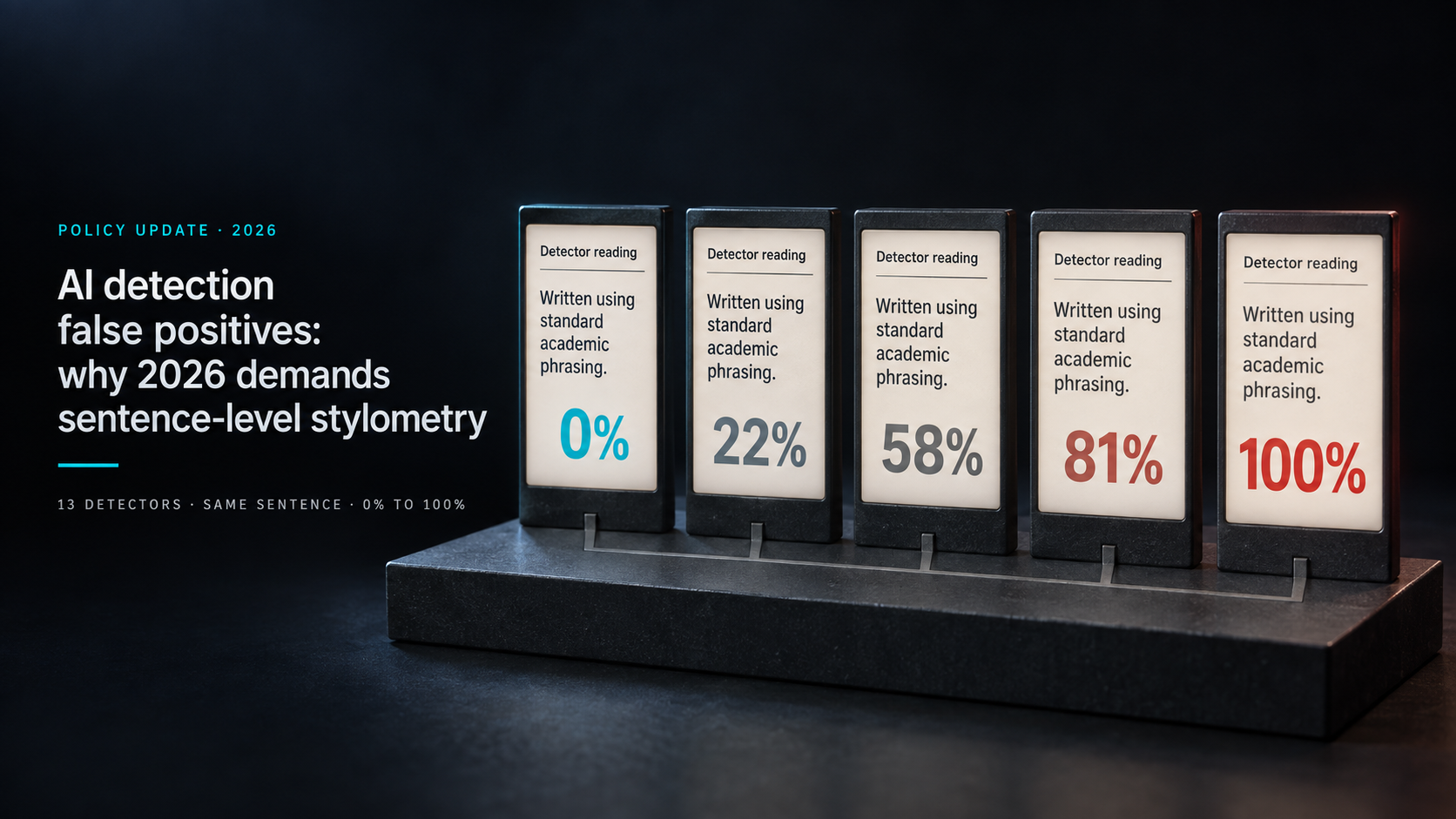
ESL/EFL authors face an additional fairness problem. Careful revision, controlled grammar, formulaic transition language, and professional editing can make prose more regular. A 2026 preprint studying 135,389 paired documents from an English-editing service found false-positive rates from 0% to 100% across 13 detectors, and showed that the same professional edits could raise one detector's score while lowering another's. The authors attribute this instability to style as a confound, rather than treating a detector's output as a direct reading of AI authorship. [2]
Heavy paraphrasing further disrupts conventional classification. The PADBen benchmark reports that detectors which exceed 90% accuracy on direct LLM output can fail badly against iteratively paraphrased text. Its findings support a simple editorial rule: a low AI score does not establish human authorship, and a high score does not establish misconduct. [7] Our related coverage on sentence-level stylometry and false positives looks at how this plays out in practice.
How Should Researchers Defend Legitimate Academic Writing?
A defense should be evidence-led, calm, and specific. Do not respond to a detector score by rewriting a paper merely to look more “human.” Instead, create a record that allows a supervisor, editor, or integrity office to inspect the real scholarly process.
Preserve version history. Draft in a system with dated revisions, such as Word version history, Google Docs, Overleaf, or a secure institutional repository. Keep early outlines, tracked changes, supervisor comments, and dated exports.
Keep your research trail. Retain reading notes, laboratory notebooks, data files, analysis scripts, code commits, search strategies, ethics approvals, and citation-manager libraries. These documents show how claims and methods developed.
Declare material AI use accurately. Record the tool, purpose, date, and affected component. Distinguish proofreading from substantive drafting, data analysis, code generation, image modification, or interpretation. Follow the target journal's exact policy.
Verify every citation at the source. Open the cited article, confirm the DOI, authors, title, publication details, and whether the source truly supports the claim. Plausible-looking references are not evidence.
Ask for a transparent review. If challenged, request the highlighted passages, detector version, threshold, policy basis, and an opportunity to provide process evidence. Turnitin's own guidance says its AI-writing result should not be the sole basis for adverse action. [5]
Respond to the scholarly issue, not the percentage. Explain the provenance of a flagged passage, show your drafts and sources, correct genuine citation or attribution weaknesses, and seek an independent academic review if the allegation persists.
Where Does SciCampus Fit as a Diagnostic Standard?
SciCampus should be used as a diagnostic and pre-submission evidence framework, not as a tool for evading detection and not as a machine that “proves” human authorship. Its value lies in making a difficult review process more granular, source-aware, and documentable.
First, its per-sentence probability bands — ≥99% red, ≥96% orange, and ≥93% yellow (confirm these current thresholds on the live product page before quoting exact percentages) — turn an opaque global score into a map of passages that warrant review. An author can inspect a flagged sentence alongside its source, drafting history, and disclosure record instead of treating the entire paper as suspect.
Second, SciCampus separates raw AI-generated signals from AI-paraphrased stylometry. That distinction is essential in a mixed-authorship world. A raw generated passage, a human paragraph later polished by an AI tool, and an ESL-authored paragraph improved through permitted language support are not the same research-integrity question.
Third, DOI-linked similarity and citation verification shift the focus to what editors can actually assess: whether citations resolve to authentic literature, whether a source supports the claim, and whether wording overlaps too closely with published work. Downloadable PDF reports can document that review for co-authors, supervisors, editors, or an integrity office — the same DOI-linked approach we compare against traditional similarity checking in SciCampus vs. legacy similarity checkers.
This is a more defensible standard than a black-box percentage: flag narrowly, inspect context, verify sources, disclose material assistance, and preserve human accountability. For Q1/Q2 targeting, SciCampus Journal Finder can also help authors assess journal quartiles, SJR, Impact Factor, and peer-review indicators before they submit.
References
Nature. “Universities are relying on AI-detection software to catch cheating. How well do the programs work?” 6 July 2026. https://www.nature.com/articles/d41586-026-01358-2
Park, H., Jeong, G., and Kim, B. “Style as a Confound: False Positives in AI Detection of Non-Native Academic Writing.” arXiv:2608.26710, 2026. https://arxiv.org/abs/2608.26710
Van Vlasselaer, V., Van Droogenbroeck, M., and Spruyt, V. “Who wrote this? Evaluating the reliability of AI detection tools in academic contexts.” International Journal for Educational Integrity, 2026. https://link.springer.com/article/10.1007/s40979-026-00226-w
Originality.ai. “AI Detection Accuracy Studies: Meta-Analysis of 16 Studies.” 2026. https://originality.ai/blog/ai-detection-studies-round-up
Turnitin. “AI writing detection in the new, enhanced Similarity Report.” 2025. https://guides.turnitin.com/hc/en-us/articles/22774058814093-AI-writing-detection-in-the-new-enhanced-Similarity-Report
Becker, J., and Imas, A. “Artificial Writing and Automated Detection.” Becker Friedman Institute, University of Chicago, 2025. https://bfi.uchicago.edu/insights/artificial-writing-and-automated-detection/
Zha, Y., Min, R., and Sushmita, S. “PADBen: A Comprehensive Benchmark for Evaluating AI Text Detectors Against Paraphrase Attacks.” arXiv:2511.00416, 2025. https://arxiv.org/abs/2511.00416
Related reading (topic ideas for future posts)
How Pangram, GPTZero, and Turnitin actually differ on humanized AI text
A researcher's guide to reading a Turnitin AI-writing report correctly
Why paraphrase-attack benchmarks like PADBen matter for journal policy
Building an institution-level policy on acceptable detector use