A SciCampus editorial for researchers, editors, and research-integrity leaders.
A research-integrity system that mistakes polished human writing for machine output does more than produce a bad score: it can damage an early-career scholar's reputation, distort editorial decisions, and penalize the multilingual researchers universities most want to support. In 2026, the question is no longer whether a detector can flag obvious, untouched chatbot prose. It is whether it can distinguish authentic academic writing, legitimate language support, raw LLM output, and AI-paraphrased text without treating any one signal as proof.
The newest evidence points to a hard conclusion for editors and integrity officers: a single, document-level "AI likelihood" score is too blunt for high-stakes decisions. Detection must become granular, source-aware, and paired with accountable human review.
The false-positive dilemma
The fairness problem is empirical, not hypothetical. Nature's 2026 review of AI-detection tools cites a 2025 evaluation of GPTZero that found a false-positive rate of 16% on human-written essays — eight of fifty misclassified — despite strong performance on fully AI-generated papers. The same report discusses an earlier study in which detectors misclassified more than half of 91 pre-ChatGPT English-language essays written by Chinese EFL students as AI-generated, producing an average false-positive rate of 61.3%.1
The mechanism matters. Many legacy detectors use signals related to perplexity — how statistically predictable a sequence of words appears to a language model — and related stylistic regularities. Formal academic prose, controlled grammar, repeated disciplinary phrasing, conventional transitions, and language shaped by EFL instruction can look statistically "smooth." That does not establish machine authorship. It can simply reflect an author writing carefully within disciplinary conventions.
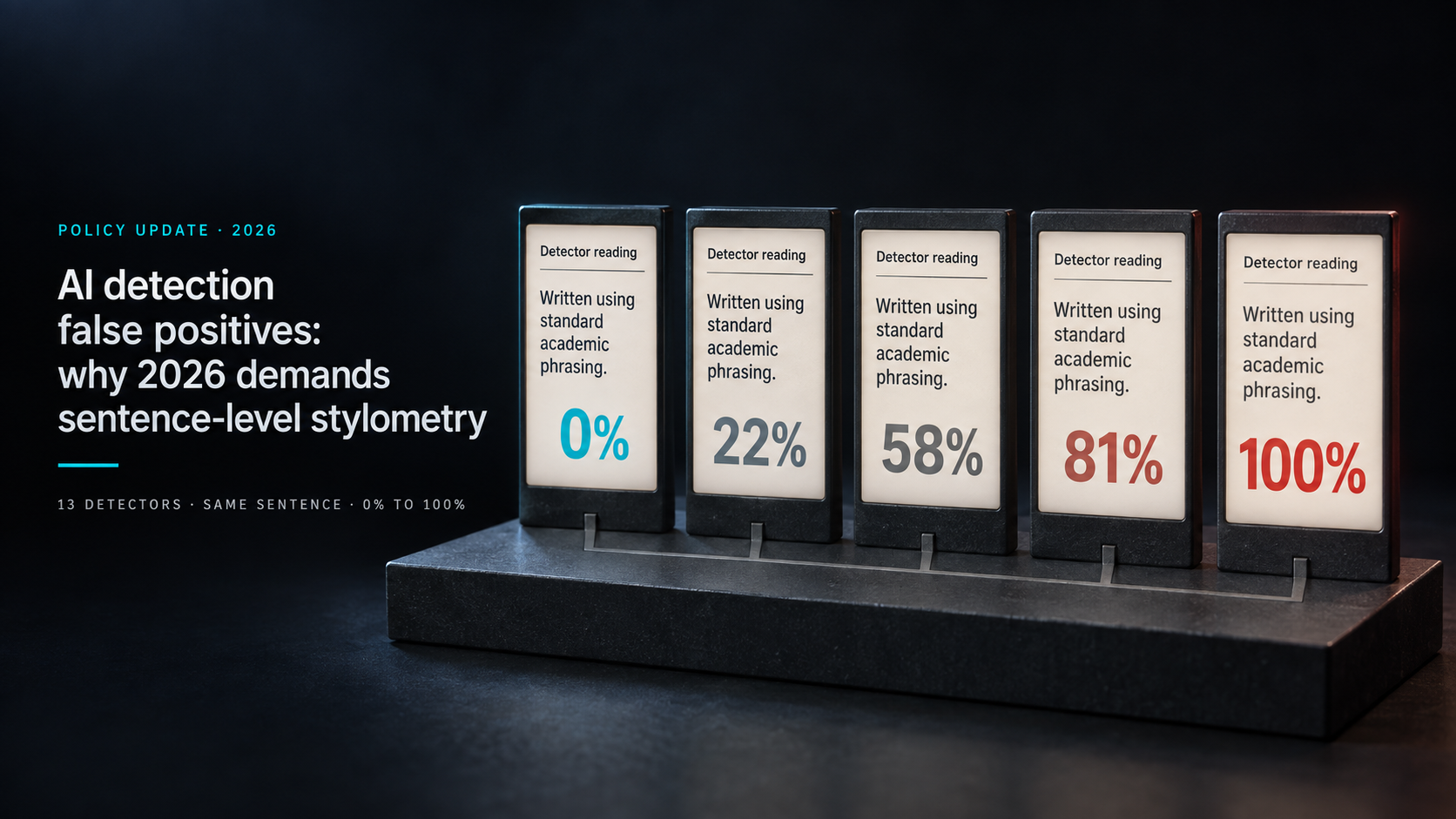
A large August 2026 preprint reinforces the warning with a controlled design. Researchers examined 135,389 paired documents from a professional English-editing service, comparing non-native-English manuscripts with native-edited versions while preserving underlying authorship and content. Across 13 AI detectors, human-written false-positive rates ranged from 0.0% to 100.0%. The same professional edits raised AI scores in some detectors and lowered them in others; score shifts also correlated with the extent of editing.2
This does not mean all detectors fail all the time, or that editing is inherently suspicious. It means detector outputs can be confounded by writing style and editorial intervention. A journal, university, or funding body should therefore never convert a high automated score directly into an accusation of misconduct — especially for ESL/EFL researchers or authors who have used permitted professional language support.
A defensible review process should:
Treat a detection result as a triage signal, not a verdict.
Inspect the specific passages responsible for the signal.
Consider declared language editing and permitted AI assistance.
Verify claims, citations, data, and methods.
Give the author a meaningful opportunity to explain process and provide supporting records.
Stylometry, watermarking, and paraphrase
AI-text detection is often discussed as though it were one technology. It is not. The difference between stylometric detection and watermarking is central to interpreting any result.
Stylometric and classifier-based detection looks for statistical patterns in the text itself. Depending on the system, these may include token predictability, lexical distribution, sentence structure, punctuation habits, function-word patterns, syntactic regularity, semantic embeddings, or features derived from a neural language model. Perplexity and burstiness belong to this broader family: the former estimates predictability, while the latter loosely captures variation in sentence and word-pattern complexity.
These methods can work well on clean, direct outputs from known models in controlled benchmarks. Their weakness is distribution shift. A new model, a different discipline, a multilingual author, a human revision pass, or an AI paraphrasing tool can alter the patterns a detector learned to recognize.
Watermarking works differently. A model provider deliberately embeds a statistical signature during generation — often by subtly biasing token selection at the logits level. In theory, a detector with the appropriate key can test whether the output contains the expected token-selection pattern. Watermarks can offer more formal statistical guarantees than a general black-box classifier, but only when content was generated by a participating, watermark-enabled model and has not been substantially transformed.
A 2025 arXiv study on adaptive watermark detection recognizes both the promise and limitation of this approach. It notes that conventional AI detectors can fail to control false-positive rates and can exhibit bias, while watermarking offers statistical tests with explicit p-values. The study also emphasizes that academic settings include many degrees of permitted intervention — from grammar correction to content expansion — and evaluates native and non-native English essays across seven simulated levels of AI editing.3
The 2025 PADBen benchmark captures the related "laundering" problem. Its authors report that detectors can achieve more than 90% accuracy on direct LLM outputs yet fail severely against iteratively paraphrased content. Across 11 evaluated detectors, the researchers found a critical asymmetry: systems could identify plagiarism-evasion cases but failed at authorship obfuscation in the intermediate, heavily paraphrased zone.4
Why sentence-level diagnostics win
The most useful evolution in academic AI detection is not the search for a supposedly perfect universal classifier. It is the move from black-box, whole-document scoring toward granular diagnostics.
A single score collapses a complex manuscript into one number. It cannot show whether one isolated paragraph resembles raw LLM output while the rest reflects stable human authorship; whether a literature review has been extensively AI-paraphrased; whether a polished introduction was professionally language-edited; or whether a flagged claim is grounded in a real DOI source. We have written elsewhere about why aggregate AI scores fail authors and editors.
Sentence-level analysis cannot solve attribution on its own, but it makes review more interpretable. It lets an editor ask targeted questions: Why is this exact sentence flagged? Does it contain an unverifiable citation? Is its wording unusually generic? Does it conflict with the cited study? Is there evidence of revision and author understanding?
The broader research agenda has already shifted in this direction. PAN 2026, a long-running evaluation initiative for computational stylometry and text forensics, includes tasks for generative-AI detection and text watermarking as well as multi-author writing-style analysis, generative plagiarism detection, source retrieval and alignment, and reasoning-trajectory detection. This design recognizes mixed and obfuscated authorship as a primary real-world problem rather than treating documents as cleanly human or cleanly machine generated.5
Advanced paraphrasing raises the stakes further. A NeurIPS 2025 study introduced adversarial paraphrasing that uses an LLM under guidance from an AI detector to produce text optimized to evade it. Across neural, watermark-based, and zero-shot systems, the authors reported an average 87.88% reduction in true-positive performance at a 1% false-positive operating point under their tested attack setting.6
This is not a reason to abandon integrity review. It is a reason to stop treating detection as a one-number adjudication system. The editorial goal should be evidence-based assessment: granular signals, transparent declarations, source verification, and accountable human judgment.
A diagnostic framework, not a verdict machine
SciCampus is best understood as a pre-submission diagnostic and evidence layer, not as an instrument for evading journal rules or "proving" authorship through a score.
Its AI Detector provides sentence-level probability bands at ≥99% (red), ≥96% (orange), and ≥93% (yellow), giving researchers and editors a map of passages that deserve closer review. Rather than reacting to an opaque document-level label, an author can inspect a flagged sentence in context, confirm its provenance, revise unclear language, or disclose substantive AI support where journal policy requires it.
The platform's dual-score model — separating raw AI-generated signals from AI-paraphrased stylometry — is aligned with the current benchmark reality. Direct LLM prose and heavily transformed text are different detection problems. Treating them as one undifferentiated category risks both false negatives in paraphrased content and false positives in legitimate, carefully edited academic writing.
DOI-linked similarity adds a layer that stylometry alone cannot provide: source-grounded verification. When an AI score identifies a passage for review, the next question should not be whether the author can make it look less AI-like. It should be whether the claim is supported by the cited paper, whether the DOI resolves to the relevant source, whether the language is too close to a source even after paraphrasing, and whether the citations are real and accurately represented.
Downloadable PDF evidence reports can document that review process for co-authors, supervisors, research-integrity teams, and editors. They support a transparent record of screening and source checking, but they should never be represented as definitive proof of human authorship. No detector currently warrants that claim in a high-stakes academic case.1,2
For researchers selecting an outlet, the Journal Finder can complement this workflow by helping identify journals through quartiles and SJR metrics before submission. Early journal selection enables authors to check the destination journal's AI declaration rules, prepare the correct disclosure language, and ensure that the manuscript's evidence trail matches editorial expectations. Our guide to choosing the right Q1/Q2 journal covers that process in detail.
Review the sentences, not the score. SciCampus is free to start — no card required. Create a free account.
Frequently asked questions
How often do AI detectors wrongly flag human writing?
It varies enormously by tool and by text. A 2025 evaluation of GPTZero reported a 16% false-positive rate on human essays, while a controlled 2026 study of 13 detectors across 135,389 manuscript pairs found human false-positive rates spanning the full range from 0% to 100%. There is no single reliable figure, which is precisely the problem for anyone using one score to make a decision.
Why are non-native English writers flagged more often?
Many detectors rely on perplexity and related measures of statistical predictability. Writing that is formal, grammatically controlled, and uses conventional disciplinary phrasing — common among EFL-trained academic writers — reads as predictable to these systems. One widely cited study found detectors misclassified more than half of pre-ChatGPT essays by Chinese EFL students, at an average false-positive rate of 61.3%.
Does professional language editing make my manuscript look AI-generated?
Sometimes, and inconsistently. The 2026 paired-document study found that the same professional edits raised AI scores in some detectors and lowered them in others. Declared, legitimate editing should be part of the context an editor considers, not a hidden variable that shifts a score without explanation.
Is watermarking a better answer than stylometric detection?
It offers stronger statistical guarantees, but only in narrow conditions: the content must come from a participating, watermark-enabled model and must not have been substantially transformed. It cannot help with text from non-watermarked models or content that has been paraphrased.
What should an editor do with a high AI score?
Treat it as a prompt to investigate specific passages, not as a finding. Inspect the flagged sentences, consider declared editing and permitted AI assistance, verify citations and data, and give the author a real opportunity to explain their process and supply drafting records before any conclusion is drawn.
References
McKie, A. "Universities are relying on AI-detection software to catch cheating. How well do the programs work?" Nature 655, 535–537 (2026). https://doi.org/10.1038/d41586-026-01358-2
Park, H., Jeong, G., and Kim, B. "Style as a Confound: False Positives in AI Detection of Non-Native Academic Writing." arXiv:2608.26710 (2026). arxiv.org/abs/2608.26710
Xie, Y., Chen, X., Ren, Z., and Su, W. J. "Watermark in the Classroom: A Conformal Framework for Adaptive AI Usage Detection." arXiv:2507.23113 (2025). arxiv.org/abs/2507.23113
Zha, Y., Min, R., and Sushmita, S. "PADBen: A Comprehensive Benchmark for Evaluating AI Text Detectors Against Paraphrase Attacks." arXiv:2511.00416 (2025). arxiv.org/abs/2511.00416
Bevendorff, J., et al. "Overview of PAN 2026: Voight-Kampff Generative AI Detection, Text Watermarking, Multi-Author Writing Style Analysis, Generative Plagiarism Detection, and Reasoning Trajectory Detection." arXiv:2602.09147 (2026). arxiv.org/abs/2602.09147
Cheng, Y., Sadasivan, V. S., Saberi, M., Saha, S., and Feizi, S. "Adversarial Paraphrasing: A Universal Attack for Humanizing AI-Generated Text." NeurIPS 2025; arXiv:2506.07001. arxiv.org/abs/2506.07001