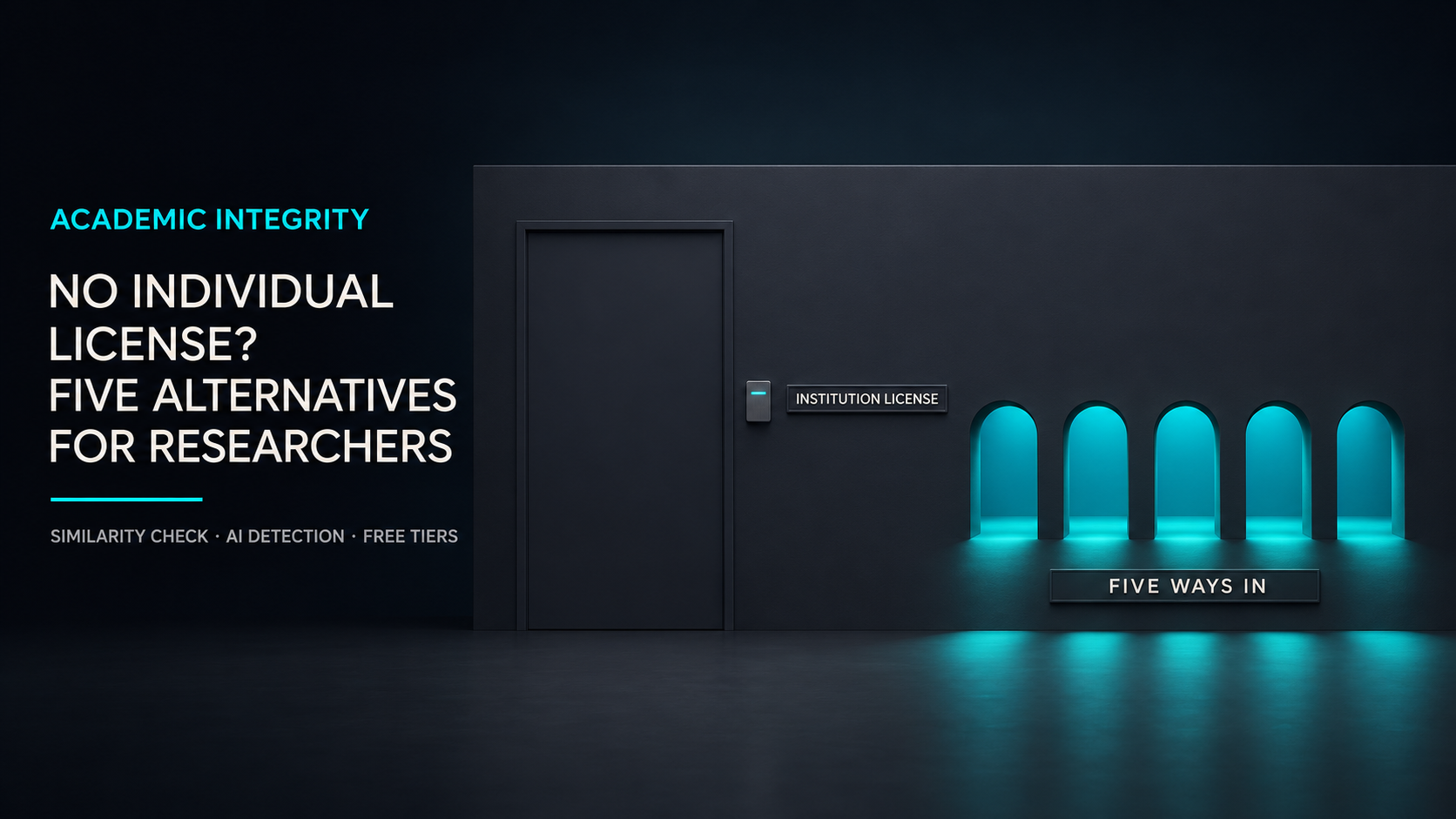
Short answer: you cannot buy Turnitin as an individual, so independent researchers and students need a different route. The realistic options are iThenticate (Turnitin's own per-manuscript product for individuals), a free or low-cost similarity checker, and a separate AI-text detector. No single tool replaces Turnitin, because similarity checking and AI detection answer different questions. This guide compares five accessible options (SciCampus, QuillBot, Grammarly, GPTZero and Copyleaks), explains what each free tier really covers, and gives a pre-submission checklist.
Disclosure: SciCampus publishes this article and is one of the five tools listed. Competitor details come from vendor pages and third-party reviews, not from our own testing, and they change often. Check each provider's current plan page before you pay.
Why can't I just use Turnitin?
Turnitin sells to institutions. Its help center states that Turnitin does not offer individual license purchases. If your university licenses it, you reach it through your course or library. If it does not, you cannot buy your way in.
Turnitin's sibling product, iThenticate, is the exception. It sells credits to individual researchers, scholars and graduate students. According to its pricing page, a single-manuscript credit costs $125 (as of this writing) and covers files up to 25,000 words, and AI writing detection is not available to individual users. That is a real option for a final, high-stakes check, but it is expensive for repeated drafts.
Similarity check or AI detector: which do I need?
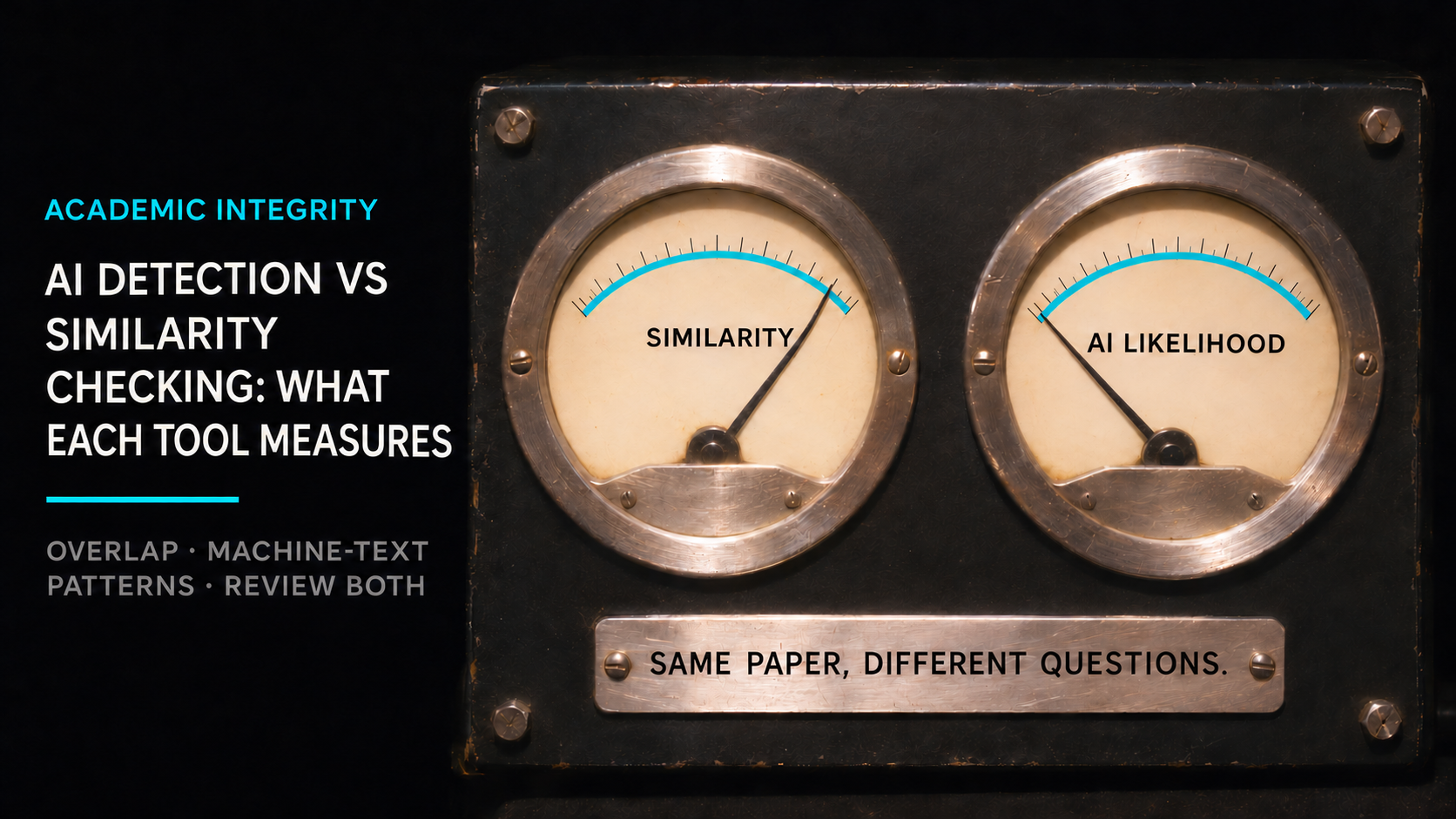
They measure different things, and mixing them up causes most bad decisions.
Similarity checking finds text that overlaps with existing sources. A high score is not proof of plagiarism; quotations and reference lists also match.
AI detection estimates whether wording looks machine-generated. It gives a probability, not proof.
For the full explanation, read AI Detection and Similarity Checking: What Each One Measures.
What does SciCampus offer?
SciCampus runs an AI Detector and a Similarity Check in one analysis. You can paste text or upload a PDF or DOCX up to 20 MB. Each sentence is classified as human, AI-generated or AI-paraphrased with a probability, the document score is weighted by word count, and you can download a PDF report. The similarity step compares your text with published academic sources such as Crossref, OpenAlex, arXiv, PubMed and Semantic Scholar, and shows passage-level matches with source links. Results are estimates, not proof. Details are on the AI Detector and Similarity Check pages.
What does QuillBot offer?
QuillBot bundles a paraphraser, grammar checker, AI detector and plagiarism checker. Its free AI detector is limited, with reports of about 1,200 words per scan. The plagiarism checker is a Premium feature, reported at up to 25,000 words per month.
What does Grammarly offer?
Grammarly is mainly a writing assistant. Several reviews list plagiarism detection and AI detection as Pro features, while one 2026 roundup reports a small free plagiarism check. Because sources disagree, check Grammarly's current plan page.
What does GPTZero offer?
GPTZero is built around AI detection. Its support page says the free plan gives the Basic AI Scan, which returns an overall detection score, plus one free Advanced Scan to try sentence-level highlighting. Reviews report a free allowance of 10,000 words per month.
What does Copyleaks offer?
Copyleaks covers AI detection and plagiarism checking. Third-party listings report a very small free allowance (around 2,000 words per month), so treat it as a trial rather than a manuscript-level check unless you pay.
Can I trust an AI-detector score?
Treat it as a signal, not a verdict. Liang and colleagues (2023) found that several GPT detectors misclassified a large share of TOEFL essays by non-native English writers as AI-generated (about 61% on average), while handling native-speaker essays far better. If English is your second language, a high AI score on your own writing is a reason to review the text and keep drafting evidence, not proof of misconduct. See why aggregate AI scores fail and how to defend a manuscript against a false positive.
How should I choose?
Final check before a journal submission: use a similarity tool that covers published literature. iThenticate is the individual option from Turnitin's family; Crossref Similarity Check is what many publishers use, so ask your target journal what it runs.
Frequent draft checks on a budget: use free tiers, but check word limits first. A 3,000-word cap will not cover a full paper in one run.
Worried about a false AI flag: use a detector that shows sentence-level results, so you can see which passages triggered it.
Writing polish, not integrity: a writing assistant fixes grammar; it does not replace a similarity check.
Pre-submission checklist
Run a similarity check on the final text, not only an early draft.
Read every flagged passage; exclude quotations and references from your interpretation, and cite or rewrite real overlaps.
Check your journal's AI-use and disclosure policy before submitting (publisher AI policies).
Keep dated drafts and notes as evidence of your own writing process.
Never paste unpublished manuscripts into a tool before reading its privacy and data-retention terms.
Do not "fix" a similarity score by swapping words; that can change meaning (semantic drift in paraphrasing).
Choose the journal deliberately too, with the Journal Finder.
Related Reading (Topic Ideas for Future Posts)
Sources
Turnitin Help Center: "How can I buy a Turnitin subscription / license for myself?"
iThenticate: pricing and individual credit pages (ithenticate.com)
GPTZero Support: "What is the difference between the free and paid plans?"
Liang, W., et al. (2023). GPT detectors are biased against non-native English writers. Patterns.
Third-party plan reviews for QuillBot, Grammarly and Copyleaks (details change; verify on each vendor's site)