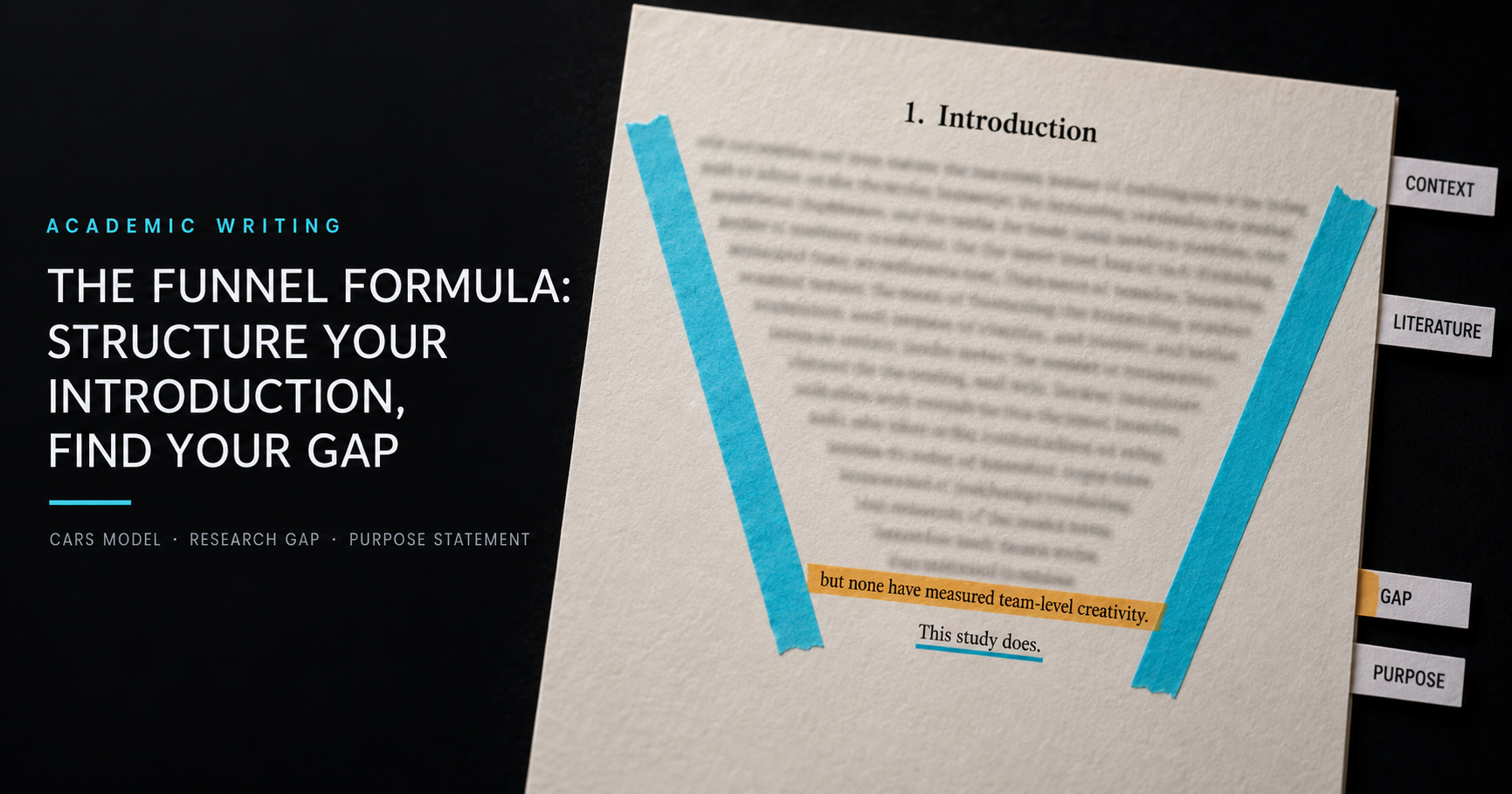
A manuscript's introduction shapes how a reviewer reads everything that follows. The methods might be sound and the discussion competent, yet the paper can still draw a “does not sufficiently justify its contribution” verdict, because no one built the argument that earns the reader's attention before asking for it.
That argument has a name and a shape. Linguist John Swales, after analyzing well over a hundred published research-article introductions, described the pattern as a sequence of rhetorical “moves” that writers use to carve out intellectual territory for their own work. He called it the Create a Research Space model, or CARS. Composition instructors have long taught a visual shorthand for the same idea: the funnel, narrowing from broad context down to a single, sharp point. Understanding why this structure works, and specifically how to execute its hardest step, the gap statement, separates an introduction that reads as obligatory throat-clearing from one that makes a reviewer lean forward.
Why Does the Funnel Dominate Scientific Writing?
The funnel persists across disciplines because it solves a genuine cognitive problem for readers. A reader arriving at your introduction knows nothing about why your specific question matters, so you cannot assume shared urgency. The funnel front-loads orientation before specificity: it establishes that a domain matters, narrows to the particular slice you inhabit, shows what is already known within that slice, and only then reveals where knowledge runs out.
This ordering matters because readers process novelty claims poorly without context. A sentence like “no study has examined X in adolescent populations” means little until the reader understands why X matters and what has been studied in adjacent populations. The funnel builds that scaffolding in sequence, so the gap lands as an inevitability rather than an assertion.
Swales formalized this shape into three moves that map onto the funnel's stages, as summarized in the University of Waterloo Writing and Communication Centre's guide to the CaRS model: establishing a territory, establishing a niche, and occupying that niche. The model describes what successful writers already do, which is what makes it teachable to writers who haven't yet developed the instinct. It also asks you to condense prior studies into a few sentences, which is exactly where meaning tends to shift; our piece on semantic drift in academic paraphrasing shows how to compress a source without changing what it claims.
What Are the Stages of the Funnel, in Order?
1. Broad Context: Establishing the Territory
Open by asserting that the general domain matters, not with an unsupported platitude but with a claim you can back with citation or data. Swales calls this “claiming centrality.” This is the widest part of the funnel, and it should stay wide only briefly, one to three sentences in most journal introductions, longer in dissertations.
2. Narrowing to the Specific Field or Subfield
From the domain, move to the particular subfield, mechanism, population, or phenomenon your paper addresses. This is where “topic generalizations” happen: statements about current consensus or accepted practice within that narrower space.
3. Prior Literature Synthesis
Think of this section as a selective, argumentative synthesis, condensed far below the scope of a full literature review, of the studies that bear directly on the gap you are about to name. Every citation should be doing work toward the gap, rather than simply demonstrating breadth of reading.
4. Identification of the Research Gap
This is the pivot point, where prior-cited knowledge stops and unresolved territory begins. It is Move 2 in CARS, “establishing a niche,” accomplished through counter-claiming, indicating a genuine gap, raising an unanswered question, or extending a research tradition, as detailed in USC's Organizing Your Social Sciences Research Guide.
5. Statement of Purpose and Objectives
Once the niche is established, you occupy it: state directly what your study does in response to the specific absence identified. The language should mirror the gap's vocabulary; if the gap concerns methodology, the purpose statement should promise a methodological remedy, not a vague “further investigation.”
6. Preview of Contribution (Optional)
Many journals, particularly in the sciences, now expect a brief forecast of principal findings or article structure at the end of the introduction. CARS treats this step as optional, though it's become common in empirical fields where editors want reviewers oriented before the methods section.
How Do You Diagnose a Genuine Research Gap?
The most common failure in doctoral and early-career writing is diagnostic, not structural: writers place something in the “gap” slot without first verifying that a gap actually exists there. A gap statement is a claim that needs to be earned through evidence, not asserted through convention.
A rigorous framework for gap identification comes from Robinson, Saldanha and McKoy's 2011 paper, “Development of a framework to identify research gaps from systematic reviews,” produced alongside an Agency for Healthcare Research and Quality report. Developed originally for clinical and health-services systematic reviews, using PICOS elements such as population, intervention, comparator, outcome, and setting, the framework classifies gaps by why evidence is lacking: insufficient, biased, or inconsistent results, or results that don't apply to your population or setting. Extended here beyond its evidence-based-medicine origin as a general-purpose lens, that logic maps onto five gap types worth naming in any field.
Empirical gaps exist when a phenomenon is theorized but untested, or tested only in limited conditions.
Theoretical gaps exist when existing frameworks fail to explain an observed pattern, or none exists yet.
Methodological gaps involve prior approaches with known limitations, such as small samples or self-report where objective measures would help.
Contextual or population gaps exist when findings from one setting, culture, or age group haven't been examined elsewhere; this is the most overused category and the one reviewers scrutinize hardest.
Contradictory-findings gaps involve genuine, substantive disagreement your design is positioned to adjudicate, not merely two studies that happened to differ.
A useful test for distinguishing a genuine gap from a fabricated one: could a reasonably informed reviewer, reading only your synthesis, independently reach the same conclusion about what's missing? A gap that becomes visible only because you've selectively excluded studies that already addressed it is an omission, not a gap, and reviewers with domain expertise catch it quickly.
What Mistakes Should You Avoid When Stating the Gap?
The most frequent failure is the vague-absence claim, something like “little research has been conducted on this topic,” offered without a synthesis trail showing what exists and where it stops short. That phrasing invites an obvious rebuttal, since it asserts absence without demonstrating the search behind it.
A second failure is the disconnected gap: a gap statement that doesn't follow logically from the synthesis immediately preceding it. If your synthesis discusses methodological limitations in three studies but the gap statement suddenly pivots to an unmentioned population, the reader experiences a non-sequitur. The gap needs to be the direct product of the synthesis, not a separately conceived idea grafted onto it.
A third failure is overstated novelty: claiming your study is the first to do something when a more defensible claim would be that it is among the first. A single reviewer citing a missed study can unravel that framing, and editors read overstated novelty as incomplete literature engagement. Writing-center guides to the CARS model commonly note recurring lexical signals of an evidenced gap, phrasing such as “has not been clarified” or “findings are inconsistent,” which only work honestly when the preceding synthesis backs them up.
What Do Weak and Strong Gap Statements Look Like?
The difference between a weak and strong gap statement usually comes down to specificity.
Weak: “Little is known about how remote work affects team creativity.”
Stronger: “Prior studies have examined remote work's effect on individual productivity, but none have measured its effect on team-level creative output using validated collaborative-task metrics.”
The weak version fails because it doesn't specify what has already been studied or where current knowledge stops. The stronger version names both sides of that boundary.
Overstated novelty follows a similar pattern: “this is the first study to ever explore this issue” is unfalsifiable and often untrue, while conceding existing work strengthens the claim, as in noting that two recent studies examined a mechanism in adults but not adolescents. Generic filler causes similar problems. “Further research is needed” could follow almost any paper, whereas naming a genuine theoretical contradiction gives reviewers something concrete, such as competing models predicting opposite effects under stress that no study has tested directly. “There is a gap in the literature” names a gap without describing it, while specifying the mechanism, such as reliance on retrospective self-report leaving open whether an association reflects recall bias rather than a true effect, does real work.
How Do You Move From Gap to Purpose?
The gap statement functions as a hinge rather than a full stop: the purpose statement that follows must answer it in its own terms. If the gap concerns an untested population, the purpose statement should name that population; if it concerns a methodological limitation, it should name the corrected method. Read your gap and purpose sentences back to back, with everything else removed. When a reader can predict roughly what the purpose statement will say, the transition works; when it introduces an idea absent from the gap, something has broken down between Moves 2 and 3.
Research questions or hypotheses should then operationalize the purpose statement into testable form, naming the predicted direction under each condition rather than restating the purpose as a question. Because the synthesis feeding your gap is built from other people's work, it is also worth checking how closely your sentences track their sources before you submit; SciCampus's similarity checker can flag passages that sit too close to a published source so you can quote, cite or reframe them.
What Do Reviewers Expect From an Introduction?
Reviewers commonly look for this sequence, context, narrowing, synthesis, gap, purpose, even without knowing the CARS terminology, and are quick to flag manuscripts where the gap feels asserted rather than demonstrated, or where the synthesis fails to logically produce it. An introduction's job is to help readers understand a paper's contribution before reaching the results, a function the funnel performs by delaying the “why should I care” question until context supports it.
A Practical Checklist
Before submitting, test your introduction against these criteria:
The opening claim of importance is supported by citation or data, not asserted as self-evident.
Each cited study in the literature synthesis does visible work toward the gap, rather than just demonstrating breadth of reading.
The gap statement names a specific type, empirical, theoretical, methodological, contextual, or contradictory, rather than a generic absence.
A reader unfamiliar with your study could independently derive the gap from your synthesis alone.
No phrase in your gap statement could be copy-pasted unchanged into an unrelated paper in a different subfield.
The purpose statement uses the same vocabulary and specificity as the gap statement it answers.
Your novelty claim is calibrated, “among the first” or “extends prior work by,” rather than an absolute first you cannot verify.
The Underlying Discipline
The funnel is often taught as a formatting convention, something to imitate because journals expect it. That undersells what it is: a compressed argument for why your work deserves to exist, built on the same evidentiary standards you'd apply to any other scientific claim. Treating a gap statement with that rigor separates introductions that merely satisfy a template from those that make reviewers want to keep reading. Once the introduction holds together, the next decision is where to send it; our guide to journal selection and avoiding desk rejection picks up from there.
References
Swales J. Genre Analysis: English in Academic and Research Settings. Cambridge University Press; 1990.
Purdue Online Writing Lab. Organization and the CARS model. https://owl.purdue.edu/owl/general_writing/the_writing_process/organization_CARS_Model.html
University of Waterloo Writing and Communication Centre. Creating a research space: CaRS model. https://uwaterloo.ca/writing-and-communication-centre/creating-research-space-cars-model
USC Libraries. The C.A.R.S. model. Organizing Your Social Sciences Research Paper. https://libguides.usc.edu/writingguide/CARS
Robinson KA, Saldanha IJ, McKoy NA. Development of a framework to identify research gaps from systematic reviews. Journal of Clinical Epidemiology. 2011;64(12):1325–1330.
Robinson KA, Saldanha IJ, McKoy NA. Frameworks for determining research gaps during systematic reviews. Methods Future Research Needs Report No. 2. AHRQ Publication No. 11-EHC043-EF. Agency for Healthcare Research and Quality; 2011. https://www.ncbi.nlm.nih.gov/books/NBK62478/
Related reading (topic ideas for future posts)
How to write a literature synthesis that builds toward a gap
Calibrating novelty claims: “first” versus “among the first”
From gap statement to research question: a worked example
When the CARS model doesn't fit: introductions in the humanities and theory papers