A SciCampus editorial for researchers navigating a volatile publishing landscape.
A convincing journal website, a familiar title, and a Q1 claim can now coexist with a broken editorial process — or with a fraudulent operation impersonating a legitimate journal. For researchers facing promotion, graduation, or funding deadlines, a wrong submission is not merely an administrative setback. It can expose unpublished work, waste an article-processing charge, delay a career milestone, and place a paper outside the database or metric system an institution expects.
The 2025–2026 publishing story is therefore not a simple "indexing purge." It is a continuing integrity reset: databases are tightening quality controls, publishers are responding to paper-mill contamination, and citation metrics are being recalibrated to reduce the effect of retracted research. The practical response is verification — not trust in a badge, a logo, or a number copied onto a website.
The 2026 indexing purge
"De-listing" is often used as shorthand for a dramatic, one-time removal event. The reality is more disciplined and more consequential: major indexes continually reassess journals against editorial-quality and ethics criteria. Clarivate states that a journal removed from Web of Science for failing one or more quality criteria is removed from the Master Journal List as an Editorial De-listing and normally faces at least a two-year embargo before it may be resubmitted for evaluation. Clarivate may also remove published content from coverage in serious cases.1
Recent cases show why authors should not treat past index status as a permanent credential. Retraction Watch reported that Bioengineered lost its place in Clarivate's Web of Science index in the April 2025 update. The journal's publisher, Taylor & Francis, said it had acted against a paper mill and that 86 papers had been retracted since January 2022; the title then faced a potential two-year embargo before rejoining the index.2
Scopus has faced comparable pressure. In May 2025, Retraction Watch reported that Elsevier would remove Science of Law from Scopus after questions were raised about a fake editorial board and a sham archive.3 Such episodes are not proof that all indexed journals are unsafe. They demonstrate why indexing should be checked as a current, title-specific fact rather than assumed from an old website claim or a screenshot.
The broader cleanup remains difficult. A 2025 Retraction Watch report on research into coordinated publication fraud stated that journals linked to suspected paper-mill activity were de-indexed from Scopus at a far higher rate than other journals in the study — 33.3% versus 0.5%. The same research estimated that only 28.7% of suspected paper-mill products in its dataset had been retracted. These figures should not be read as a universal rate for all journals; they illustrate how incomplete post-publication correction can be once compromised work enters the literature.4
Hijacked journals and sophisticated scams
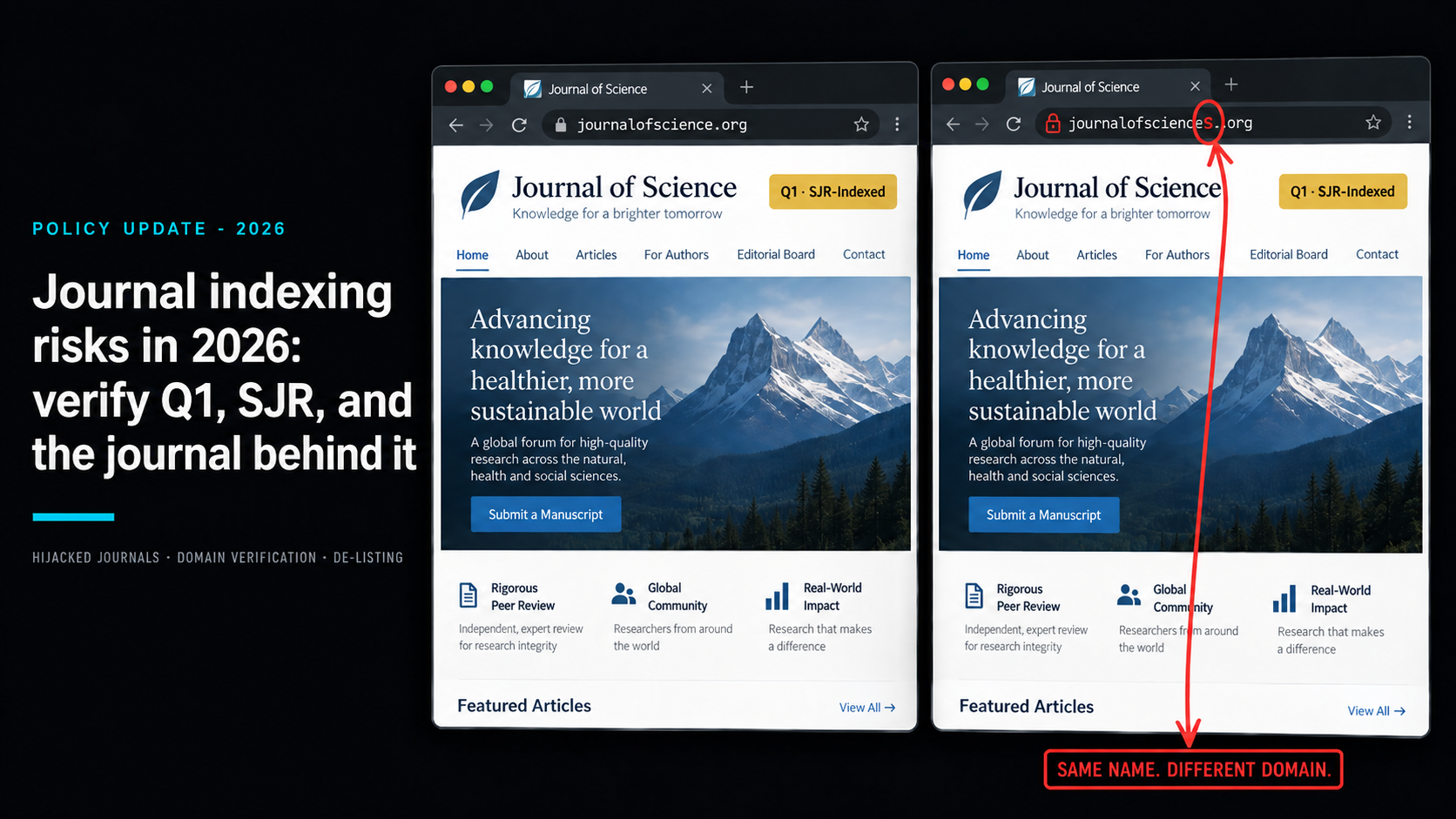
A predatory journal and a hijacked journal create different risks. A predatory journal generally misrepresents editorial standards or publishing services. A hijacked journal is a fraudulent operation that impersonates a real title, often cloning its name, ISSN, branding, website structure, or claimed database status. The latter can be particularly dangerous because the target may be a legitimate journal with a genuine record.
In September 2025, Retraction Watch documented a case involving a fraudulent operation using the title and ISSN associated with the legitimate Zhongguo Kuangye Daxue Xuebao/Journal of China University of Mining and Technology. The impostor appeared to benefit from the real journal's Scopus indexing and Q1 standing on SCImago, while the fraudulent website itself could not be independently validated through Scopus because the database entry did not provide the journal website, author instructions, or editorial contact.5
The lesson is precise: a real SJR value, a real quartile, or a real ISSN does not authenticate the website asking for a submission or fee. The credential may belong to the genuine journal while the sender, domain, payment instructions, and submission portal belong to an impostor.
By the end of 2025, the Retraction Watch Hijacked Journal Checker had surpassed 400 entries. Its verification guidance is practical: inspect domain registration through WHOIS; validate DOIs; remember that authentic DOIs begin with "10"; examine whether published topics fit the journal's declared scope; and check the exact website — not merely the journal title — against a hijacked-journal registry.6
Before submitting, authors should independently confirm the title, ISSN, publisher, official domain, editorial office contact, current index status, and the journal's current metrics. A claimed "Scopus indexed" label, copied SCImago badge, or email promising unusually rapid publication is evidence to investigate, not evidence to trust.
Why Q1 and SJR verification is non-negotiable
Q1 and Q2 labels have real career weight in many departments and national systems, but the requirement is local — not universal. Researchers should read their institution's current promotion, graduation, grant, and tenure rules rather than assume that a Q1 claim alone satisfies them. Some policies specify a database, category, calendar year, document type, or publication date; some accept a journal's status at submission, while others assess its status at publication.
That is why metric verification must be date-stamped. In the 2026 Journal Citation Reports release, Clarivate reported metrics for 22,643 journals across 254 categories and continued its move toward unified journal rankings. It also continued to exclude citations to and from retracted content in Journal Impact Factor calculations.7
The metric shift began with the 2025 JCR release, which excluded citations to and from retracted content from the JIF numerator while retaining retracted articles in the denominator for transparency. Clarivate reported that the change affected 1% of journals and was designed to reduce distortion from flawed or fraudulent research.8
For a researcher, the conclusion is not that a single metric has become invalid. It is that no metric is self-authenticating. Q1/Q2 placement, SJR, CiteScore, Journal Impact Factor, and peer-review information are useful decision inputs when they are checked against an authoritative and current source, interpreted within the relevant subject category, and paired with due diligence on the actual journal and its publishing operation. For a full framework, see our guide on choosing the right Q1/Q2 journal.
A structured pre-submission workflow
Journal screening does not need to be a fragmented, week-long task. Searching across multiple academic databases in parallel and comparing quartiles, SJR, Impact Factor, and peer-review metrics on a single view helps researchers evaluate plausible targets before investing more time in formatting or submission.
The value is not simply speed. A single comparison view encourages the right questions: Is the journal currently indexed? Which category produces the cited quartile? Do its scope, peer-review model, and metrics fit the manuscript? Is the title's official identity consistent across independent sources? Researchers should still verify the final submission domain through the publisher and database records, especially before sharing unpublished work or making any payment.
Once a legitimate Q1 or Q2 target is selected, language-support tools can help non-native English researchers improve clarity, flow, and disciplinary tone without sacrificing scientific precision. These tools are most responsibly used as part of an author-led revision process: preserve the data and claims, verify every citation, comply with the target journal's AI-disclosure policy, and ensure the final manuscript remains a defensible expression of the researchers' own scholarly judgment. Our guide on academic paraphrasing without altering scientific meaning covers that balance in detail.
In 2026, the safest publication strategy is not to chase a quartile badge. It is to build a verifiable chain of decisions — from journal identity and indexing status to metric context, manuscript quality, and submission domain. That is how researchers protect both a paper and the reputation it is meant to advance.
Verify before you submit. SciCampus is free to start — no card required. Create a free account.
Frequently asked questions
What is the difference between a predatory journal and a hijacked journal?
A predatory journal is a real operation that misrepresents its editorial standards, typically by promising fast publication for a fee with little or no genuine peer review. A hijacked journal is a fraudulent website that impersonates a real, often reputable journal — cloning its name, ISSN, and branding — to collect submission fees while the legitimate journal has no knowledge of the fraud.
If a journal shows a real SJR score and Q1 ranking, is it safe to submit to?
Not necessarily. A documented case found a fraudulent website using the identity of a real, Q1-ranked, Scopus-indexed journal. The metric was genuine; the website collecting submissions was not. Verify the domain, editorial contact, and submission portal independently of the metric.
Does losing Web of Science indexing happen instantly and permanently?
No. Clarivate's editorial de-listing process typically follows a period of review, and a de-listed journal normally faces at least a two-year embargo before it can be resubmitted for evaluation — it is not automatically permanent, but it is also not immediate reinstatement.
How can I check if a journal might be hijacked before I submit?
Check the exact website domain — not just the journal title — against the Retraction Watch Hijacked Journal Checker. Verify domain registration, confirm that DOIs resolve correctly and begin with "10," and independently confirm the editorial contact and publisher through the journal's official database entry rather than the website alone.
Why does the same Q1 claim work for one researcher's institution but not another's?
Quartile requirements are set locally by each institution, department, or funder, and they are not standardized. Some require a specific database (Scopus versus Web of Science), a specific subject category, or status at a specific point in time (submission versus publication). Always check your own institution's current written policy rather than assuming a Q1 label is universally sufficient.
References
Clarivate. "Editorial policies, category change requests, and appeals: Journals removed from coverage." Web of Science Core Collection, updated 16 March 2026. clarivate.com
Retraction Watch. "Web of Science delists bioengineering journal in wake of paper mill cleanup." 8 May 2025. retractionwatch.com
Retraction Watch. "Scopus indexed a journal with a fake editorial board and sham archive." 16 May 2025. retractionwatch.com
Retraction Watch. "Fighting coordinated publication fraud is like 'emptying an overflowing bathtub with a spoon,' study coauthor says." 4 August 2025. retractionwatch.com
Retraction Watch. "Guest post: In the name of Scopus, one hijacked journal easily tricks authors." 3 September 2025. retractionwatch.com
Retraction Watch. "The Retraction Watch Hijacked Journal Checker now has 400 entries." 26 December 2025. retractionwatch.com
Clarivate. "Clarivate releases 2026 Journal Citation Reports." 17 June 2026. clarivate.com
Clarivate. "JCR 2025: Excluding retraction citations to reinforce integrity." 15 May 2025. clarivate.com