Short answer: A similarity score falls for the right reasons when you fix what each match actually shows: write Methods from your own study records, write the literature review from your notes rather than from the source text, quote and cite wording you genuinely need, and tell the editor about any reuse of your own published text. The percentage is a starting point for review, not a verdict, so read the matches before you rewrite anything.
What does a similarity score actually measure?
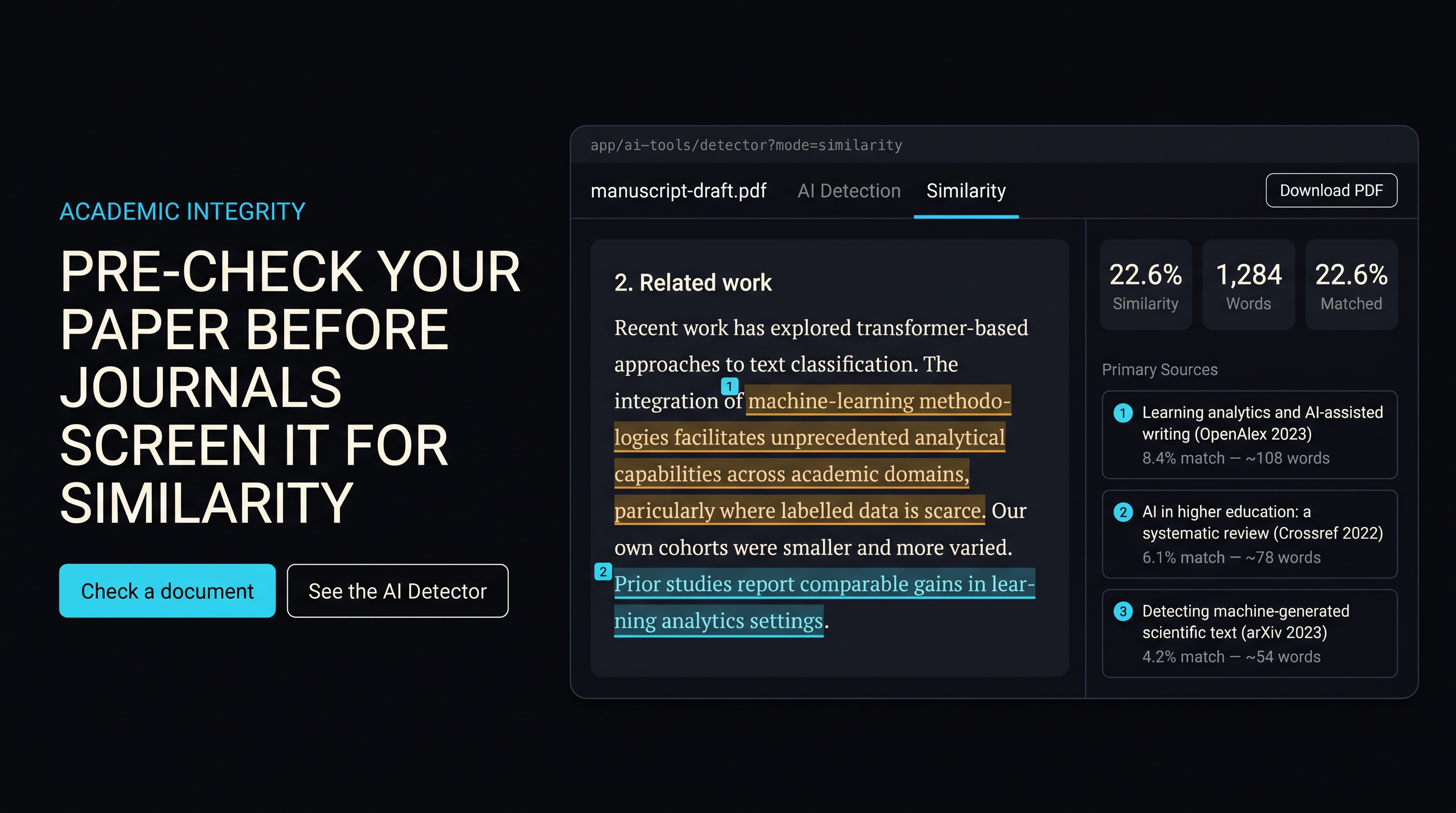
Crossref Similarity Check, which runs on iThenticate, calculates the score as the share of words in your manuscript that match text in the repositories it searched. Crossref states plainly that the tool checks for similarity, not plagiarism, and it advises editors not to set a score above which manuscripts are rejected automatically. Editors are expected to look at each flagged match and decide whether it is acceptable.
That has two practical consequences for you as an author:
A match is not automatically a problem. The exact name of a questionnaire, a standard reagent description or a correctly quoted and cited phrase may need to stay as it is.
A paragraph that follows another author’s wording and sentence order for several lines deserves attention, even if it ends with a citation.
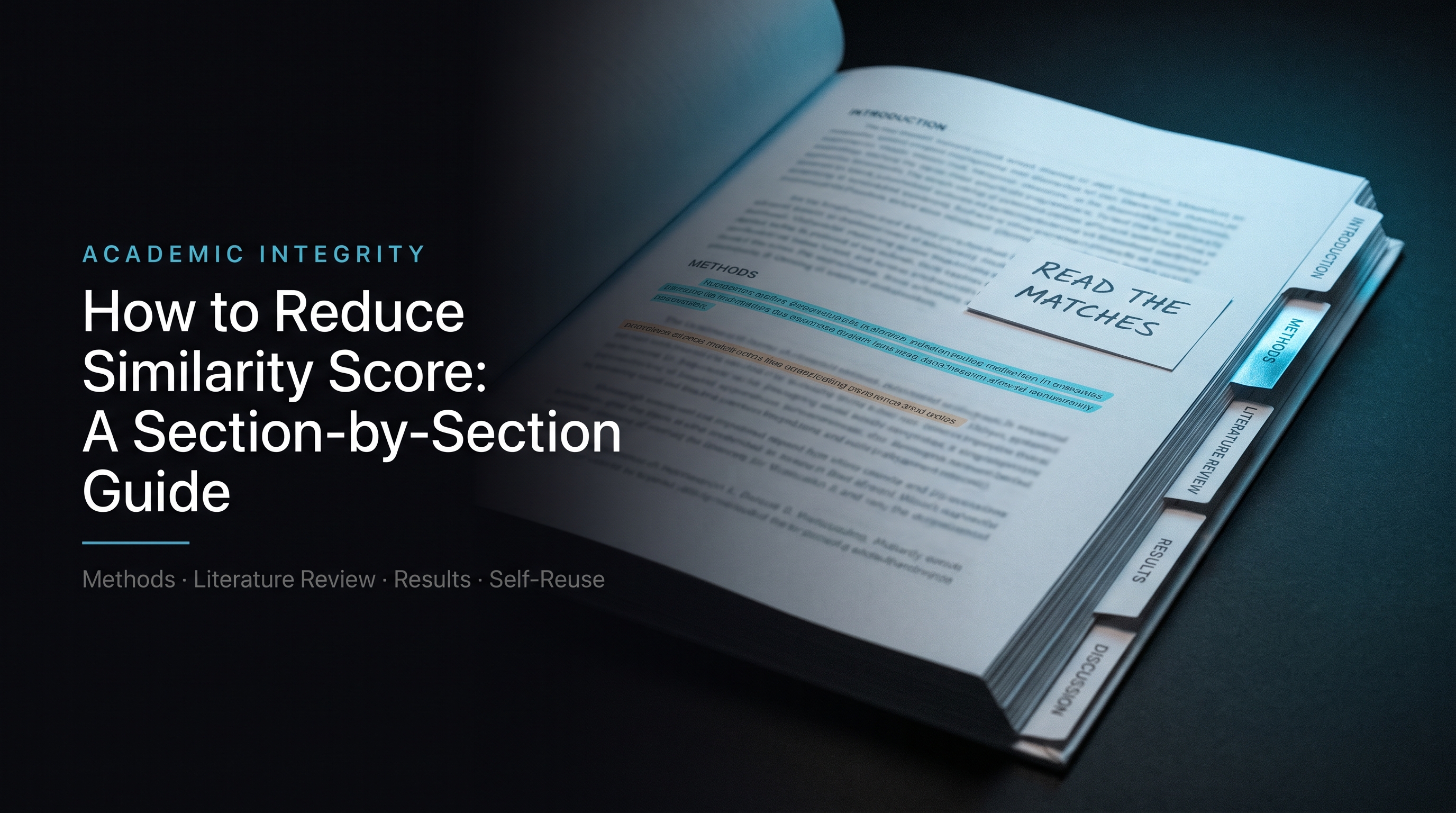
So before revising, open one highlighted passage and read it beside the original. Then look at where the overlap sits, because what readers need differs by section: in Methods they need to know what you did; in the literature review they need to understand what the studies say about your question.
How do you rewrite a Methods section that matches an earlier paper?
Set the earlier paper aside and open your own records: lab notebook, protocol, analysis scripts. Which procedure did you follow? Which conditions did you keep the same? What did you change? Write the paragraph from those answers, then return to the source only to check terminology and add the citation.
Suppose you compared two solar-panel layouts. A sentence like “System performance was evaluated under different conditions” leaves the reader guessing. If it reflects what you actually did, you could write: “We used the same weather data to estimate how much electricity each layout would generate over one year.” The revision names the comparison, the time period and the shared input, and the word estimate tells readers how the result was obtained.
Is it acceptable to reuse my own Methods text?
Often, yes. The text recycling guidelines developed by BioMed Central editors with the Committee on Publication Ethics (COPE) note that some methods can be described in only a few ways, and keeping the wording consistent can help readers see that the same method was used, provided the original article is cited. The guidance makes transparency the deciding factor: cite the earlier paper and tell the editor about the reuse when you submit. Editors use their discretion on how much overlap is acceptable, so check the journal’s own policy before reusing a long passage word for word.
Keep the technical terms that make your procedure precise. Replacing a standard term with a synonym to lower the score usually makes the method harder to reproduce.
How do you avoid close paraphrasing in a literature review?
Close paraphrasing often starts in your notes, with a missing pair of quotation marks. When you copy a useful sentence, put quotation marks around it immediately and record the source and page. Write your own observation on a separate line. Days later, you can see at a glance which words belong to the author and what you wanted to say about them.
Give each paragraph one question
Before drafting, decide what the paragraph has to answer. Suppose you want to know how solar panels perform in everyday use. One study might report a year of meter readings while another estimates annual output from weather records. That distinction gives the paragraph its structure: what was observed, what was estimated, and how each study helps answer your question. Place each citation beside the finding it supports. Organizing sources around questions, rather than summarizing them one by one, also shows readers where the evidence is still thin.
Check the source after you write
Once the paragraph is drafted, reopen the sources. Check the finding, the conditions and any qualification that matters. If your draft says a system produced a certain amount of electricity but the study only predicted it, restore that distinction. If an author’s exact wording is essential to your argument, quote the phrase and cite it.
What about the other sections?
Section | How overlap is usually viewed | What to do |
|---|---|---|
Introduction | Some reuse of background can be acceptable when the related articles are cited. | If an opening paragraph tracks a published review, go back to the original studies and keep only the findings that lead to your question. |
Methods | Reuse of a previously described method is often acceptable with citation and disclosure. | Write from your records; cite the earlier paper; tell the editor. |
Results | Overlap often amounts to duplicate publication and is nearly always unacceptable. | Write from your tables and figures. If any data were published before, say so, cite that work and raise it with the editor rather than rewording it. |
Discussion and conclusions | Reused text is seldom acceptable in conclusions, which should focus on what is new. | Separate your finding from your interpretation; credit another team’s explanation and say whether you tested it. |
Checklist before you submit
Read your most heavily revised passage again. Can a colleague still tell exactly what you did?
Can a reader trace every borrowed idea to its source?
Did any value, unit, condition or qualification disappear during rewording? Restore it.
Are all copied phrases in quotation marks with a citation?
Have you disclosed any reuse of your own published text in the cover letter?
If you compare similarity reports from two drafts, did you use the same settings? Exclusions remove matches and recalculate the percentage, so changed settings can hide or exaggerate the effect of your revisions.
Frequently asked questions
What similarity score is acceptable for a journal?
There is no universal number. Crossref advises editors against automatic rejection thresholds and expects them to judge matches individually. Check your target journal’s guidance, and focus on what the matches are rather than on the total.
Will using synonyms lower my score?
It may lower the number, but swapping words while keeping another author’s structure is still close paraphrasing, and it can blur technical meaning. Rewriting from your own notes and records is the reliable fix.
Does citing a source make copied text acceptable?
Not by itself. Copied wording needs quotation marks as well as a citation, and reuse of your own published text should also be disclosed to the editor.
Why does my own preprint show up as a match?
Crossref notes that a match to the author’s own preprint is expected; iThenticate also crawls preprint repositories on the web. Mention the preprint in your submission so the editor can recognize the overlap.
Checking your draft with SciCampus Similarity Check
Editorial note: SciCampus Similarity Check is our own tool.
For a final read-through, SciCampus Similarity Check runs as part of the AI Detector analysis and compares your text with published scholarly sources, including records from Crossref, OpenAlex, arXiv, PubMed and Semantic Scholar, looking for both wording and meaning overlap. It does not search private student-paper repositories, so its results will not match those of a journal’s iThenticate check. Use it to find passages worth a second look, then open the source beside your draft and decide whether the passage needs clearer explanation, a quotation or a citation.
Related Reading (Topic Ideas for Future Posts)
Sources
Crossref. Understanding your Similarity Report.
Harriman, S., & Patel, J. (2014). Text recycling: acceptable or misconduct? BMC Medicine, 12, 148.
BioMed Central & COPE. Text Recycling Guidelines.
Turabian, K. L. (2013). A Manual for Writers of Research Papers, Theses, and Dissertations (8th ed.). University of Chicago Press. See §4.2 on taking notes and §§7.9–7.9.2 on inadvertent plagiarism, quotation and paraphrase.
Pautasso, M. (2013). Ten simple rules for writing a literature review. PLOS Computational Biology, 9(7), e1003149.