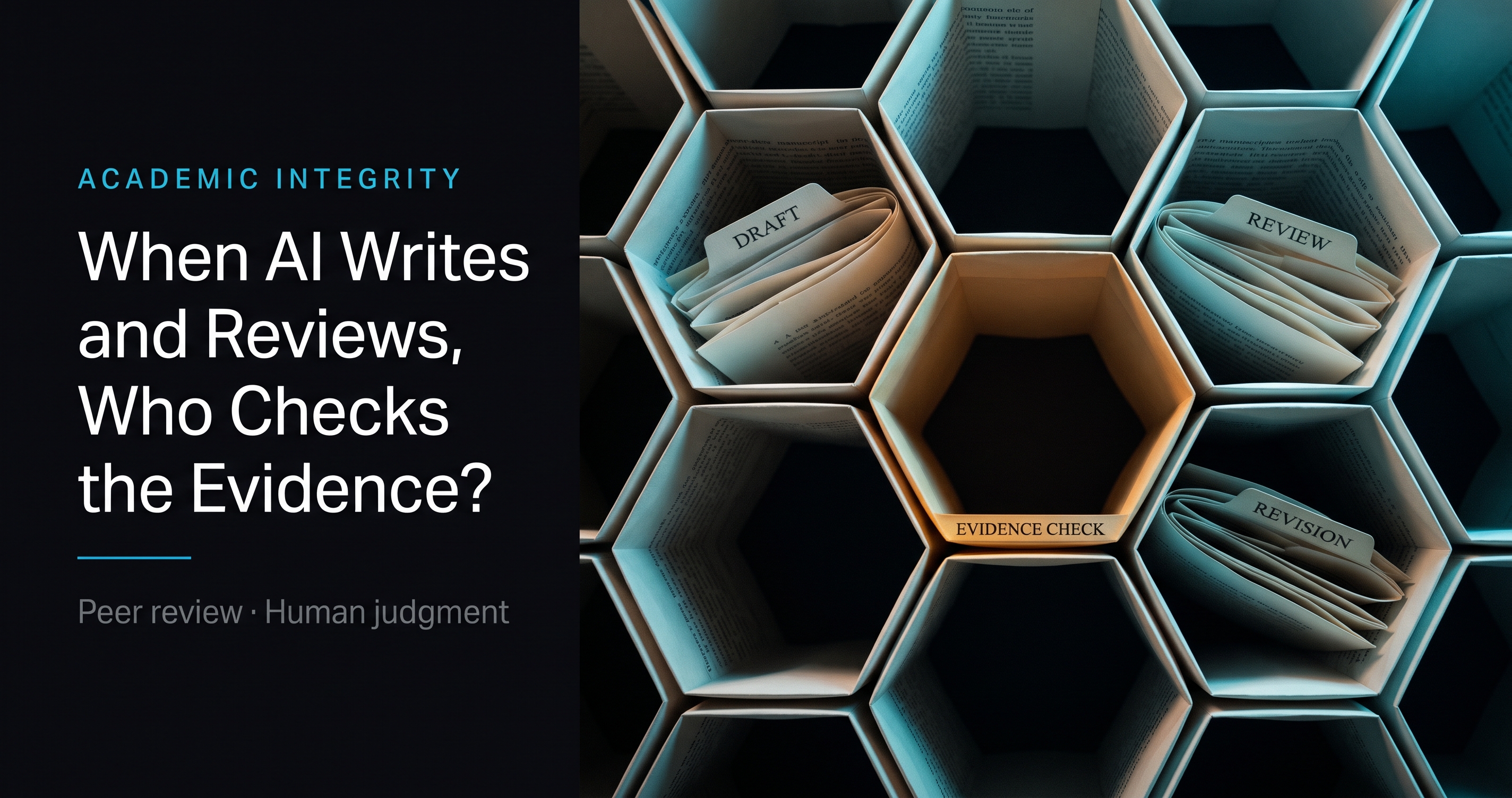
Short answer: When Ai helps write a research paper and also assists with peer review, authors and reviewers still need to check the evidence independently. Authors are responsible for the methods, analysis, and claims they submit. Reviewers are responsible for their scientific assessment, and editors are responsible for the editorial decision. Ai can help organize the work, but a polished manuscript or review cannot establish whether the evidence supports the conclusion.
What happens when Ai helps write and review the same paper?
Imagine an author using a large language model to refine a hypothesis, suggest an analysis, and draft the discussion. A reviewer uses another model to identify weaknesses in that paper. The author then uses Ai to draft a response and revise the manuscript. At each step, the writing may become clearer while the original assumptions receive little independent scrutiny.
Consider a paper that reports an association between an exposure and an outcome. The draft describes the association in causal terms. A review tool suggests adding a limitation about confounding, and a revision tool adds that caveat while leaving the causal claim in the abstract. The decisive question is whether the design and analysis support the causal interpretation. Answering it requires checking the methods, results, and assumptions directly.
There is evidence of Ai involvement in some review writing. A 2024 study estimated that 6.5% to 16.9% of the text in peer-review submissions across four Ai conferences may have been substantially modified by large language models. The estimate applies to the text in those collections. It cannot tell us which individual reviewers used Ai or whether they delegated scientific evaluation. Liang et al., ICML 2024.
Can Ai help develop an original research idea?
Ai can suggest explanations for an unexpected finding, surface variables to investigate, or help a researcher formulate questions for a literature search. In one study involving more than 100 natural language processing researchers, expert evaluators rated Ai-generated research ideas higher on novelty while rating them slightly lower on feasibility. A novelty rating still leaves open whether the proposed experiment is practical and whether the idea has already appeared in prior work. Si et al., ICLR 2025.
How a question is framed matters, too. Asking a model for the strongest case for a hypothesis serves a different purpose from asking how to falsify it. Research on prompt sensitivity also shows that changes in prompt wording can affect model responses. Use those responses to identify assumptions worth testing, then check them against published work and the constraints of the study. Chatterjee et al., EMNLP 2024.
What can a queenless honeybee colony illustrate?
A honeybee colony that loses its queen can sometimes raise a replacement from suitable young brood. If it cannot do so, some workers may begin laying unfertilized eggs that develop into drones. The colony can still produce offspring without replenishing its workforce. The analogy for publishing is limited but concrete: a manuscript can go through more rounds of writing, reviewing, and revising while the scientific claim at its center goes unchecked. University of Delaware, honeybee colony biology.
Could Ai make research ideas more uniform?
A 2024 experiment with short-story writers found that access to Ai-generated ideas improved some individual creativity ratings while making stories more similar to one another. The study examined fiction. Whether similar effects occur when researchers formulate hypotheses or reviewers evaluate unconventional methods remains an open question. One practical response is to identify which observations would distinguish the proposed explanation from credible alternatives before asking a model for feedback. Doshi and Hauser, Science Advances.
What do publishers allow in Ai-assisted peer review?
Elsevier says reviewers should keep submitted manuscripts out of Ai tools. Its policy allows limited support, such as improving the wording of a review or assisting with a background literature search, subject to confidentiality, human oversight, and its requirements for private tools. Reviewers remain responsible for the scientific assessment and should check the policy for disclosure requirements. Elsevier's generative Ai policy.
Springer Nature's guidance emphasizes human responsibility, verification, and confidentiality. In October 2026, Springer Nature and Google DeepMind announced a research partnership to design an assistant that would help reviewers navigate papers and identify sections deserving closer attention. The stated purpose is to give experts more time for questions that require scientific judgment. Springer Nature's Ai guidance and the partnership announcement.
In November 2026, Retraction Watch reported that Taylor & Francis retracted a paper after an instruction directed at Ai was found in its published data availability statement. The report establishes that an instruction was found and the paper was retracted. Whether an Ai tool influenced the acceptance decision remains unestablished. Retraction Watch's reporting.
How can authors, reviewers, and editors keep scientific evaluation independent?
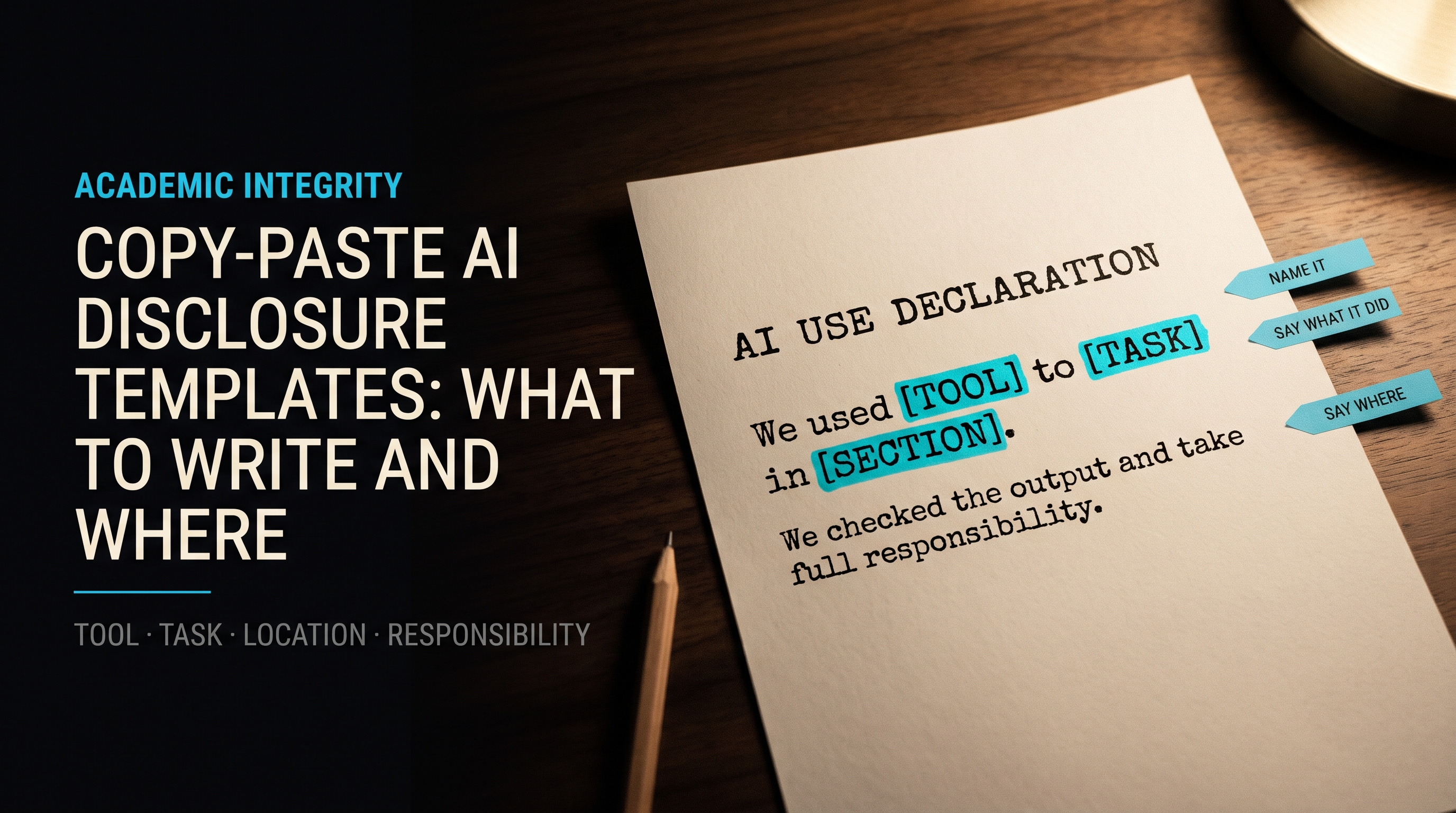
Authors: Verify citations against the original papers. Link each main claim to the data, analysis, or source that supports it. Record material changes in the response to reviewers and disclose Ai use as required by the journal.
Reviewers: Form an initial assessment of the methods and evidence independently. Tie major comments to a specific figure, table, analysis, or passage. Check the journal's Ai and confidentiality rules before using any tool.
Editors: Look for reviews that give specific, evidence-based reasons for their recommendations. When experts disagree about a method or interpretation, ask them to address that point directly or seek an additional specialist assessment.
What can an Ai detector tell you before submission?
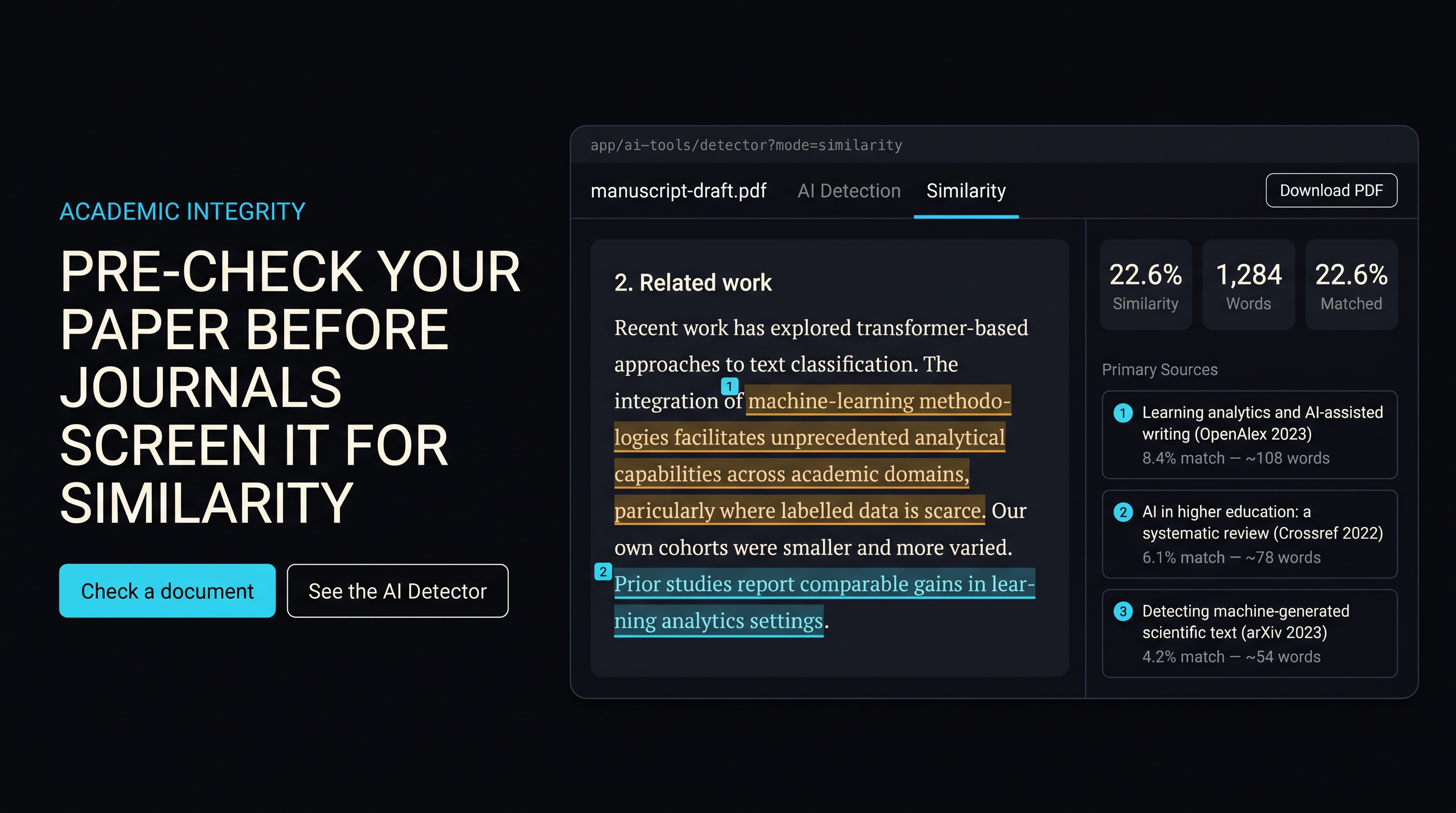
The SciCampus Ai Detector estimates whether individual sentences resemble human-written, Ai-generated, or Ai-paraphrased text. A flag can identify a passage to reread alongside earlier drafts. Questions about authorship, the originality of a research idea, or the validity of its findings require separate evidence. Weber-Wulff et al., International Journal for Educational Integrity.
Editorial disclosure: SciCampus publishes this article and operates the Ai Detector mentioned above.
Frequently Asked Questions
Can peer reviewers use Ai to review a manuscript?
Check the specific journal's reviewer policy before using any Ai tool. Publishers can distinguish between drafting or editing a review report, uploading confidential manuscript content, and evaluating the paper's scientific merits. Each activity may be subject to different limits.
Does an Ai-assisted manuscript require an Ai disclosure?
Follow the target journal's instructions. Requirements can depend on what the tool did, where it was used, and whether it contributed to the analysis or manuscript. Record the tool and its role so you can provide an accurate disclosure if required.
How can an author respond to a generic reviewer comment?
Identify the underlying scientific question and point to the specific evidence or revision that addresses it. If a suggested change would be inappropriate for the study design, explain why and cite the relevant methods or results. Ask the editor for clarification if the requested change remains unclear.
Related Reading
Related Reading (Topic Ideas for Future Posts)
How to write a response to reviewers that ties each change to the evidence
When can peer reviewers use Ai? How to check journal confidentiality rules
How to document Ai use from research design to manuscript submission
Sources
Liang et al. (2024), Monitoring Ai-Modified Content at Scale
Chatterjee et al. (2024), POSIX: A Prompt Sensitivity Index for Large Language Models
Doshi and Hauser (2024), Generative Ai and the diversity of creative writing
Springer Nature, Guidance for researchers, editors and reviewers on the use of Ai in publishing
Springer Nature and Google DeepMind, peer-review research partnership announcement
Retraction Watch, reporting on Ai-directed instructions in published papers
Weber-Wulff et al. (2023), Testing of detection tools for Ai-generated text