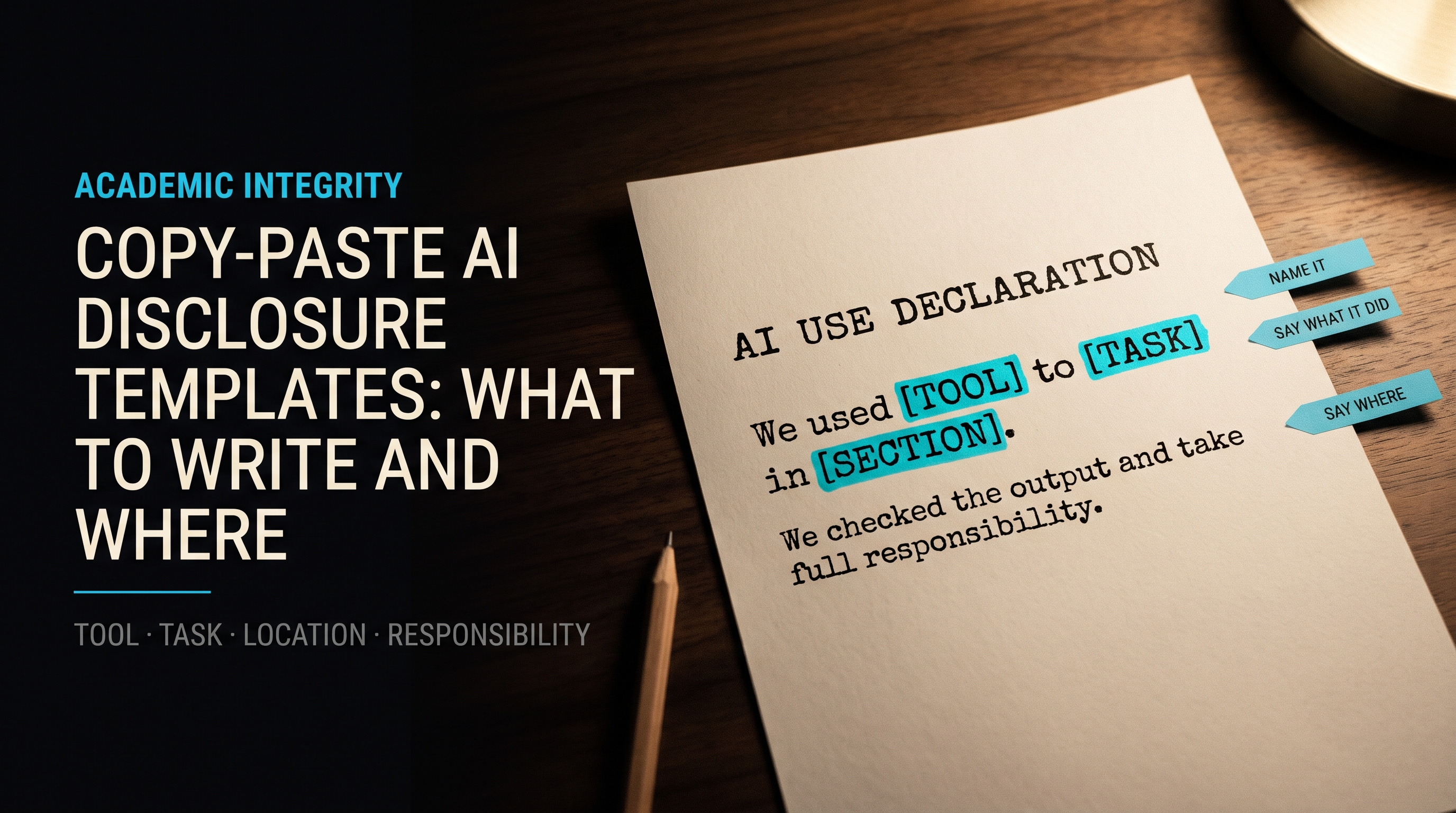
Short answer: A good AI disclosure statement names the tool, says exactly what it did, says where in the manuscript it was used, and confirms that the authors checked the result and take responsibility. Where the statement goes depends on the publisher and on the task: Elsevier wants a separate declaration, Springer Nature an end-of-paper AI Use Declaration, IEEE the Acknowledgments, and Wiley the Acknowledgments or Methods depending on what the AI did. Below are seven copy-and-paste templates, a comparison table and a checklist.
Editorial note: SciCampus wrote these templates from the publisher policies linked in each section. They are not official publisher wording. If your journal supplies its own wording or form field, use that instead. Replace every bracketed field and describe only what you actually did.
Why is “we used ChatGPT to improve the manuscript” not enough?
An editor reading that sentence has to guess what happened. Did the tool translate the abstract, reorganise the Discussion, or help decide which studies went into a review? A useful statement names the tool, describes its contribution, and tells readers where that contribution appears. The task also decides where the statement belongs: Wiley’s guidance, for example, treats translation as a writing task and AI used in a literature review as part of the research procedure.
Where does each publisher want the statement?
Publisher | Where to disclose | What to include | Routine language polishing |
|---|---|---|---|
Elsevier | Separate declaration at the end of the manuscript, before the references; AI used in the research itself goes in Methods | Tool, purpose and extent of oversight | Basic grammar, spelling and punctuation checks need no declaration; substantive changes to sentence structure or organisation should be disclosed |
Springer Nature (group guidance) | AI Use Declaration at the end of the paper; research use described in Methods | Tool versions, dates, prompts and extent of AI contribution | The group guidance says AI-assisted copy editing should be declared; older imprint policy pages say it need not be. Check your journal. |
IEEE | Acknowledgments section | AI system, the part of the article affected, and a brief note on the level of contribution | Disclosure recommended, not required |
Nature | Follows Springer Nature group guidance; check the instructions for your specific journal | As for Springer Nature | As for Springer Nature |
Wiley | Methods, a disclosure statement or the Acknowledgments, as applicable to the task | Specific description of the tool’s role | Spelling, grammar and general editing tools are excluded from disclosure |
Strategic Management Journal (Wiley) | Cover letter plus a labelled “AI Use Statement” paragraph before the References | Tool(s), stage(s) of the work and how the output was used | Follow the journal’s own guidelines |
How do I write an Elsevier AI disclosure statement?
Elsevier’s journal policy asks for a declaration, usually headed “Declaration of generative AI and AI-assisted technologies in the manuscript preparation process” and placed before the reference list. It says basic checks of grammar, spelling and punctuation do not need a declaration, but substantive changes to sentence structure or organisation should be disclosed. AI used as part of the research itself should be described in detail in the Methods section. Use the template below as a starting point and compare it with the format on Elsevier’s page, which Elsevier recommends.
Template 1: Manuscript preparation
We used [tool name] to [specific task] while preparing [section or passages]. We reviewed the output and [describe how you checked it and any revisions you made]. We take full responsibility for the content of the published article.
Example: if you wrote the Discussion and asked a tool to suggest a new paragraph order, “to suggest an order for the three paragraphs comparing our findings with earlier studies” describes the task far better than “to improve the Discussion.”
How do I write a Springer Nature AI disclosure statement?
Springer Nature’s group guidance says generative AI use should be declared, with details such as tool versions, usage dates, prompts and the extent of the AI contribution. Research uses belong in Methods, with an AI Use Declaration at the end of the paper pointing readers there. For manuscript preparation, authors detail the use in the AI Use Declaration. Springer Nature’s group page treats polishing language as a lower-risk use and extensive copy editing as one needing more care, while some older imprint pages still say plain copy editing does not need declaring. If your journal’s instructions differ, follow the journal.
Template 2: Copy editing an author-written draft
We used [tool and version] on [date or date range] to [describe the editing task] in [specific passages or sections]. The prompt(s) used were [provide the prompts or identify where they are documented]. We reviewed the edits by [describe the review performed] and take responsibility for the final text.
Template 3: End-of-paper declaration for AI used in the research
We used [tool and version] to [specific research task]. The Methods subsection “[exact subsection title]” describes how we used the tool and assessed its output. We take full responsibility for the work.
Write the Methods subsection first, then use Template 3 so that a reader who follows the reference finds the inputs, prompts and verification steps.
How do I write an IEEE AI disclosure statement?
IEEE’s guidelines say AI-generated content, including text, figures, images and code, must be disclosed in the Acknowledgments. The disclosure should identify the AI system, the sections that use AI-generated content, and briefly explain at what level the system was used. For editing and grammar enhancement, IEEE says disclosure is recommended but not required.
Template 4: AI-generated text, code or other material
We used [AI system] in [section, figure or listing number]. It generated [identify the material and briefly describe its contribution].
Illustrative example: “We used [AI system] to draft the plotting function in Listing 2. The authors selected the variables and tested the function against the reference output.” Include the sentence about testing only if you performed that test.
How do I write an AI disclosure statement for Nature?
Nature journals follow Springer Nature’s group framework, which lists drafting explanatory summaries, comparing results with existing literature and extensive copy editing among uses that call for caution, human oversight, verification and disclosure. Check the instructions for the specific journal you are submitting to. When a tool helped explain a result, say so precisely.
Template 5: AI assistance with an explanation or interpretation
We used [tool and version] on [date or date range] to [describe its contribution] in [section]. The prompt(s) were [provide the prompts or indicate where they are documented]. We checked the output against [data, analysis or publications actually consulted] and take responsibility for the interpretation presented in the manuscript.
Choose the verb carefully. “Suggested wording for our explanation of Figure 3” describes an editing task. “Suggested possible explanations for the pattern in Figure 3” tells the reader the tool also contributed to interpretation. Use the wording that matches what happened.
How do I write a Wiley AI disclosure statement?
Wiley’s guidance asks authors to disclose AI used to develop, substantially edit or translate manuscript content, in the Methods section, a disclosure statement or the Acknowledgments, as applicable. Tools used only for spelling, grammar and general editing are excluded. Translating your own abstract is a writing task; screening abstracts to decide which studies enter your review is part of the research procedure and fits better in Methods.
Template 6: Acknowledgments for a translated abstract
We used [tool and version, if known] to translate the abstract from [source language] into [target language]. We reviewed the translation by [describe the review actually performed].
Template 7: Methods for an AI-assisted literature review
During [stage of the review], we used [tool and version] to [task] on [records or materials]. We used its output to [describe how it informed the review]. [Explain how the records were checked and who made the final decisions.]
What if my journal has its own instructions?
Always follow them. The Strategic Management Journal’s author guidelines ask authors to briefly describe the AI tools and their purpose in the cover letter, and to add a labelled “AI Use Statement” paragraph at the end of the paper, before the References, covering the tools, the stage of the work and how the output was used. An author submitting there should use that structure rather than the generic Wiley placement.
Pre-submission checklist for an AI disclosure statement
Name the exact tool, and the version or date if the publisher asks for it.
Describe the task in plain verbs: translated, reordered, suggested, drafted, screened.
Say where in the manuscript the tool was used.
Describe only checks, edits and tests that someone actually performed.
Put research uses in Methods and writing uses where the publisher asks.
Read the statement alongside your revision history and your coauthors’ notes.
Do not list AI as an author.
Can an AI detector help with my disclosure?
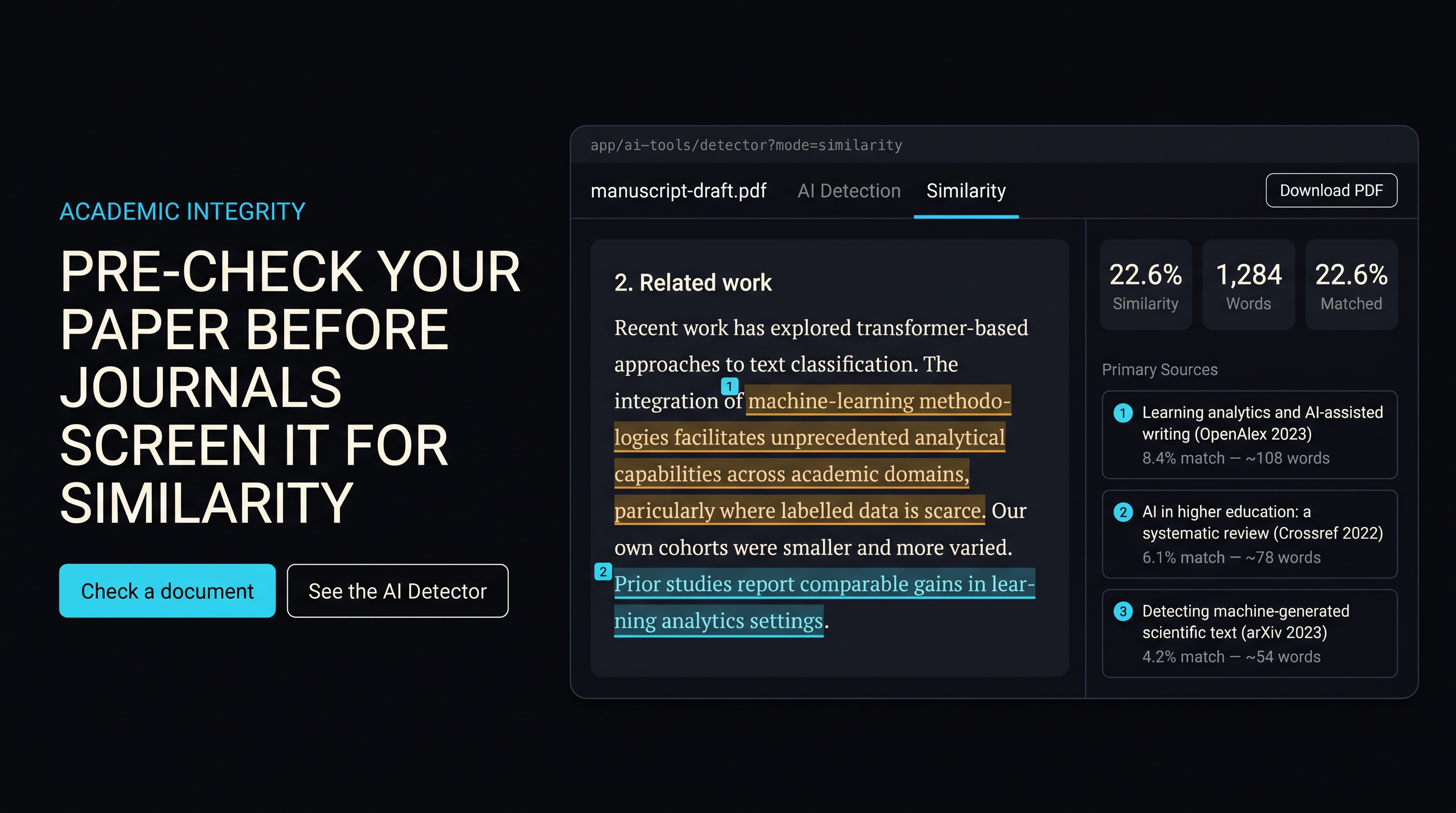
Not as evidence of what you did. A detector estimates how text looks, it cannot tell you which tools you used, and its output is not proof. The statement should come from the records you and your coauthors keep. For a final read-through, the SciCampus AI Detector reports human, AI-generated or AI-paraphrased probabilities per sentence, which can help you choose passages to reread. See why aggregate AI scores fail and how to build an evidence file for what to keep.
Frequently asked questions
Do I have to disclose grammar checking?
Elsevier and Wiley say basic grammar, spelling and punctuation tools need no declaration, and IEEE recommends but does not require it. Springer Nature’s guidance is stricter about copy editing, so check the journal.
Where should I put the disclosure?
It depends on the publisher and task. See the table above, and follow your journal’s own instructions where they differ.
Can I list ChatGPT or Claude as an author?
No. Publishers such as Elsevier and Springer Nature say AI tools do not meet authorship criteria because authorship carries accountability.
Should I include my prompts?
Springer Nature’s guidance asks for prompts and dates. Keep them anyway, since they make a statement verifiable.
Related: AI academic writing ethics, publisher AI policies in 2026 and responsible AI use in research.
Related Reading (Topic Ideas for Future Posts)
How to document AI use in Methods so a reviewer can reproduce it
Disclosing AI-assisted translation: what editors expect
Keeping a prompt log for your research project
Taylor & Francis, Sage and Cambridge AI disclosure templates