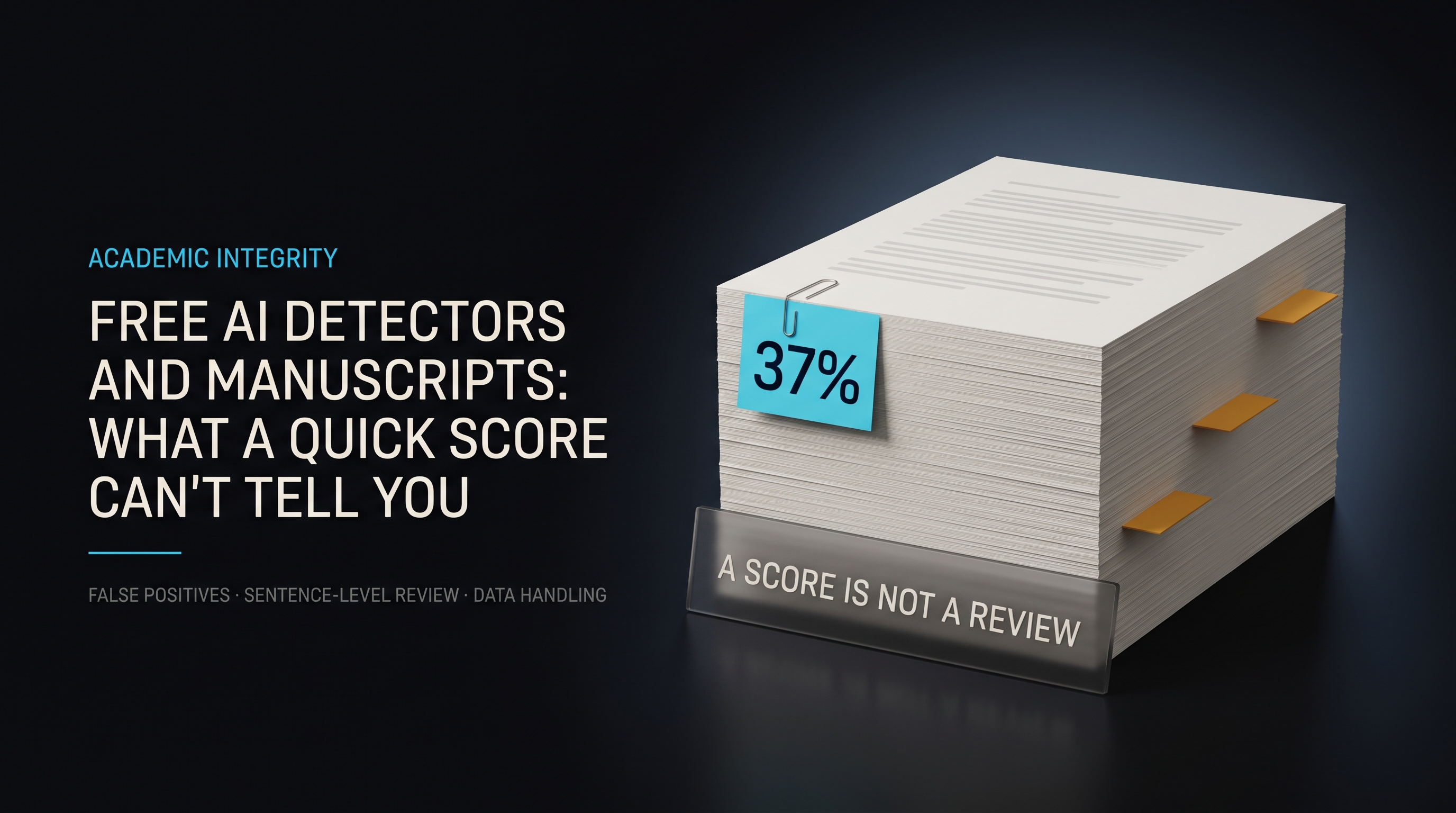
Short answer: a free AI detector can be a fine first check, but a single percentage is not a manuscript review. Detectors estimate how text resembles AI writing; they do not observe how you wrote it. Studies have found false positives, especially for non-native English writers, and every detector, including free ones such as ZeroGPT, states that its results are probabilistic. Before you act on a score, look at which sentences were flagged, check your journal's AI policy, and read the tool's data-handling terms before uploading unpublished work.
You have spent months on a paper. The experiments are done, the references are checked, and you run a quick free AI check before submission. A percentage appears in seconds. What should you do with it?
The problem is not that free detection is automatically inaccurate. It is that a quick check and a detailed manuscript review are different things.
Can I trust a free AI detector score for my manuscript?
Treat it as a screening signal. AI detectors analyze patterns in writing to estimate whether text resembles content generated by AI. They do not see your drafts, notes or editing history. That matters for academic writing, where precise terminology, conventional phrasing and formal structure are normal.
Two points are worth keeping in mind:
A high score does not prove AI authorship.
A low score does not prove human authorship or compliance with a journal's rules.
Why can human-written academic text be flagged as AI?
This is a false positive: genuine human writing is classified as AI-generated. Liang and colleagues (Patterns, 2023) tested seven widely used GPT detectors on 91 TOEFL essays written by non-native English speakers and found that the detectors frequently misclassified them as AI-generated, while native-speaker writing was classified far more accurately. Their paper reports an average false-positive rate of about 61% on the TOEFL essays.
Weber-Wulff and co-authors (International Journal for Educational Integrity, 2023) tested 14 detection tools and concluded that the available tools were neither accurate nor reliable, with a main bias toward classifying text as human-written. Content obfuscation made performance significantly worse.
Not every study reports the same picture. A 2026 study in the same journal, by Van Vlasselaer, Van Droogenbroeck and Spruyt, evaluated four detection tools in higher education and reported that false positives were rare across all four, while still warning that detectors should not be the sole evidence in high-stakes integrity cases.
These studies used different tools, texts and dates. They do not establish the current error rate of every detector. What they do show is why one flagged paragraph should not be treated as evidence. For more, see why false positives happen and why a single aggregate score fails.
Does AI-assisted editing make detection harder?
Yes. Many manuscripts are written by the researcher and then edited with grammar or language tools. That is a mixed case, not a clean human-versus-AI case. Weber-Wulff and colleagues found that obfuscation techniques significantly worsen detector performance, so the meaning of a score depends on the text and the tool. Read the result alongside your writing process, and check what your target journal asks you to disclose (publisher AI policies).
What changes between free and paid AI detection?
Plans differ in word limits, scan counts and how much detail you get about why text was flagged. The table summarizes what each provider documents. It describes plan features only and makes no claim about accuracy.
Provider | Free plan (per provider) | Paid plan (per provider) |
|---|---|---|
GPTZero | Basic AI Scan with an overall score, plus one free Advanced Scan; 10,000 words a month, up to 10,000 characters per scan | Premium adds the Advanced Scan (in-depth analysis with sentence highlighting), writing feedback and plagiarism check |
QuillBot | Up to 1,200 words per scan, up to 6 scans a day, 1 free explainer card | No word limit for detection scans, unlimited scans, detailed explainers across the full text |
Grammarly | Free web AI Detector with an overall percentage estimate | Pro includes the AI Detector agent, which walks through flagged passages |
SciCampus | 1 run per day, up to 3,000 words, with sentence-level classes and probabilities | Higher-volume plans and pay-per-run options |
Free and paid plans can differ substantially in the information available to you. That does not prove paid models are more accurate; it means some paid plans give a more detailed workflow for examining results. Plans change, so confirm current limits on each provider's page.
What does ZeroGPT say about its own results?
ZeroGPT is one example of a free detector with paid options. Its Terms of Use state that AI detection is probabilistic and that no detector, including ZeroGPT, can determine authorship with absolute certainty in every case. They list false positives, false negatives, incorrect classifications and inconsistent results as possible outcomes, and say a score does not constitute definitive proof of who wrote a text. They also say an output must not be treated as the sole basis for a consequential decision.
These limits are not unique to ZeroGPT. They reflect a wider fact about AI text detection: a classification is not verified evidence of authorship. The same applies to the other tools in this article, including ours.
Why does manuscript review need more than an AI percentage?
Imagine a high score on your introduction. It contains definitions, established terminology and descriptions of earlier studies, exactly the kind of text detectors may flag. Without looking at individual passages and your writing history, you cannot tell why it was flagged. Rewriting sentences only to lower a number can pull attention away from what matters: whether the science is accurate and clearly expressed.
A meaningful review means:
reading the flagged passages, not only the total;
remembering how the manuscript was prepared and keeping dated drafts;
checking the journal's rules on AI-assisted writing;
using a similarity check separately for overlap with published work (what each tool measures).
Is it safe to upload an unpublished manuscript to a detector?
Not automatically. Unpublished manuscripts hold findings that are not public yet, so read the provider's data-handling terms first. Practices differ and should not be generalized from one tool to another.
GPTZero's support pages show how specific these details are: they say text submitted through its dashboard, app or Chrome extension is stored so you can reach your scan history, and that text submitted by teachers and institutional customers is not used for model training. Check the exact terms of the plan you would use.
Before uploading to any service, including SciCampus, review its Privacy Policy and Terms for how uploaded text is stored, retained and used. For wider guidance, see AI detectors and unpublished manuscripts.
What should you look for in an AI detector?
Sentence-level findings, so you can see which passages drove the result.
Clear wording that results are estimates, not proof.
Document support for your real file type and length.
Clear data-handling terms for unpublished work.
A workflow for review, not just a number to push down.
How does the SciCampus AI Detector work?
The SciCampus AI Detector accepts pasted text or PDF and DOCX files up to 20 MB. It gives a document-level score weighted by word count and classifies each sentence as human-written, AI-generated or AI-paraphrased, with probabilities. You can download a PDF report. The free plan allows one run per day of up to 3,000 words, and paid options add volume. Like any detector, it produces estimates. The value of the report is information you can review, not proof of who wrote the manuscript. A Similarity Check, which compares text with published academic sources, is available alongside it at Similarity.
Frequently asked questions
Is a free AI detector good enough for a quick check?
For a preliminary look, often yes. For a thesis, dissertation or journal manuscript, check word limits and whether you can see sentence-level detail.
Does a low AI score mean I am safe?
No. It says nothing certain about your writing process or about journal requirements.
Should I rewrite text just to lower the score?
No. Focus on accuracy and clarity, and keep evidence of your own drafting.
Can I upload an unpublished paper to a free tool?
Only after reading its privacy and retention terms.
Related Reading (Topic Ideas for Future Posts)
How to keep a drafting evidence file in case of a false AI flag (see defending a manuscript against a false positive)
How to read a sentence-level AI detection report
What data-handling questions to ask any manuscript-checking tool
Editorial disclosure: this article is published by SciCampus, which is one of the tools discussed. Product capabilities are described from provider documentation. No accuracy ranking of the platforms is claimed.
Sources
Liang, W., Yuksekgonul, M., Mao, Y., Wu, E., & Zou, J. (2023). GPT detectors are biased against non-native English writers. Patterns, 4(7), 100779. doi:10.1016/j.patter.2023.100779
Weber-Wulff, D., et al. (2023). Testing of detection tools for AI-generated text. International Journal for Educational Integrity, 19, 26. doi:10.1007/s40979-023-00146-z
Van Vlasselaer, M., Van Droogenbroeck, F., & Spruyt, B. (2026). Who wrote this? Evaluating the reliability of AI detection tools in higher education. International Journal for Educational Integrity.
GPTZero Support: What is the difference between the free and paid plans?
GPTZero Support: What data does GPTZero collect when I use it? and Is GPTZero FERPA compliant?