In brief: Springer Nature and Google DeepMind announced on 26 October 2026 a research partnership to co-design an AI peer review assistant. A prototype is being tested. The announcement gives no launch date, access details or performance results, says expert human judgement stays central, and announces no change to submission requirements.
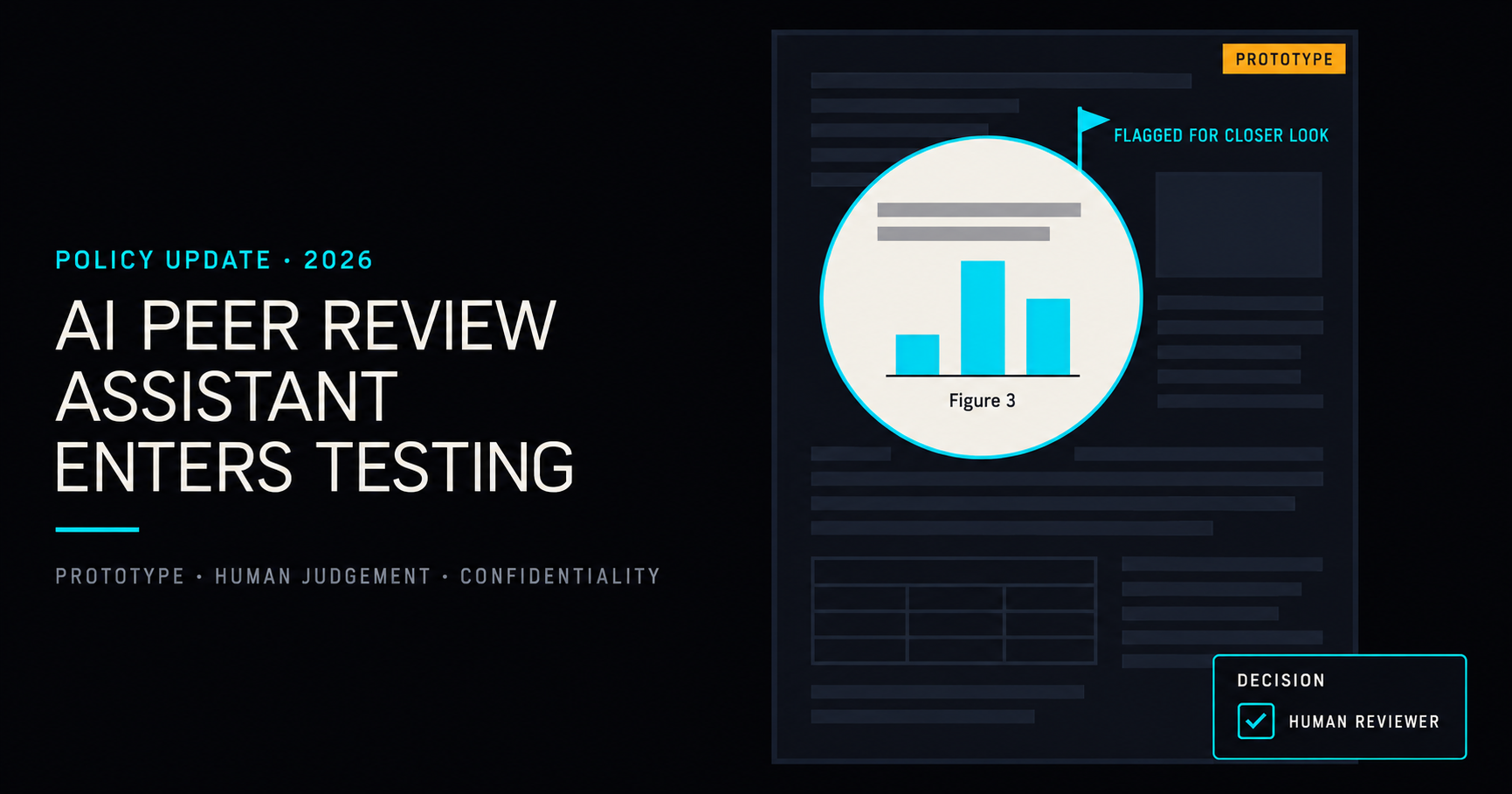
Springer Nature and Google DeepMind announced a research partnership to co-design an AI peer review assistant, according to the joint announcement. The assistant is intended to help reviewers navigate manuscripts and focus on questions that need specialist judgement. The release describes a prototype in testing, not a service with a stated launch.
What Is the AI Peer Review Assistant Meant to Do?
The partners say the assistant is meant to help reviewers examine papers more effectively. In their description, it supports navigation of manuscripts, helps analyse large amounts of text, charts and figures, and identifies areas that may need closer attention. The stated aim is to leave reviewers more time for questions requiring specialist scientific judgement. Springer Nature contributes its experience of managing peer review, and Google DeepMind contributes its Gemini models.
The release also cites Google’s earlier agentic research tools, ScholarPeer and Deep Review, as background. “Agentic” describes software that carries out multi-step tasks rather than answering a single prompt. The release does not say what, if anything, the prototype shares with them.
What Does the Announcement Establish — and Not Establish?
The release establishes that the two organisations are co-designing the assistant, that a prototype is currently being tested, and that further updates are promised as testing continues. The partners say expert human judgement stays at the centre of the process. Springer Nature’s Chief Product Officer, Saskia Steinacker, says innovation and trust have to go hand in hand.
Springer Nature and Google DeepMind are co-designing the assistant.
Not specified in the sources reviewed: Who is testing the prototype, at which journals, or by what methods.
A prototype is being tested; updates are promised.
Not specified in the sources reviewed: Launch date, timetable for wider deployment, or model versions.
It helps with navigation, large amounts of text, charts and figures, and flags areas for closer attention.
Not specified in the sources reviewed: Performance results or any independent evaluation.
Human expert judgement stays central.
Not specified in the sources reviewed: How researchers can access it, or whether external reviewers can take part in testing.
It runs in Springer Nature’s private Gemini Enterprise environment.
Not specified in the sources reviewed: Hosting, retention, encryption and model-training terms.
The sources reviewed do not describe automated scoring, reference verification, plagiarism screening or editorial decisions. This is a partners’ announcement, and nothing in it shows that the assistant improves review quality, speed, fairness or reliability.
Why Does the Deployment Environment Matter?
The announcement says the assistant is built with Google’s open-source Agent Development Kit, a software framework for building agents. The open-source description applies to that kit. It does not make the assistant or the Gemini models open source.
The release describes the system as running solely in Springer Nature’s private, secure Gemini Enterprise platform. It says content used to develop and test the assistant remains within Springer Nature’s secure environment. These are the partners’ statements, not the findings of an independent security audit.
The contrast that matters is one of governance. The partners describe a defined arrangement for one specific system. A reviewer who independently uploads manuscript content to an external tool is in a different position, because whether that tool is approved depends on the journal’s policy and on how the particular service handles data. This is not a ranking of products. Until hosting, retention, encryption and training terms are published, “private” and “secure” are descriptions to test, not technical guarantees.
What Should Authors Take From This?
The announcement does not announce new submission requirements, and it does not explain whether the prototype changes routine review procedures at any participating journal. It provides no basis for changing a manuscript to satisfy an assumed AI reviewer. Follow the target journal’s published requirements, and use the SciCampus Journal Finder to compare candidate journals before reading each one’s policies. For wider publisher-policy context, see our report on journal AI policy and the traceability standard, and our guide to the peer review process.
What Should Reviewers Take From This?
This advice draws on Springer Nature’s existing policies, not on the announcement. Springer Nature’s AI guidance says reviewers remain responsible for their own evaluation, may use secure or institutionally approved AI tools, and should not upload manuscript content to unsecured or public AI systems. Its September 2026 policy update also states that handing peer review over to AI remains prohibited (Springer Nature, 2026; Springer Nature, n.d.). The announcement does not say how this prototype relates to those rules, or whether it counts as an approved tool for any specific journal.
Reviewers should follow the policy of the specific journal they are reviewing for, and ask the handling editor if unsure. The announcement should not be treated as permission to use external AI tools. The partners frame the assistant as support for expert reviewers, not a replacement for them. A flag from a tool is a prompt to look again, not a finding. For a broader view, read our guide to AI academic writing ethics.
What Evidence Would Allow Evaluation of the Assistant?
The following is editorial interpretation. Helping a reviewer locate a passage is a different task from deciding whether the evidence supports a scientific claim. An open question is whether the tool only aids navigation or also shapes which issues reviewers examine. Faster navigation is also not the same as better scientific assessment, so time saved alone would be a thin measure of success.
Questions that would help researchers judge the project:
Which outcomes will count as success, and who defines them: reviewers, editors or authors?
Will evaluations record factual errors and missed problems, not just speed?
How will performance be assessed across disciplines, manuscript types and authors’ language backgrounds?
How can reviewers challenge or disregard the assistant’s suggestions, and will that be recorded?
What will be published about access, participating journals and data governance?
Sources
Springer Nature. (2026, October 26). Springer Nature and Google DeepMind research partnership to support peer review [Press release]. https://group.springernature.com/gp/group/media/press-releases/research-partnership-with-googledeepmind-to-support-peer-review/53891572
Research Information. (2026, October 26). Springer Nature and Google DeepMind partner on AI peer review assistant. https://www.researchinformation.info/news/springer-nature-and-google-deepmind-partner-on-ai-peer-review-assistant/
Springer Nature. (2026, September 10). Springer Nature launches updated AI policies and guidance to support responsible AI use [Press release]. https://group.springernature.com/gp/group/media/press-releases/sn-policy-responsible-ai-use/53209516
Springer Nature. (n.d.). AI guidance for our researchers and communities. https://group.springernature.com/gp/group/ai/ai-guidance-for-our-researchers-and-communities