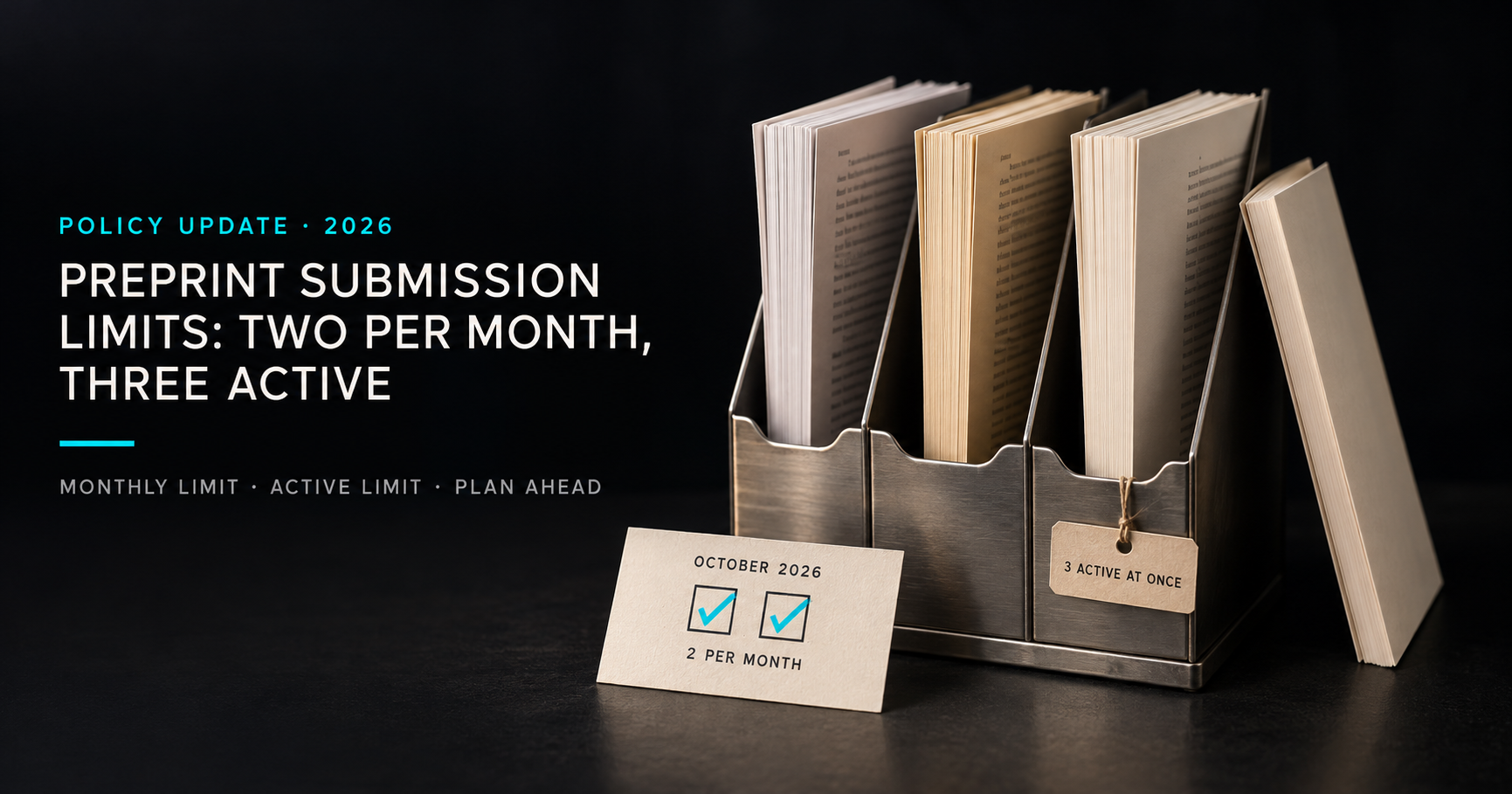
In brief: From 1 October 2026, arXiv allows each submitter up to two submissions per calendar month and no more than three active submissions at any one time. Rejected submissions count toward the month, co-authors are not affected by someone else’s submission, and the three-active limit has applied since 2024.
The arXiv submission limit now allows each submitter up to two submissions per calendar month and no more than three active submissions at any one time, according to arXiv’s announcement of 1 October 2026. The updated policy took effect that day. Both limits attach to the submitter, the person who actually submits the work, rather than to every listed co-author.
What Are arXiv’s Submission Limit Rules?
These points come from the announcement and its FAQ, and from press coverage of it.
Monthly allowance
What arXiv says: Each submitter may make up to two submissions per calendar month. The announcement describes a calendar month, not a rolling 30-day period.
Active submissions
What arXiv says: No more than three may be active at any given time, separately from the monthly allowance. This limit has applied since 2024.
Categories
What arXiv says: The limits apply across all subject categories, with no separate allowance for each.
Rejected submissions
What arXiv says: They count toward the month, because the limit covers submissions rather than announced papers.
Co-authored submissions
What arXiv says: The rules apply to the person submitting, so a co-authored paper counts toward the submitter’s rate, not the co-authors’.
Holds carried over
What arXiv says: Submissions still on hold from a previous month do not count against the new month’s limit, but they do count toward the three-active limit.
Deleted before announcement
What arXiv says: A paper deleted before it is announced does not count toward either limit. The announcement does not extend this to withdrawing an already-announced paper.
Backlogs and deadlines
What arXiv says: Authors with a backlog or a conference deadline are asked to plan carefully; no exemption is described.
The sources reviewed do not specify a reset time or time zone for the monthly allowance. arXiv’s moderation help page is also reported to say that arXiv may ask a particular author to limit their submission rate further, so treat the limits as ceilings, not guaranteed entitlements.
How Do the Monthly and Active Limits Interact?
The monthly allowance counts submissions made in a calendar month; the active limit counts those in progress at one moment. Both must be satisfied, and one does not override the other. The examples below are hypothetical, not actual cases.
Example A: two October submissions, one rejected. Both count toward October, so the monthly allowance is used until November. Rejection does not restore it. The example makes no claim about the active limit, which the announcement does not address for rejected submissions.
Example B: two holds carried into November. Assume two October submissions are still on hold on 1 November and the submitter has no other active submissions. They do not use November’s monthly allowance, so two monthly submissions remain. They do occupy two of the three active slots, so only one further submission fits until a slot is freed.
Example C: a paper with several co-authors. Assume Dr A submits a paper listing authors B, C and D. Only Dr A’s submission rate is affected, and B, C and D keep their own allowances. Nothing limits how many papers anyone may co-author, and arXiv’s authorship, account and submission requirements still apply.
Why Did arXiv Introduce the Update?
arXiv describes the change as a stopgap while it works out best practice for authors using more advanced AI tools and improves its moderation tools. It says the aim is to distribute volunteer moderators’ time more equitably and protect the arXiv corpus from a sharp increase in inappropriate submissions.
For context, arXiv reports receiving 20,569 submissions in September 2024 and 40,363 in September 2026, and almost 9,000 support tickets (Research Information). These are submissions, not announced papers, and arXiv does not say what share involved AI or was of low quality. It says moderators have seen more thin papers of narrow scope and more “salami” papers, meaning a single work split into several smaller ones.
The announcement does not ban AI. It says arXiv policy permits AI as a research tool if its use is disclosed and the work meets arXiv’s standards of scholarly interest. arXiv says it will monitor the update’s effects; the sources reviewed contain no outcome evidence, such as moderation times. For disclosure norms elsewhere, see our guides to AI academic writing ethics and journal AI policy and the traceability standard.
What Should Research Teams Check Before Submitting to arXiv?
Name the submitter in advance, in line with arXiv’s authorship, account and submission requirements.
Check that person’s submissions this calendar month, including any that were rejected.
Count their active submissions, including holds carried over from earlier months.
Coordinate co-authors, deadlines and existing holds.
Confirm manuscript readiness and co-author approval before submitting.
Allow for delay: holds can take several days because of submission volume, so no announcement date can be assumed.
Do not submit a duplicate while a paper is on hold; arXiv’s status page says deleting and resubmitting a held paper leads to further delays.
Our editorial advice, not an arXiv rule: do not delete submissions merely to recycle allowance. For unresolved cases, use arXiv’s user support portal or the contact channels named on its moderation policy page.
If the preprint is a step toward a journal, check the journal’s preprint policy early; the SciCampus Journal Finder can help you shortlist journals, and our guide to journal selection and cover letters covers what to say about prior posting.
What Remains Unclear About the arXiv Limits?
arXiv’s moderation policy has been described as stating that the monthly limit applies to “new submissions” and giving a separate limit of one replacement per week after version 5. That page is undated, so it may not reflect the position on 28 October 2026. The official sources reviewed do not clarify:
whether replacements count toward the three-active-submission limit;
how the announcement’s word “submissions” relates to the moderation page’s “new submissions” wording;
which statuses count as “active”;
how appeals, resubmissions or conference-proceedings submissions are counted.
Readers have raised related questions in the announcement’s comments. Those comments are not arXiv policy. Before any time-sensitive submission, check the current rate-limit announcement and the moderation policy for changes.
Sources
arXiv. (2026, October 1). Fair moderation, equitable access, and AI: arXiv’s updated rate limit policy. https://blog.arxiv.org/2026/10/01/updated-rate-limit-policy/
Research Information. (2026). arXiv imposes submission limits amid surge in AI-generated papers. https://www.researchinformation.info/news/arxiv-imposes-submission-limits-amid-surge-in-ai-generated-papers/
The Register. (2026, October 2). arXiv imposes rate limit on paper submissions to stem the AI slop tide. https://www.theregister.com/ai-and-ml/2026/10/02/arxiv-imposes-rate-limit-on-paper-submissions-to-stem-the-ai-slop-tide/5300899
arXiv. (n.d.). Moderation policy. https://info.arxiv.org/help/moderation/index.html
arXiv. (n.d.). Submission status. https://info.arxiv.org/help/submit_status.html