Short answer: On November 20, 2026, Anthropic mathematician Levent Alpöge announced that he had, working with Claude, discovered a proof of the Riemann hypothesis. The proof is released as Lean code, and by November 22 independent checks reported by MIT's Andrew Sutherland and a joint Lean/Mathlib community statement said the code compiles and states the standard Riemann hypothesis. That is a strong computer-checked result, but it is not yet a peer-reviewed publication, a human-readable proof, or a Clay Millennium Prize. The Clay Mathematics Institute still listed the problem as unsolved at last report.
Editorial note: Claude is made by Anthropic, the company Alpöge works for. SciCampus is independent of both. This is a fast-moving story, so the status below is as of November 22, 2026; check the primary sources linked at the end for updates.
What is the Riemann hypothesis?
There are 25 prime numbers below 100 and 168 below 1,000. Primes get less common as numbers grow, but not at a steady rate. The prime number theorem describes the overall trend, and the Riemann hypothesis would give much tighter control over how far the actual count can stray from that trend.
In 1859, Bernhard Riemann showed how to study the primes through a function now called the Riemann zeta function, written ζ(s). The link comes from unique factorisation: every whole number greater than one breaks into primes in exactly one way, apart from order (for example 12 = 2 × 2 × 3). Where its defining series converges, the zeta function can also be written as a product with one factor for each prime, so one function encodes information about all of them.
The function takes a complex number as input, which you can picture as a point on a plane: the real part is its horizontal position and the imaginary part its vertical position. A zero is a point where the output is zero. Some zeros sit at the negative even integers −2, −4, −6, … (the trivial zeros). All other zeros lie in a vertical band between real parts 0 and 1, the critical strip.
The hypothesis says every nontrivial zero lies exactly halfway across that band, on the line where the real part is 1/2 (the critical line). One nontrivial zero off that line would disprove it, and a proof has to cover all of the infinitely many zeros.
Why does a line in the complex plane matter for prime numbers?
The positions of the zeta zeros help determine how the true prime count fluctuates around its estimate. If every nontrivial zero is on the critical line, mathematicians get a much tighter bound on the error in prime-counting estimates.
Numerical evidence has been strong for a long time. In a 2021 paper in the Bulletin of the London Mathematical Society, Dave Platt and Tim Trudgian rigorously verified that all nontrivial zeros with positive imaginary part up to 3 × 10¹² lie on the critical line. That result covers a finite range of heights only. A proof must apply at every height.
What did Levent Alpöge and Claude announce?
On November 20, 2026, Alpöge posted a four-page note on his personal website saying: “I believe I have, working with Claude, discovered a proof of the Riemann Hypothesis.” He also said the method covers the generalized Riemann hypothesis for Dirichlet L-functions, a related claim about a broader family of functions. Nature, Science and other outlets reported the announcement.
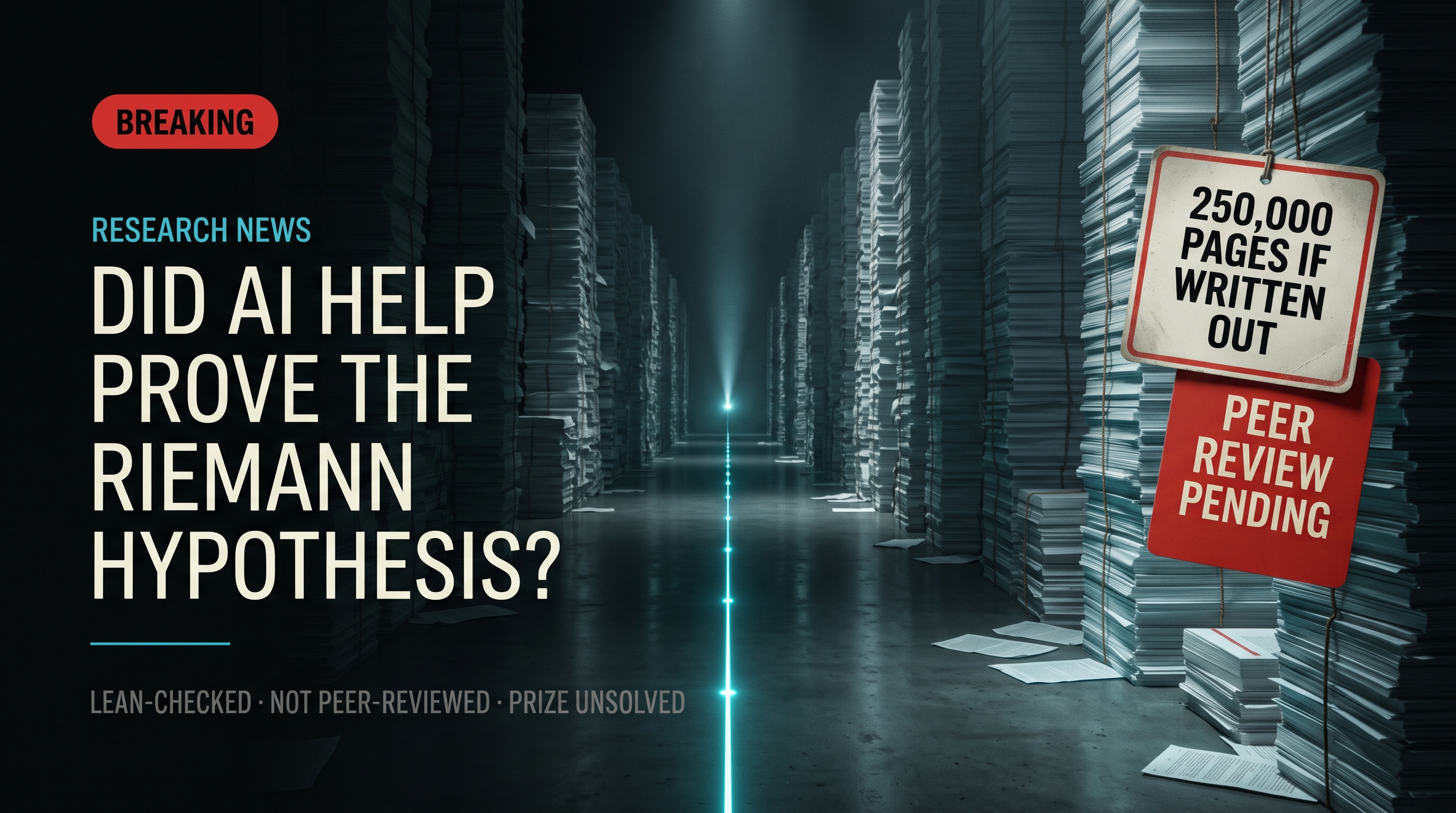
The note links to the proof as a very large Lean library. Lean is a system for writing mathematics so that a computer can check every step. Reports describe the archive as 175,187 Lean files, roughly 17 million lines of code. Science reported that Alpöge has not released a human-readable explanation, which he says would run to over 250,000 pages if written out.
How does Lean verification work, and what can go wrong?
A Lean checker confirms that each step follows from the definitions, assumptions and earlier results used. That makes the logic checkable at scale. Two other questions still matter:
Does the statement match the problem? The theorem the computer checked must really be the Riemann hypothesis, not a similar-looking statement.
Which axioms does it rely on? Only standard foundations should be used.
Has the proposed proof been verified?
According to reports on Sutherland's verification log (last updated November 22, 2026) and the Lean and Mathlib communities' joint statement of November 21:
All 175,187 modules compile without errors.
The five headline theorems use only Lean's three standard axioms (propext, Classical.choice and Quot.sound).
Independently written checkers (nanoda, con-leche and lean4lean) accepted the exported proof or its compiled modules.
A statement comparison confirmed the result targets Mathlib's existing
RiemannHypothesisdefinition.The verified scope is the Riemann hypothesis and the generalized Riemann hypothesis for Dirichlet L-functions. Other generalizations were not covered.
Some runs were still listed as in progress, including full-export kernel runs and an end-to-end comparator run (whose statement and axiom checks had already passed). Ravi Vakil also posted a separate preprint within hours of the announcement, and mathematicians such as Andrew Granville told Nature that a clearer write-up was needed.
Is the Riemann hypothesis officially solved?
Not in the Clay Millennium Prize sense. Clay's rules require publication in a qualifying outlet, at least two years since publication, and general acceptance by the global mathematics community. A secondary report says Clay's problem page still showed “Unsolved” on November 22. In plain terms: a proposed proof developed with Claude has passed several independent computer checks; the human review, explanation and prize process is just beginning.
What does this mean for researchers using AI?
This is an unusually checkable case because Lean gives an objective test. Most AI-assisted research has no such referee, so authors still need to verify every claim, disclose AI use as journals require, and keep an evidence trail. See responsible AI use in academic research and publisher policies on generative AI.
Frequently asked questions
Did Claude prove the Riemann hypothesis on its own?
The announcement says Alpöge worked with Claude. It is a human–AI collaboration, and the human author is the one making the claim.
Is the proof confirmed?
The Lean code has passed several independent computer checks, reported by Sutherland and the Lean/Mathlib communities. It has not yet gone through journal publication or the Clay process, and a human-readable proof has not been released.
Does the 3 × 10¹² verification already prove it?
No. Platt and Trudgian checked zeros up to a finite height. A proof must cover every zero.
Has anyone won the $1 million prize?
No award has been reported. Clay requires publication, a two-year wait and general acceptance first.
Related Reading (Topic Ideas for Future Posts)
What is Lean, and how do proof assistants check mathematics?
How journals should handle AI-assisted proofs and formalised results
Checking AI-generated citations and claims in your own manuscript
Prime numbers and the zeta function explained for non-mathematicians
Sources
Nature: Mathematicians astounded by AI and human-written proofs of the Riemann hypothesis
Science: AI may have solved math's greatest mystery. Can humans understand the answer?
The Boston Globe: Anthropic worker claims to have solved math problems with help of AI
Clay Mathematics Institute: Rules for the Millennium Prize Problems
Platt and Trudgian, Bulletin of the London Mathematical Society, 2021