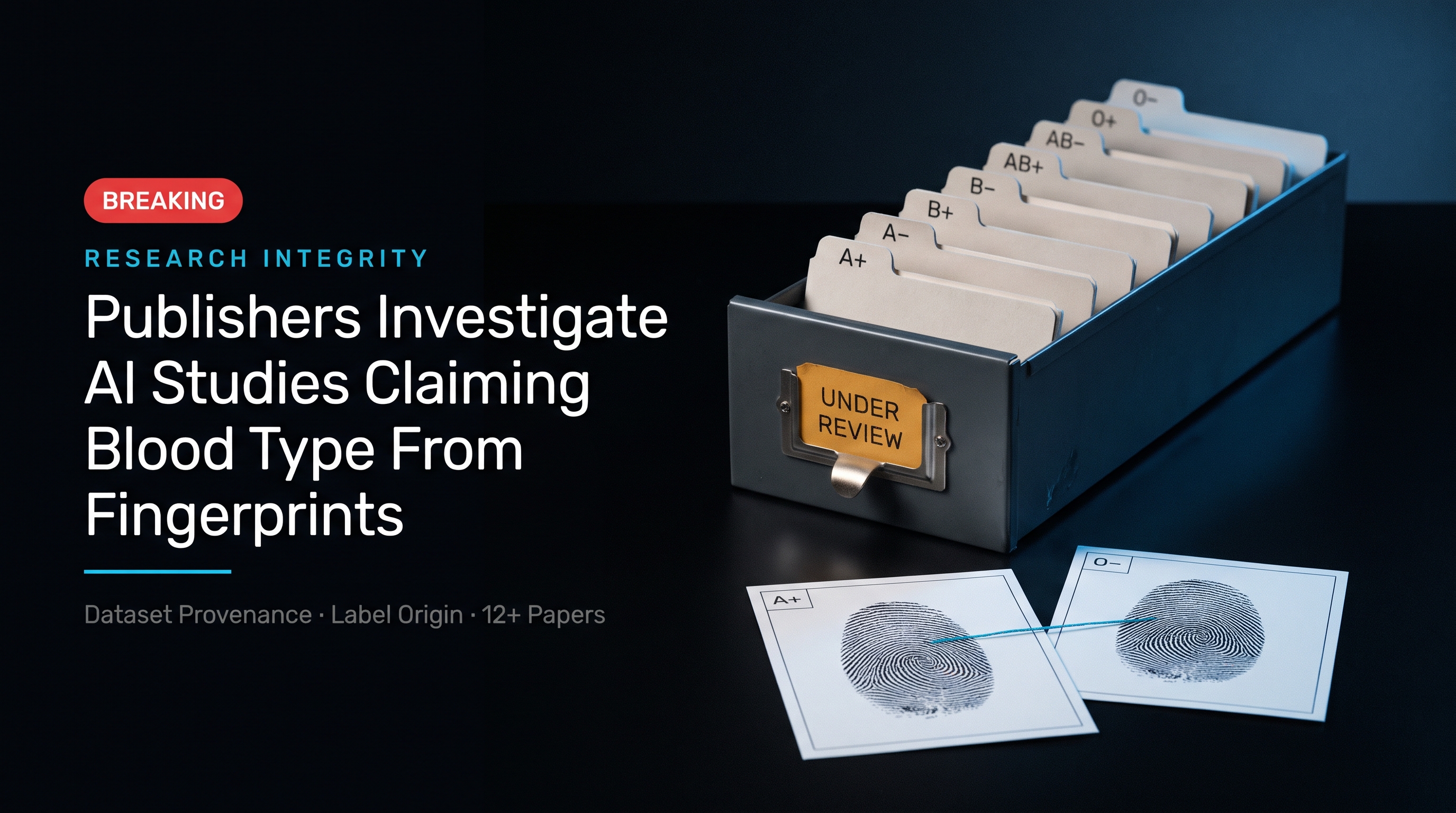
Short answer: Elsevier and IEEE are examining more than a dozen papers, published since 2023, that claim AI can predict a person’s blood type from a fingerprint. Two Australian researchers found that the Kaggle datasets behind the papers appear to reuse images from SOCOFing, a biometric fingerprint dataset that contains no blood-type data, with blood-group labels that seem to have been produced by clustering. Neither publisher had announced an outcome as of November 23, 2026.
What did the researchers find?
As reported by Retraction Watch on November 23, 2026, Lars Kooijman, an adjunct engineering research fellow at Monash University, and Stephanie Summersby, an adjunct associate lecturer in psychology at UNSW, identified more than a dozen conference papers and journal articles that train models to sort fingerprints into blood groups. They carried out the analysis independently of their university work.
The papers report accuracy above 90%, which the two researchers consider implausibly high for a biological question. They found no such papers from before 2023 and believe more are likely to exist.
Where did the fingerprint images come from?
The Kaggle datasets used in the papers hold about 6,000 fingerprint images sorted into eight blood-group folders. Kooijman and Summersby ran the files through a hashing algorithm, which produces a signature of each file’s contents, and found more than 6,000 exact matches with the Sokoto Coventry Fingerprint Dataset (SOCOFing).
SOCOFing was built for biometric research. It contains 6,000 original fingerprints from 600 adult subjects, ten per person, plus synthetically altered versions, and its documented attributes are gender, hand and finger name. It records no blood type. Vasile Palade, one of the dataset’s creators, told Retraction Watch that his team has never collected blood-type data or predicted blood type from the scans.
How were the blood-group labels created?
The labels appear to come from clustering, not laboratory testing. The file names still contain the word “Cluster,” and the uploader of one derivative dataset stated in its description that the images came from SOCOFing and had been clustered into blood groups.
That matters because a model trained on such labels can only learn to reproduce the clustering. High accuracy on those labels says nothing about whether fingerprints carry information about blood type.
How have Elsevier and IEEE responded?
Elsevier: Franklin Open
One of the papers, “Advancements in hemotype identification: Fingerprint analysis for blood group determination,” was published in the Elsevier journal Franklin Open in December 2025. The paper did not name its dataset. Its lead author, computer scientist Sanivarapu Prasanth Vaidya, told Retraction Watch the team used the “Fingerprint Blood Group Classification Dataset” on Kaggle.
Vaidya said the team neither collected fingerprint samples nor ran blood-group tests, that they did not know the images might come from SOCOFing or that the labels were generated by clustering, and that they chose the data in good faith. An Elsevier spokesperson said an investigation is underway and no further information can be shared yet.
IEEE: conference proceedings
Most of the other papers appeared as conference proceedings on IEEE Xplore. A spokesperson for IEEE’s publishing ethics team said IEEE is evaluating the papers. Krisha R., lead author of two of them, said the team ran no blood tests of its own and that it is too early to say whether a correction or retraction is needed.
What has Kaggle done?
Kaggle removed seven of the datasets after Kooijman reported them for plagiarism. At least two versions remain public, including the one Vaidya named.
Is there any evidence that fingerprints reveal blood type?
Very little. Retraction Watch notes that one study found a population-level association but said it cannot be used to determine an individual’s blood type, while other studies found no link. Blood typing for transfusion relies on established laboratory tests, and nothing in this case suggests fingerprint-based prediction could replace them.
What should researchers take from this case?
Issue | What went wrong here | What to check in your own work |
|---|---|---|
Data provenance | Kaggle uploads repackaged images from a dataset built for a different purpose. | Trace every dataset to its original collector, purpose and licence, and name it in the paper. |
Ground truth | Labels appear to come from clustering, not blood tests. | Document how each label was measured; for clinical claims, require laboratory-confirmed labels. |
Plausibility | Accuracy above 90% on a question with little biological support. | Treat results far beyond prior evidence as a reason to audit the data, not to publish faster. |
Duplication | File hashes revealed thousands of identical images. | Hash your files to find duplicates and leakage between training and test sets. |
Checklist before submitting an AI study built on public data
Can you name the original source of every dataset, and does the paper say which one you used?
Do you know how the labels were produced, and would a reviewer accept that method as ground truth?
Have you checked for duplicate files within and across training and test splits?
Is the reported accuracy consistent with what earlier, independent studies found?
Could another team reproduce your preprocessing, labelling and evaluation from what you have published?
Frequently asked questions
Have any of these papers been retracted?
Not as of the November 23, 2026 report. Elsevier and IEEE said only that their reviews are underway.
Is SOCOFing itself a problem?
No. SOCOFing is a documented biometric dataset; the concern is that its images were relabelled with blood groups it never contained.
Were the authors aware of the dataset’s origin?
The two lead authors quoted by Retraction Watch said they did not run their own blood tests, and Vaidya said his team did not know the images came from SOCOFing.
Related Reading (Topic Ideas for Future Posts)
How to document dataset provenance in a Methods section
Data leakage in machine learning papers: what reviewers look for
Sources
Retraction Watch (November 23, 2026). Two publishers investigating studies claiming to predict blood type from fingerprints.
Vaidya, S. P., et al. (2025). Advancements in hemotype identification: Fingerprint analysis for blood group determination. Franklin Open. https://doi.org/10.1016/j.fraope.2025.100429
Shehu, Y. I., Ruiz-Garcia, A., Palade, V., & James, A. (2018). Sokoto Coventry Fingerprint Dataset. arXiv:1807.10609.