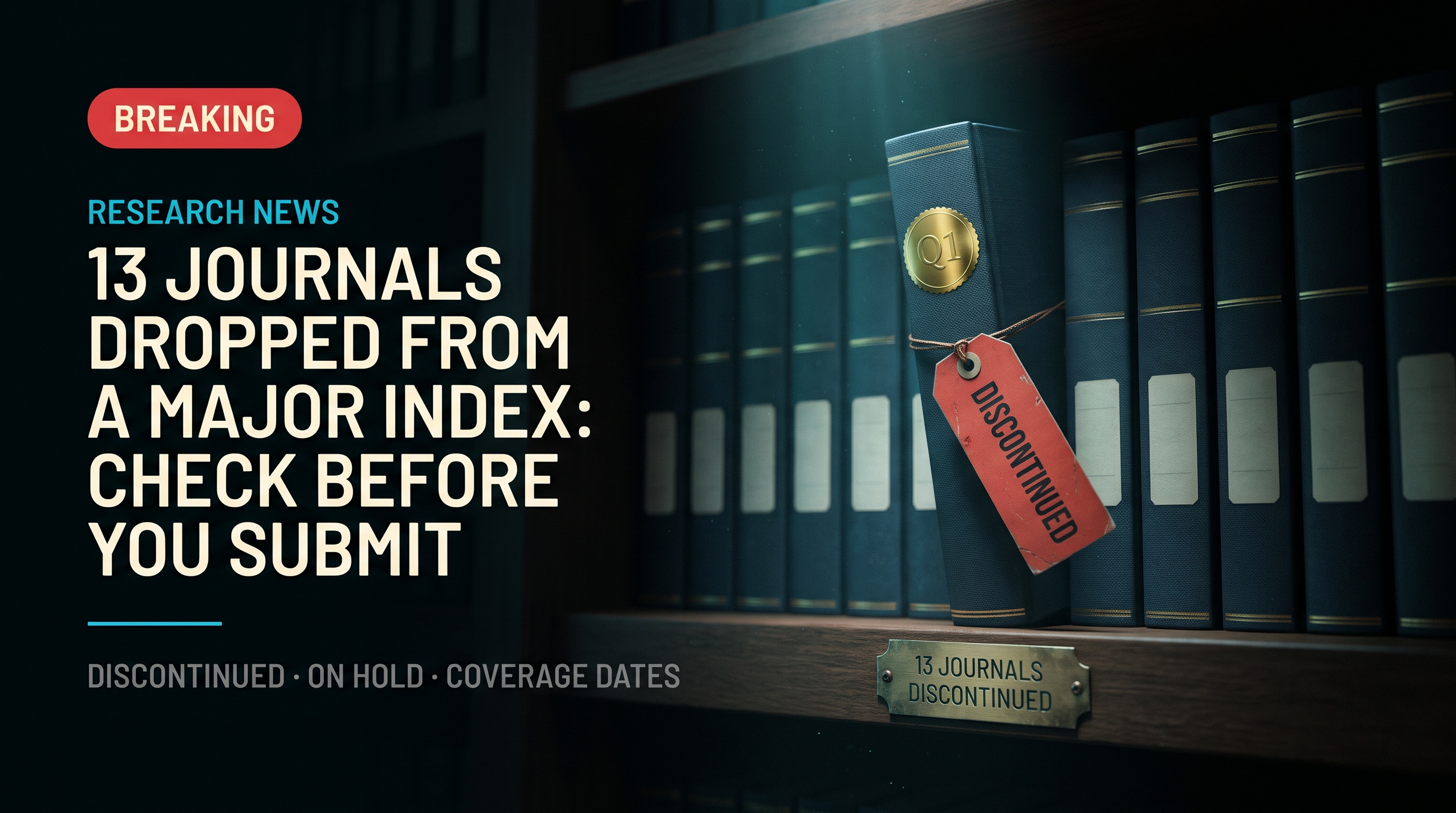
Short answer: Scopus’s October 2026 update lists 13 journals as recently discontinued. Ten are labelled “Discontinuation” and three “Journal change policy”. Web of Science works separately: it marks a journal “On Hold” while it re-evaluates it, and records an “Editorial De-listing” if coverage ends. If you planned to submit to one of these titles, check its ISSN and its last covered volume and issue before you do anything else.
Note: “Q4” in this article means the fourth quarter of 2026, not the Q4 journal quartile. Quartile (Q1–Q4) is a journal ranking, and being discontinued is a different thing. Most of the journals below are not Q4 journals; see the quartile table.
Which journals were discontinued in Scopus’s October 2026 update?
Elsevier’s Scopus source title list includes a discontinued-titles worksheet that is updated monthly. The October 2026 update was reported as released on 13 November, and independent trackers (Journal Searches and PhDTalks) list the same 13 titles. The month names the edition of the list. For an individual paper, what matters is the journal’s final covered volume and issue.
Journal | ISSN / eISSN | Scopus classification | SJR best quartile (latest figure found) |
|---|---|---|---|
Acta Innovations | 2300-5599 | Discontinuation | Q2 (SJR 0.351, 2025) |
Agricultural Biotechnology Journal | 2228-6705 / 2228-6500 | Discontinuation | Q3 (SJR 0.245, 2025) |
Digest Journal of Nanomaterials and Biostructures | 1842-3582 | Journal change policy | Mixed: Q3 in two categories, Q4 in five (SJR 0.243, 2024) |
Egyptian Journal of Medical Microbiology | 1110-2179 / 2537-0979 | Discontinuation | Q4 (SJR 0.180, 2025) |
European Journal of STEM Education | 2468-4368 | Discontinuation | Q1 (SJR 0.673, 2025) |
Genetics and Molecular Research | 1676-5680 | Discontinuation | Q4 (SJR 0.157, 2024) |
International Journal of Drug Delivery Technology | 0975-4415 | Discontinuation | Q3 (SJR 0.175, 2025) |
International Journal of Special Education | 0827-3383 | Discontinuation | Q4 (SJR 0.187, 2024); older data showed Q3 |
Journal of Intelligent Decision Making and Information Science | 3079-0875 | Discontinuation | Quartile not confirmed (SJR 0.771 reported, 2025) |
Mari Papel y Corrugado | 1794-3396 | Journal change policy | Q4 (SJR 0.135, 2025) |
Natural Resources for Human Health | 2583-1194 | Discontinuation | Q3 (SJR 0.220, 2025) |
Onkologia i Radioterapia | 1896-8961 / 2449-9161 | Discontinuation | Q4 (SJR 0.123, 2025) |
VISUAL REVIEW. International Visual Culture Review | 2695-9631 | Journal change policy | Q1 in Visual Arts and Performing Arts; Q2 in Cultural Studies (SJR 0.196, 2025) |
Are these journals Q4?
Mostly not. Using SCImago Journal Rank (SJR) figures reported by third-party aggregators, only four of the 13 are clearly Q4 journals: Egyptian Journal of Medical Microbiology, Genetics and Molecular Research, Mari Papel y Corrugado and Onkologia i Radioterapia. International Journal of Special Education was Q4 in its 2024 data. Digest Journal of Nanomaterials and Biostructures is mixed across categories. The rest are Q1, Q2 or Q3, and one (Journal of Intelligent Decision Making and Information Science) could not be confirmed.
The point for authors is that a Q1 or Q2 label does not mean a journal is still covered. European Journal of STEM Education, for example, shows a Q1 SJR figure and is still on the discontinued list. Quartiles come from past citation data, while discontinuation is a separate decision about whether Scopus keeps indexing new content. Quartile figures also vary by year and by subject category, so confirm them on SCImago before relying on them.
What if your paper was already published?
Take the Egyptian Journal of Medical Microbiology, whose final coverage is reported as 2026, volume 35, issue 3. If you published there in 2026, the year alone does not tell you whether your issue is within the indexed period. Compare your paper’s volume and issue with the cutoff, then search Scopus for the paper itself. Elsevier describes final coverage as the last complete volume and issue covered, after which no content is added.
What does “On Hold” mean in Web of Science?
Clarivate says that during a re-evaluation new content is not processed for indexing and an “On Hold” notice is placed on the Master Journal List. Its own explanation says the hold pauses indexing of new content while the journal is re-evaluated, and the journal stays visible in the Master Journal List. A hold is not a final decision, but it does mean your paper may not be indexed while it lasts. Clarivate also says most journals remain on hold for around six weeks, with timeframes varying by case.
This article does not list individual Web of Science changes for October or November 2026, because we could not verify journal-level entries in Clarivate’s monthly files. Use the two records below to check a title yourself:
Is there a hold notice today? Look up the title or ISSN in the Master Journal List.
When was a de-listing reported? Clarivate says a journal removed for not meeting its quality criteria appears as an “Editorial De-listing” in the next Monthly Changes file, available from the Master Journal List downloads page.
How do I check a journal before submitting?
Search the journal’s title or ISSN on Scopus Sources and read its status and coverage years.
If your institution requires Web of Science, check the same ISSN in the Master Journal List and look for a hold notice.
If you need both, check both records.
Check the journal’s quartile separately on SCImago, and remember it does not prove current coverage.
Check the date of the last indexed issue against your expected publication date.
If a coverage change sends you back to your shortlist, you can enter your title, abstract or keywords in SciCampus Journal Finder to find journals that publish similar work. Then confirm the candidate’s ISSN directly with Scopus or Clarivate before submitting. See also journal indexing risks in 2026 and choosing Q1 and Q2 journals using SJR quartiles.
Frequently asked questions
Does “discontinued” mean the journal is predatory?
Not necessarily. Scopus can discontinue a title after a re-evaluation or because it stopped publishing. Do not infer the reason from the label alone.
Are articles already indexed removed from Scopus?
Coverage stops with the final covered volume and issue; Scopus’s guidance is that content already indexed stays available.
Is “Q4” in the title the same as a Q4 journal?
No. Here it means the fourth quarter of 2026.
Related Reading (Topic Ideas for Future Posts)
Scopus vs Web of Science: what each index actually covers
How to read an SJR quartile and why it can change by category
What to do if your paper was published just after a journal was discontinued
Warning signs of a journal at risk of delisting