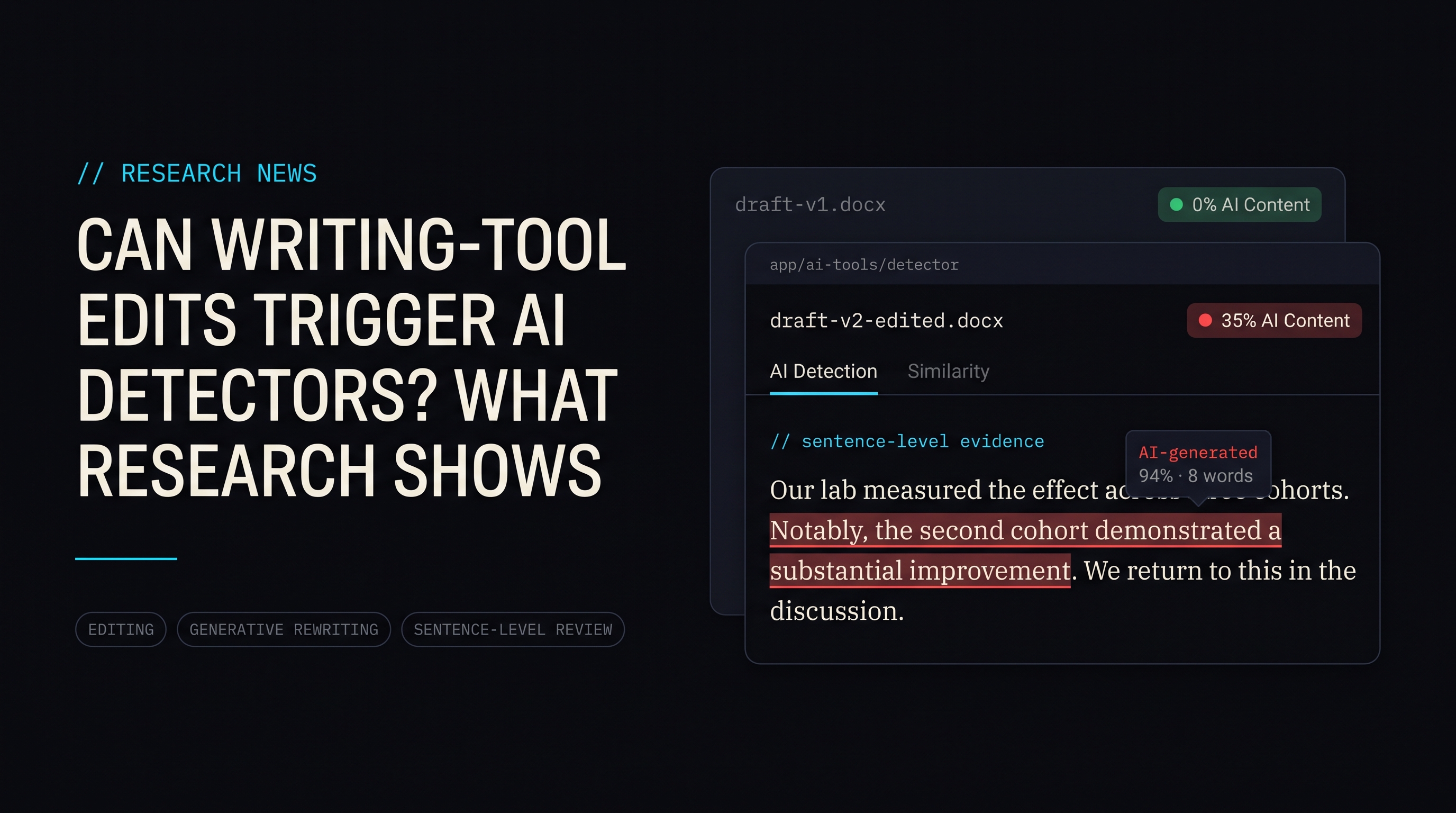
Short answer: it can happen, but it depends. Published research shows that editing human-written text can change AI-detector scores, and that the direction and size of the change vary with the detector, the amount of editing and whether generative features were used. Grammarly itself says that text rewritten by its generative agents is likely to be flagged, because those rewrites come from a large language model. No study establishes a general false-positive rate for Grammarly-edited academic writing.
Many researchers use Grammarly to improve the grammar, clarity and readability of manuscripts. A natural worry follows: could editing human-written text make an AI detector classify it differently?
What did the Grammarly-focused study find?
Bordalejo and colleagues published a preliminary study in the International Journal of Educational Technology in Higher Education in 2025. They applied several writing tools, including Grammarly, to three texts written before popular chatbots such as ChatGPT existed, and then examined the original and edited versions with Turnitin and GPTZero.
The abstract reports that tools like Grammarly, which subtly enhance readability, can also trigger detection and increase false positives, especially for non-native speakers, while paraphrasing tools generally scored low in the detection software. The authors describe the work as preliminary, and with only three texts it cannot support broad conclusions about detector accuracy.
A 2026 study in Education and Information Technologies looked at Turnitin specifically and reported an AI score of 0% for scripts edited using the non-LLM part of Grammarly. Different detectors, different texts and different Grammarly features can therefore produce different results.
Does professional editing change AI-detector scores?
A larger 2026 study, by Park, Jeong and Kim and presented in the EMNLP 2026 Industry Track, examined 135,389 pairs of academic manuscripts from a professional English editing service: non-native manuscripts and their native-edited versions. The authors tested 13 AI text detectors. Editing consistently shifted detector scores, raising them for some detectors and lowering them for others, and the shift grew with how heavily the text was edited.
This study examined professional human editing, not Grammarly. Its value is the general point: detectors respond to writing style and linguistic polish, not only to who or what produced the text.
Is conventional Grammarly editing different from generative rewriting?
Yes, according to Grammarly's own documentation. Its AI Detector guide says that if you use Grammarly agents to rewrite your text, the AI Detector is likely to flag it as AI-generated, because rewrites from the Grammarly, Paraphraser and Humanizer agents come from its large language model. Grammarly suggests using the agents for feedback that you incorporate manually instead of using them to rewrite text directly. It also notes that any user can turn generative AI off in their account's feature settings, and warns that the AI-detection percentage is not an objective source of truth.
Type of change | Example | What the sources say |
|---|---|---|
Conventional corrections | Spelling, grammar, punctuation fixes | Results vary by detector and text; one 2026 Turnitin study reported 0% |
Readability and clarity edits | Smoothing wording, tone suggestions | A preliminary study reports some detection and false positives, especially for non-native writers |
Generative rewriting | Rewriting or paraphrasing text with an AI agent | Grammarly says it is likely to be flagged because the rewrite comes from an LLM |
What does this mean for academic manuscripts?
These findings do not mean Grammarly inevitably triggers AI detectors, and they do not establish a universal false-positive rate for Grammarly-edited academic writing. They show that writing assistance and editing style can affect AI-detection results, so a percentage should be read together with the flagged passages and the way the text was produced.
Separate conventional corrections from generative rewriting, and record which you used.
Keep dated drafts, so you can show how a passage developed (building an evidence file).
Check your journal's rules on AI-assisted writing and disclosure (publisher AI policies).
Do not rewrite sentences only to move a score; see why a single aggregate score misleads and how false positives arise.
The SciCampus AI Detector supports this kind of review by giving document-level results and sentence-level classifications into human-written, AI-generated and AI-paraphrased text. As with other AI detectors, its results are estimates and do not prove authorship.
Frequently asked questions
Does Grammarly make my paper look AI-generated?
Not necessarily. Conventional corrections do not behave like generative rewriting, but studies show detector results can shift after editing, and Grammarly says rewrites from its generative agents are likely to be flagged.
Should I stop using Grammarly because of AI detectors?
The research does not say that. It says to know what each feature does, keep your drafts, and read flagged passages in context.
Does a low AI score mean my editing was safe?
No. A score is an estimate; it does not verify your writing process or journal compliance.
Related Reading (Topic Ideas for Future Posts)
How to disclose language-editing tools in a manuscript
Why non-native English writers see more AI-detector false positives
What to do after a false AI flag on a submitted paper
Editorial disclosure: this article is published by SciCampus. It reports findings from independent research and provider documentation. SciCampus did not conduct the cited experiments.
Sources
Bordalejo, B., Pafumi, D., Onuh, F., Khalid, A. K. M. I., Pearce, M. S., & O'Donnell, D. P. (2025). “Scarlet Cloak and the Forest Adventure”: a preliminary study of the impact of AI on commonly used writing tools. International Journal of Educational Technology in Higher Education, 22. doi:10.1186/s41239-025-00505-5
Park, H., Jeong, G., & Kim, B. (2026). Style as a Confound: False Positives in AI Detection of Non-Native Academic Writing. EMNLP 2026, Industry Track. ACL Anthology
How are combinations of human-written words and LLM-generated words by ChatGPT, Copilot, Gemini and Grammarly detected by Turnitin? Education and Information Technologies (2026). Springer
Grammarly Support: AI Detector user guide and How can I turn off AI in Grammarly? Does Grammarly trigger AI detectors?