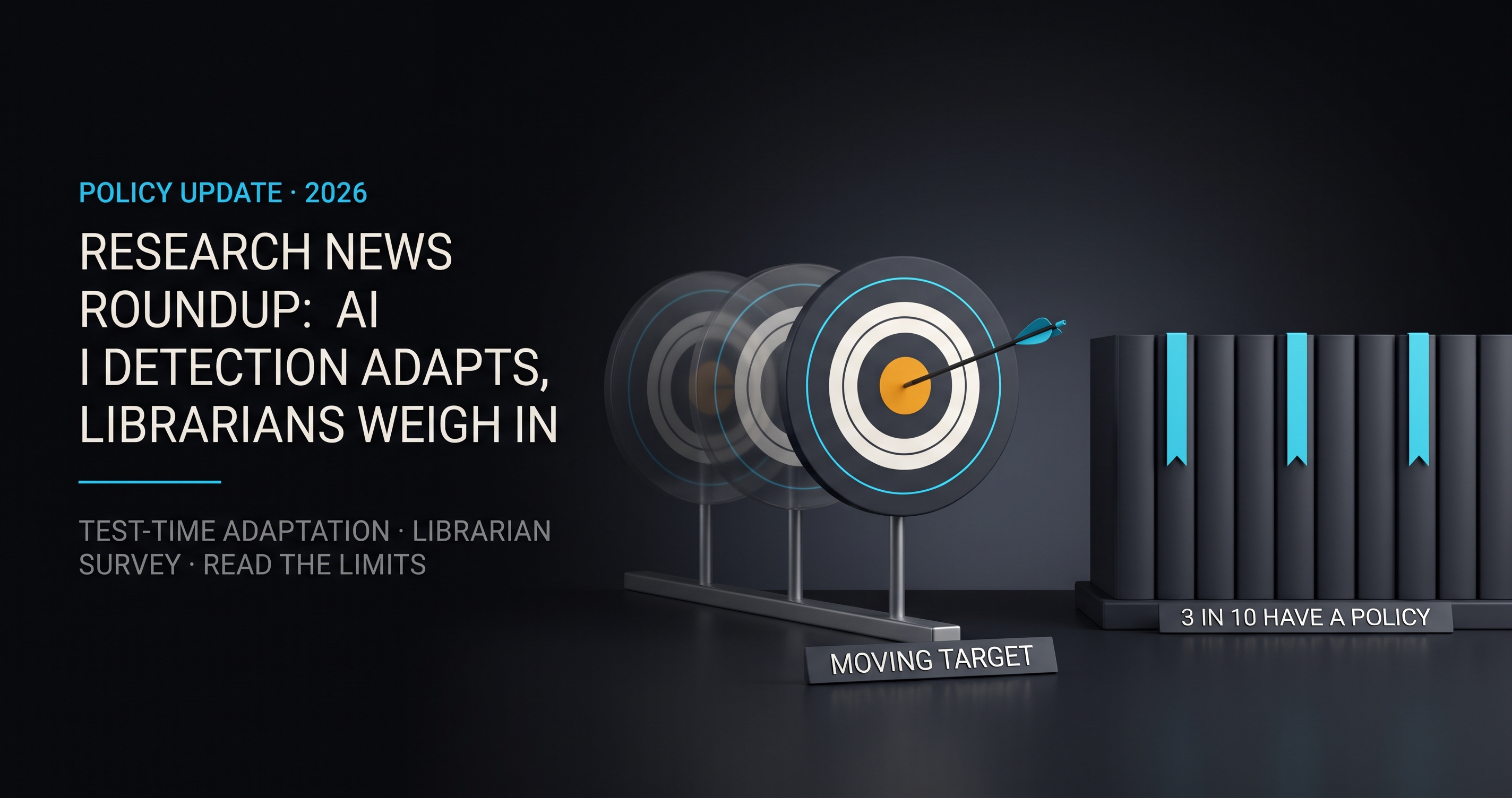
Short answer: two AI-related announcements landed on November 17–18, 2026. MIT and Cornell researchers reported a test-time adaptation method that helped an AI text detector keep working on disguised AI-generated text, and Elsevier published survey results from 1,100 academic librarians in 88 countries. They are independent stories. Both are worth reading with their limits in mind: one is an experiment, the other is a survey of opinions.
What did MIT report about adaptive AI text detection?
Researchers from MIT and Cornell University studied test-time adaptation, a way for a deployed AI text detector to adjust to new, unlabeled text instead of being retrained from scratch. The problem they target is distribution shift: detectors are trained on earlier examples, so they can fail when AI-generated text is disguised to look human-written, when new language models appear, or when human writing habits drift.
In one experiment with disguised AI-generated text, a commercial detector identified only about 27% of the samples, while the researchers' adaptive approach reached 93% accuracy.
The underlying work is the preprint Hitting a Moving Target: Test-Time Adaptation for AI Text Detection under Continual Distribution Shift by Kevin Ren, Manish Raghavan and Nikhil Garg (arXiv, June 2026), also listed as a NeurIPS 2026 poster. Its abstract reports its own figures for a named commercial detector on adversarial AI text: 24.1% detected versus 90.5% for the test-time approach. The numbers differ from the news summary because they describe specific experimental setups.
How should researchers read the 27% and 93% figures?
They show how the method performed under the reported experimental conditions. They are not the general accuracy of commercial AI detection tools.
The adversarial text was generated to evade a detector, so it is a stress test, not a typical manuscript.
It is a research method, not a product update. Nothing in the announcement says any commercial detector now uses it.
A high detection rate on AI text says nothing about false positives on human writing, which matter most when a score is used to judge an author. See why false positives happen and why one aggregate score is not enough.
What did the Elsevier librarian survey find?
Elsevier released findings from its global Librarian of the Future research, drawing on 1,100 academic librarians across 88 countries, alongside interviews with researchers and academic leaders.
Finding | Share of librarians |
|---|---|
See AI as research's biggest driver of change | 83% |
Identify AI misuse as the top threat to the scholarly record | 81% |
Expect demand for AI support to increase over the next five years | 95% |
Report that their institution has implemented an AI policy | 30% |
The announcement also discusses librarians' potential roles in AI literacy, institutional AI policies and research integrity.
How should you read these survey numbers?
They reflect the views and reported experiences of the surveyed librarians. They are not independently measured rates of AI misuse in research. The survey was run by a publisher, and this roundup has reviewed the press release, not the full report.
One practical takeaway is the 30% figure: if only a minority of institutions have an AI policy, authors often need to check the policies of their journal instead. See how publishers handle generative AI.
What does this mean for researchers preparing a manuscript?
Treat any AI-detection score as an estimate that needs sentence-level review, not as proof.
Keep dated drafts and notes so you can show how your text was written.
Check your target journal's AI-use and disclosure rules before you submit.
Use similarity checking for overlap with published work, and AI detection for style signals. They answer different questions (what each one measures).
For document review, SciCampus offers an AI Detector and a Similarity Check. Neither announcement evaluates SciCampus or its performance.
Related Reading (Topic Ideas for Future Posts)
What "distribution shift" means for AI text detectors in plain language
Humanizer tools and AI detection: why the arms race matters for authors
How libraries can support AI literacy and research integrity at your institution
Sources
MIT News: Helping AI text detectors keep up with changing conditions (Adam Zewe, November 18, 2026)
Ren, K., Raghavan, M., & Garg, N. (2026). Hitting a Moving Target: Test-Time Adaptation for AI Text Detection under Continual Distribution Shift. arXiv:2606.25152
Elsevier: AI is reshaping the role of academic librarians, Elsevier study finds (November 17, 2026)