Short answer: there is no single best literature discovery tool, because these tools build their maps from different information. Connected Papers works outward from one known paper using co-citation and bibliographic coupling. ResearchRabbit grows a map from seed papers through citation and authorship networks. Litmaps combines several discovery methods with alerts for new papers. SciCampus Literature Matrix starts from a topic, a title or a DOI and groups papers by the similarity of their titles and abstracts. Pick the tool whose starting point matches your question, and always read the original studies.
Finding research papers is one thing. Understanding how they relate to each other is another. When you start a literature review you may have only a topic; later you may want papers connected to one particular study, or work that builds on earlier research. Literature discovery and citation mapping tools help by turning collections of papers into visual maps.
What are the best citation mapping tools in 2026?
Four options worth considering are SciCampus Literature Matrix, Connected Papers, ResearchRabbit and Litmaps. They all help researchers explore academic literature, but the connections they display do not come from the same information.
Tool | Starting point | How connections are found | Free access (per provider) |
|---|---|---|---|
SciCampus Literature Matrix | Topic, paper title or DOI | Content similarity of titles and abstracts (SPECTER2), papers retrieved via OpenAlex | Included in Pro and other eligible plans |
Connected Papers | A known origin paper | Co-citation and bibliographic coupling | 5 graphs per month; paid plans unlimited |
ResearchRabbit | Seed papers (search, DOI or reference-manager import) | Citations, references, shared citations and authorship | Free tier with up to 50 seed articles; RR+ is paid |
Litmaps | One or more papers | Shared citations and references, common authors or similar text | Free plan with Monitor alerts; Pro adds more options |
Plans change, so check each provider's page before relying on a limit.
1. SciCampus Literature Matrix: how does it map a topic, title or DOI?
SciCampus Literature Matrix lets you start with a research topic, the title of a known paper or its DOI. A topic search finds relevant papers through OpenAlex. A title search helps you explore research related to a particular publication. With a DOI search, the selected paper sits at the center of the map, surrounded by related and cited works identified through OpenAlex.
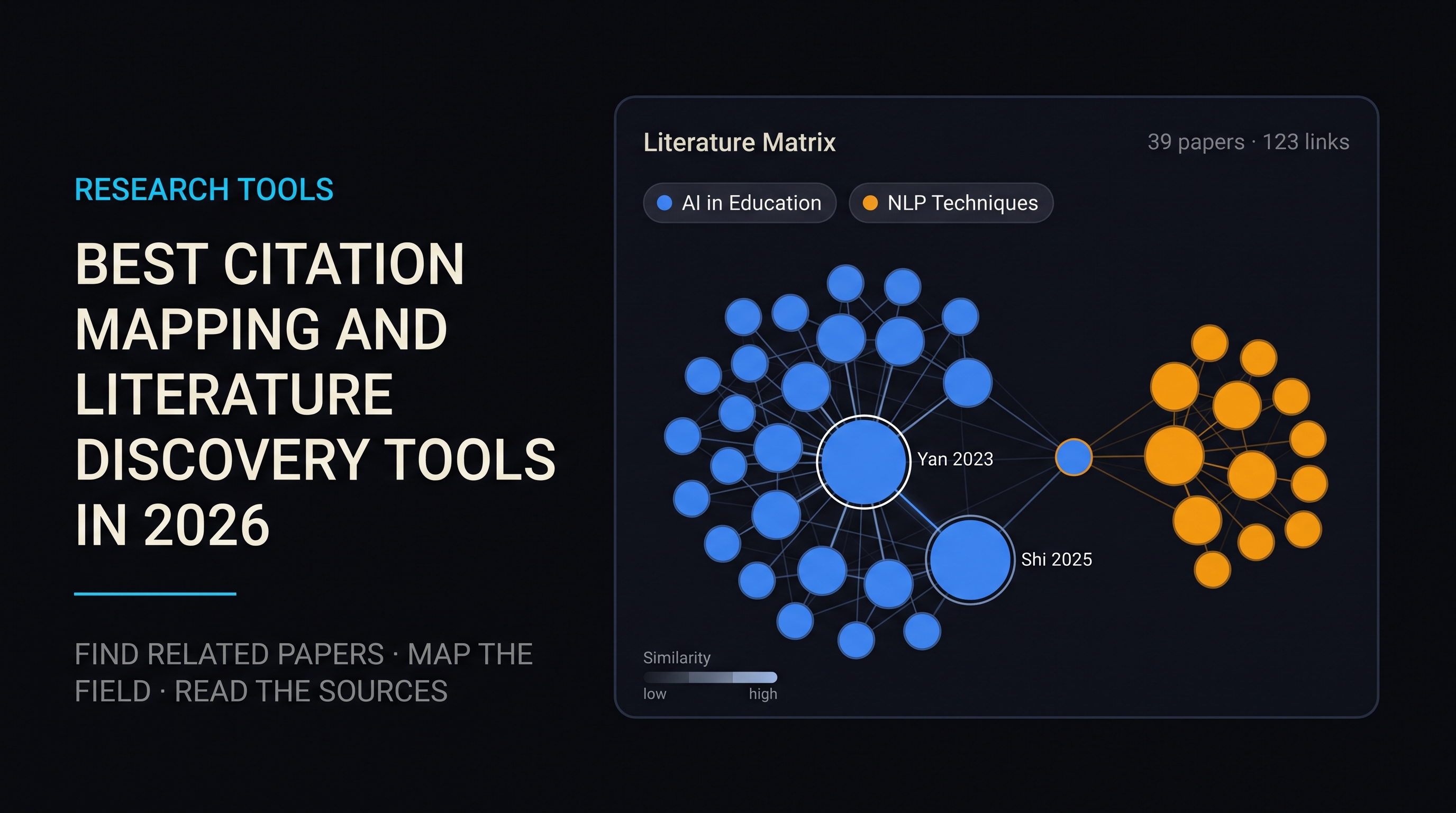
The tool displays up to 40 papers in an interactive map and uses SPECTER2 to compare information from titles and abstracts, grouping studies by content similarity. Each circle is a paper; larger circles indicate higher citation counts, colors distinguish topic groups, and darker connecting lines indicate stronger content similarity. Clicking a paper shows its authors, year, abstract, citation count and related studies. For a worked example, see how to map related papers with Literature Matrix.
Is there a real example?
SciCampus publishes a research map on automated essay scoring. According to SciCampus, it contains 40 papers published between 1998 and 2024, including work on the e-rater scoring system and studies of AI language models for automated scoring. Literature Matrix is included in SciCampus Pro and other eligible plans, and a previously generated map for the same search can be reopened without using another map-building allowance.
2. Connected Papers: how does it find studies related to a known paper?
Connected Papers builds a visual graph around an origin publication. Its similarity metric is based on co-citation (other papers cite two papers together) and bibliographic coupling (two papers cite common sources). Because of this, two papers can sit close together even when neither cites the other. Per third-party descriptions of the tool, the graph draws on the Semantic Scholar corpus and analyzes around 50,000 candidate papers to select a few dozen with the strongest links to the origin paper.
The free plan allows five graphs per month, while the Academic and Business plans offer unlimited graphs.
3. ResearchRabbit: how does it build on your existing collection?
ResearchRabbit starts from Seeds, the papers you choose. You can find them by search, enter them by DOI or import them from reference managers such as Zotero. It looks at the papers that cite your Seeds, the papers they cite and the papers often cited alongside them, then recommends the most closely connected ones. As you add or remove Seeds, the map updates, and papers can be saved to collections.
The free tier allows unlimited searches, collections and up to 50 seed articles. ResearchRabbit+ adds features such as two-way Zotero sync.
4. Litmaps: how does it combine discovery with monitoring?
Litmaps offers three search algorithms: shared citations and references, common authors, and Similar Text. Similar Text uses semantic analysis of titles and abstracts and is the only algorithm that does not use citations or references. Its Monitor feature emails you when new research matches your saved searches. Monitor is available to free users; paid tiers add configuration options.
Which literature discovery approach fits your research?
You have one key paper: Connected Papers explores its citation neighborhood.
You already keep a reference library: ResearchRabbit builds on your seeds and collections.
You want to follow a field over time: Litmaps adds Monitor alerts.
You begin with a topic, a title or a DOI and want content-based groups: SciCampus Literature Matrix focuses on the content of titles and abstracts.
Citation-based maps can miss papers that have not accumulated citations yet, and content-based maps can group papers that share words but disagree in findings. Using two tools together is a sensible way to cover both blind spots. None of these maps replaces reading the original studies or judging their methods and findings. They are tools for discovery, not for deciding scientific quality.
Frequently asked questions
Can a citation map replace a systematic search?
No. It can reveal papers you missed, but a documented search in databases is still needed for a systematic review.
Which tool is best for a brand-new topic?
Tools that start from a topic or a few seed papers suit exploration; Connected Papers needs one known origin paper.
Does a strong connection mean two papers agree?
No. A connection reflects citation patterns or content similarity, not agreement.
Conclusion
A literature review becomes easier to navigate when you can see how papers connect instead of scanning each search result alone. For researchers who begin with a question, a known article or a DOI, SciCampus Literature Matrix provides a visual starting point for related papers, research themes and citation information. Once you have mapped your field, choose where to publish with the Journal Finder and plan the write-up with the scientific writing roadmap.
Related Reading (Topic Ideas for Future Posts)
How to turn a cluster of mapped papers into a related work section
Co-citation, bibliographic coupling and content similarity explained
A search workflow that combines database searching with citation mapping
Editorial disclosure: this article is published by SciCampus, one of the platforms discussed. Product features and access conditions come from provider documentation. No independent performance ranking was conducted.